Vitamin C Serum for Rosacea: 7 Gentle Tips for Calm Skin
If you’ve ever wondered whether a vitamin C serum for rosacea is a smart idea or a recipe for a red, stinging face, you’re asking exactly the right question. Redness-prone skin can be wonderfully expressive, and frustratingly quick to react.
The honest answer? Vitamin C isn’t a rosacea treatment, and research on it for rosacea is thin. But with the right formula, a slow start, and your dermatologist in the loop, you may be able to try it carefully, even with sensitive, redness-prone skin.
Below, you’ll find what the science does and doesn’t say, which ingredients to skip, and seven gentle tips for using vitamin C serum for rosacea on mature, 40+ skin. Think calm, comfortable, and glowing, one small step at a time.
Table of Contents
Can You Use Vitamin C Serum for Rosacea?
For many people, yes, with care. A review by two consultant dermatologists of topical vitamin C calls it one of the most powerful antioxidants in the skin and says it has been shown to help protect against photoaging.
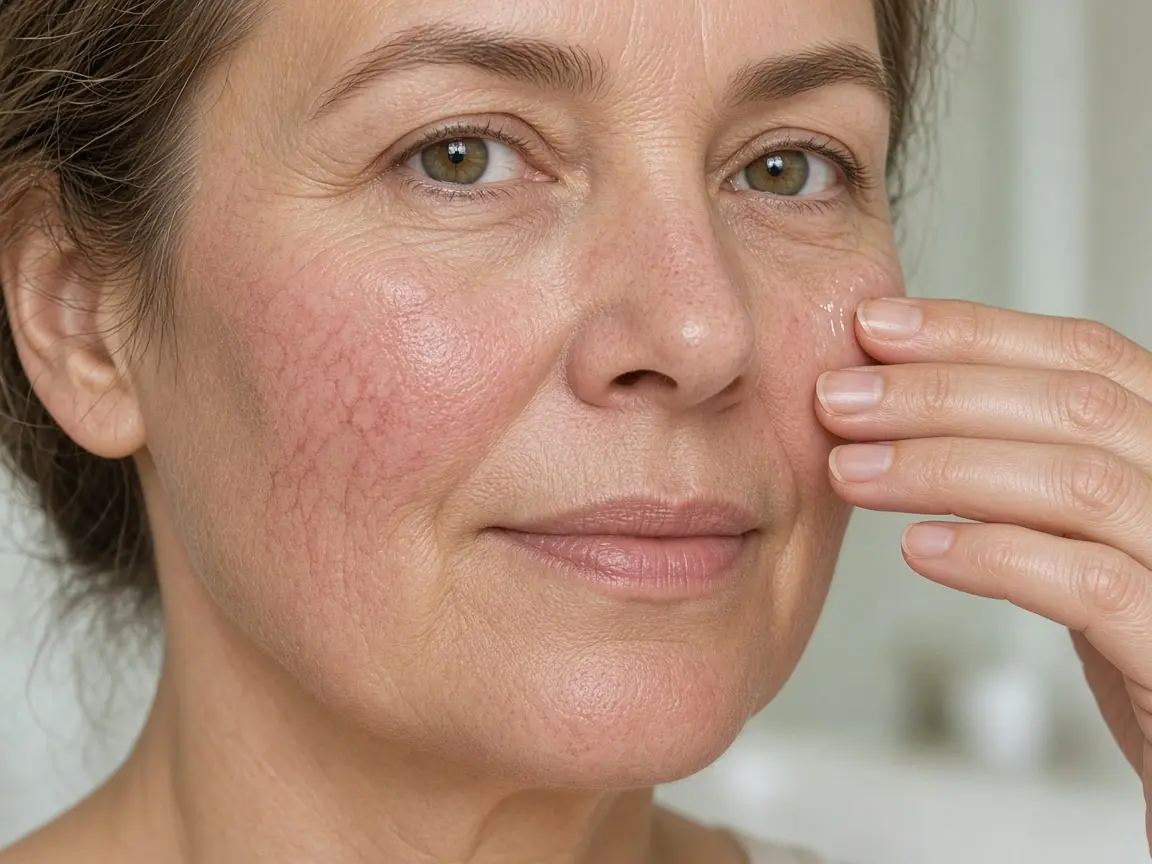
That matters because sun is a big deal for rosacea. The American Academy of Dermatology (AAD) says the sun is one of the most frequent causes of a rosacea flare-up, so an antioxidant layer under sunscreen is an appealing idea.
What the research says about vitamin C serum for rosacea
Here’s where we keep it real. A 2024 review on vitamins and nutrients in rosacea found that outcomes for vitamin C varied across studies, and it notes there are no established recommendations for vitamin and mineral supplementation in rosacea.
The dermatologists’ vitamin C review adds that clinical studies on topical vitamin C formulas remain limited. So a vitamin C serum for rosacea is best seen as a supportive skin care step, not a fix for the condition itself.
Understanding Rosacea and Redness-Prone Skin
The National Institutes of Health describes rosacea as a long-term inflammatory skin condition that causes reddened skin and a rash, usually on the nose and cheeks. Symptoms typically come and go.
It’s more common in middle-aged and older adults and in women, according to the NIH. The AAD says rosacea affects at least 14 million U.S. adults, so if your cheeks flush easily, you’re far from alone.
Rosacea looks different on every face
Signs can include flushing, lasting redness, acne-like bumps, visible blood vessels, and skin that stings or burns. On darker skin tones, the AAD notes that the lasting color may look red, violet, or brown, and the NIH says rosacea may be underdiagnosed in darker skin.
Because other conditions can also cause a red face, a dermatologist is the right person to confirm what’s going on. The NIH also advises seeing a health care provider if you have eye symptoms, since untreated ocular rosacea can damage the eyes.
Why rosacea skin stings so easily
In a small study of 32 people with rosacea and 32 healthy volunteers, researchers dabbed a 5% lactic acid solution on their cheeks. Twenty-four people with rosacea were “stingers,” compared with just six in the healthy group.
It’s one small study, but it fits what many people with rosacea notice: skin that may sting more easily than average. That’s which is why how you choose and introduce a vitamin C serum for rosacea matters as much as the serum itself.
Common triggers to know
The AAD’s guide to rosacea triggers lists sunlight, stress, heat, alcohol (especially red wine), spicy foods, wind and cold, exercise, some medicines, and some skin care, hair care, and makeup products.
Triggers differ from person to person. The AAD notes that with repeated flushing, the skin can stay red a little longer, so spotting your own triggers is worth the detective work.
What to Look for in a Vitamin C Serum for Rosacea
Not every vitamin C product suits reactive skin. The formula, extra ingredients, and texture all matter.
Skip the AAD’s “avoid” list
The AAD’s rosacea skin care tips suggest avoiding products with alcohol, camphor, fragrance, glycolic acid, lactic acid, menthol, sodium lauryl sulfate, and urea. It also recommends never using an astringent or toner.
The AAD specifically says to choose fragrance-free rather than “unscented” products. Our guide to fragrance-free vitamin C serum explains why that label difference matters.
Look at the form and strength of vitamin C
Classic L-ascorbic acid is well studied, but the dermatologists’ review explains that it works best at an acidic pH below 3.5. Dermatologists quoted in the beauty press often suggest that sensitive skin may do better with a gentler or lower-strength option.
The same review says studies found concentrations above 20% didn’t add benefit and might cause some irritation, and that reputable products sit in the 10–20% range. If you’re choosing a vitamin C serum for rosacea, a slow start matters as much as the number.
Consider a stable derivative
A lab study on 3-O-ethyl-L-ascorbic acid describes it as a stable vitamin C derivative used in topical products, while L-ascorbic acid readily oxidizes on exposure to air. In tests on pig skin, it got into the skin from several common cosmetic solvents.
That’s early lab research, not a rosacea study, and it doesn’t prove a derivative is gentler for everyone. Still, a stable form is one reason some people with sensitive skin choose a derivative-based vitamin C serum for rosacea-prone skin. Our guide to vitamin C serum for sensitive skin covers more options.
Helpful partners: niacinamide and hyaluronic acid
The 2024 vitamins review says nicotinamide (niacinamide) offers benefits such as improving skin barrier function and has anti-inflammatory properties, potentially easing the redness and inflammation of rosacea. Evidence is still limited.
If you’re curious about pairing the two, our post on niacinamide and vitamin C clears up the old myths. In our formula, hyaluronic acid adds hydration and aloe and cucumber are there for a soothing feel, which is welcome on dry, mature skin.
7 Gentle Tips for Using Vitamin C Serum for Rosacea
These tips blend AAD guidance with practical common sense. Go slowly and let your skin set the pace.
1. Talk with your dermatologist first
If you’re using a prescription for rosacea, ask your dermatologist whether a vitamin C serum for rosacea fits in and where. The AAD says to apply your rosacea medication first, then a rosacea-friendly moisturizer.
A dermatologist can also tell you if your redness is truly rosacea. That way, your vitamin C serum for rosacea-prone skin supports a plan rather than guessing at one.
2. Patch test for 7 to 10 days
The AAD’s guide to testing skin care products suggests applying a new product to a quarter-sized spot, like the underside of your arm or the bend of your elbow, twice daily for seven to 10 days.
If there’s no reaction, such as red, itchy, or swollen skin, you can try it on your face. Patch testing isn’t a promise your face will agree, but it’s a smart first filter for any vitamin C serum for rosacea.
3. Start slow with vitamin C serum for rosacea
After a clean patch test, try your serum two or three mornings a week rather than daily. There’s no official schedule for rosacea, so this is a cautious, practical approach.
If your skin stays calm for a few weeks, you can add more days. Use a small amount, too; with our serum, 1–2 pumps is the usual amount for one use, and on reactive skin the smaller amount is a good start.
4. Apply to dry skin with gentle fingertips
The AAD recommends cleansing twice a day with a mild cleanser, using just your fingertips, then gently patting your face dry with a clean cotton towel. It also says to avoid rubbing, scrubbing, or massaging skin with rosacea.
Wait until your face is fully dry before applying your vitamin C serum for rosacea. The AAD says moisturizer applied to dry skin is less likely to burn or sting, and that same patience is a kind choice for any active.
5. Follow with a rosacea-friendly cream
The AAD calls moisturizer essential for rosacea, whether your skin is dry or oily. It helps hydrate the skin, restores lipids, and can help skin feel less irritated.
The AAD even suggests choosing a cream instead of a lotion or gel. A lightweight vitamin C serum for rosacea-prone skin followed by a soothing cream is a lovely, comforting pairing for mature skin.
6. Wear sunscreen every single day
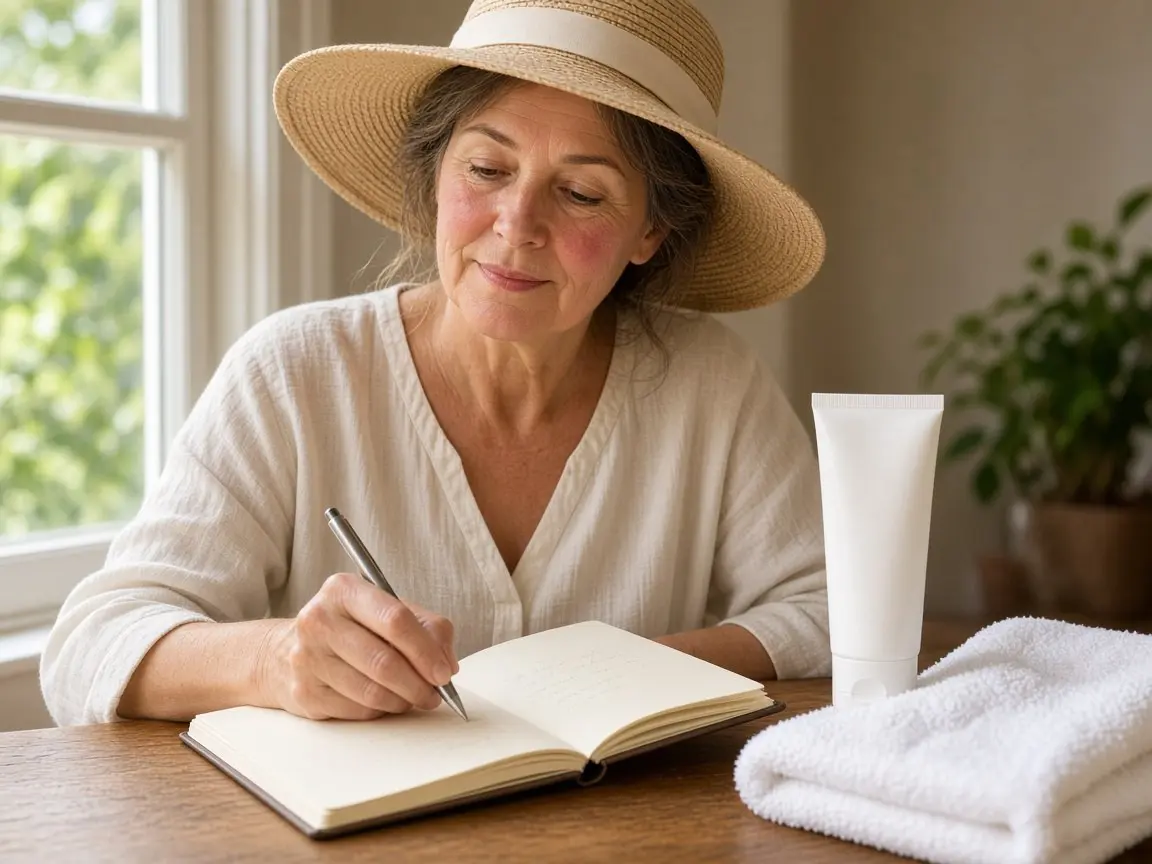
Any vitamin C serum for rosacea is a partner to sunscreen, never a replacement. For rosacea, the AAD recommends a broad-spectrum, water-resistant sunscreen with SPF 30 or higher, plus shade, a wide-brim hat, and sunglasses.
If sunscreen tends to sting, the AAD suggests a mineral formula with zinc oxide, titanium dioxide, or both, and one that’s fragrance-free. A tinted mineral sunscreen can help avoid a white cast.
7. Pause during flares and keep a diary
If your skin is in the middle of a flare, give your vitamin C serum for rosacea a rest until things settle. This isn’t an official rule, just a gentle habit.
The AAD suggests tracking foods, drinks, products, and exposures for a few weeks to find your triggers. Note your serum days, too, so you can spot patterns.
Signs Your Skin Isn’t Happy
Some people notice a brief, mild tingle when they start a vitamin C serum for rosacea-prone skin. But redness that lingers, burning, itching, swelling, or new bumps are signals to stop and reassess.
The AAD’s advice for a skin reaction is to gently wash the product off as soon as possible and not use it again. If the reaction is severe or doesn’t settle, contact your dermatologist. Our post on vitamin C serum burning explains what’s normal and what isn’t.
Our Pick: Trendy Blends 18% Vitamin C Serum
If you’d like to try a vitamin C serum for rosacea-prone skin, our Trendy Blends 18% Vitamin C Serum is built around 18% 3-O Ethyl Ascorbic Acid, with niacinamide, hyaluronic acid, aloe, and cucumber. It’s fragrance-free and comes in a 1 oz airless pump.
We want to be upfront with rosacea readers. Its ingredient list also includes botanical extracts, including orange and lemon, so patch test first, check with your dermatologist, and stop if it stings. It isn’t a treatment for rosacea.
On the plus side, the ingredient list doesn’t include fragrance, menthol, camphor, glycolic or lactic acid, sodium lauryl sulfate, urea, or ethyl alcohol. It’s $24.99 with free shipping in 3–4 business days, plus our 60-Day Glow Guarantee with free returns.
FAQ
Is vitamin C serum good for rosacea?
A vitamin C serum for rosacea may be a helpful antioxidant step for some people, but it isn’t a rosacea treatment. Research on vitamin C for rosacea is limited and mixed, so talk with your dermatologist before trying it.
Can vitamin C serum make rosacea worse?
It can if your skin reacts to it. Rosacea skin often stings more easily, so patch test first and stop if you notice lasting redness, burning, itching, or swelling.
What type of vitamin C is best for rosacea?
There’s no proven best form. Some people with sensitive skin start with a stable derivative or a lower strength, in a fragrance-free formula without the ingredients the AAD suggests avoiding.
Should I use vitamin C serum during a rosacea flare?
Pausing new actives during a flare is a cautious choice, so focus on a gentle cleanser, moisturizer, and sunscreen. Restart slowly once your skin has calmed down.
Can I use niacinamide and vitamin C if I have rosacea?
Possibly, with care. A 2024 review says niacinamide may support the skin barrier and has anti-inflammatory properties, but introduce one new product at a time so you know how your skin responds.
Does vitamin C serum reduce rosacea redness?
There isn’t strong evidence that it does. The NIH says rosacea treatment usually combines self-care and medications, so think of vitamin C as a supporting player.
Conclusion
A vitamin C serum for rosacea can be a thoughtful addition to your routine, as long as you treat it as a gentle supporting step, not a treatment. Choose a fragrance-free formula, patch test, start slow, and protect your skin from the sun every day.
Most of all, listen to your skin and keep your dermatologist in the loop. Calm, comfortable skin is the real glow.
Disclaimer: This article is for general educational purposes only and isn’t medical advice. Rosacea is a medical condition; if you have rosacea, sensitive skin, eye symptoms, or concerns about any product, please talk with a board-certified dermatologist before starting something new.
References
- Al-Niaimi F, Chiang NYZ. Topical vitamin C and the skin: mechanisms of action and clinical applications. J Clin Aesthet Dermatol. 2017;10(7):14-17. PMC
- Algarin YA, Pulumati A, Jaalouk D, Tan J, Nouri K. The role of vitamins and nutrients in rosacea. Arch Dermatol Res. 2024;316(5):142. PMC
- Lonne-Rahm SB, Fischer T, Berg M. Stinging and rosacea. Acta Derm Venereol. 1999;79(6):460-1. PubMed
- Iliopoulos F, Sil BC, Moore DJ, Lucas RA, Lane ME. 3-O-ethyl-l-ascorbic acid: characterisation and investigation of single solvent systems for delivery to the skin. Int J Pharm X. 2019;1:100025. PMC
- National Institute of Arthritis and Musculoskeletal and Skin Diseases (NIH). Rosacea.
- American Academy of Dermatology. 7 rosacea skin care tips dermatologists recommend.
- American Academy of Dermatology. Triggers could be causing your rosacea flare-ups.
- American Academy of Dermatology. How to test skin care products.
