
Vitamin C Serum and Sunscreen: 7 Proven Layering Secrets.
Table of Contents
Vitamin C serum and sunscreen are the two morning steps dermatologists and skincare lovers talk about most, and for good reason. Together, they’re one of the simplest ways to protect your glow and keep sun damage from piling up.
But the questions start fast. Which one goes first? How long do you wait? Can you just mix them in your palm and save a minute?
If you’re over 40, getting this right matters even more. Years of sun tend to show up as dark spots, crepey texture, and fine lines, and your morning routine is your best chance to slow that down. Let’s walk through it step by step.

Why Vitamin C Serum and Sunscreen Make Such a Good Team
It’s easy to think of them as two products doing the same job. They’re not. They protect your skin in completely different ways, which is exactly why they work so well together.
What sunscreen does
Sunscreen filters UV rays before they can do their damage. The American Academy of Dermatology recommends a sunscreen that’s broad-spectrum, SPF 30 or higher, and water resistant.
Broad-spectrum means it covers both UVA rays, the ones linked to aging, and UVB rays, the ones behind sunburn. That’s your first line of defense, every single day.
What vitamin C adds
Vitamin C doesn’t block UV light at all. A review of vitamin C in dermatology explains that it doesn’t absorb UV, but it helps protect skin by neutralizing the free radicals that UV exposure creates.
That same review notes that sunscreens block only about 55% of the free radicals produced by UV. So some oxidative stress still gets through, even on a well-protected day.
That’s the gap your serum helps fill, and it’s why pairing vitamin C serum and sunscreen makes so much sense. Sunscreen is the shield, and vitamin C is the cleanup crew working underneath it.
What the research shows
Some of the best-known studies come from Duke University. In a study on pig skin, a topical blend of vitamins C and E applied for four days gave significant protection against redness and sunburn cells, with an antioxidant protection factor of about 4-fold.
A later human study of a vitamin C, E, and ferulic acid formula found meaningful protection against UV damage, including fewer thymine dimers, a type of DNA damage. The researchers noted its mechanism is different from sunscreen and would be expected to supplement it, not replace it.
The sample was small, so it’s not the final word. Still, it’s encouraging for anyone pairing vitamin C serum and sunscreen each morning.
Where 3-O Ethyl Ascorbic Acid Fits In
Most of those classic studies used L-ascorbic acid. It’s well researched, but it’s also fussy. It needs a very low pH and breaks down quickly once it meets air and light.
3-O Ethyl Ascorbic Acid is a stable form of vitamin C that doesn’t need that very low pH. That’s why it tends to feel gentler, and why it holds up better in the bottle.
It has its own promising research, too. In lab testing of a 3-O Ethyl Ascorbic Acid serum, the formula boosted collagen production in skin cells and reduced a marker of UVB-induced DNA damage. It also lowered melanin in pigmented skin models.
That’s lab work, not a sunscreen trial on real faces. But it points in a hopeful direction for anyone layering vitamin C serum and sunscreen with a stable form of vitamin C.
Curious what else is in our formula? You can see every ingredient on our Trendy Blends ingredient list.
Why mature skin benefits most
A review on the roles of vitamin C in skin health points out that vitamin C levels tend to be lower in aged or photodamaged skin. UV and pollution can also drain the vitamin C stored in your skin’s outer layer.
In other words, the skin that’s seen the most sun is often the skin running lowest on its own antioxidant reserves. A daily serum is a gentle way to top them back up.
7 Proven Tips for Layering Vitamin C Serum and Sunscreen
Here’s the routine that works, plus the small details that make a real difference.
1. Put vitamin C serum and sunscreen in the right order
The rule is simple: thinnest to thickest, treatment first and protection last. Vitamin C serum goes on clean skin, and sunscreen is always the final skincare step.
Sunscreen needs to sit on top as an even, undisturbed film. Anything you layer over it, other than makeup, can thin that film out.
2. Start with clean, dry skin
Wash with a gentle cleanser and pat your face dry. A clean surface helps your serum absorb evenly instead of sitting on leftover night cream, so your vitamin C serum and sunscreen both go on smoothly.
3. Use the right amount of serum
One or two pumps is plenty for your face. If you’re treating sun spots on your neck and chest, add one more pump there.
Press it in with your fingertips rather than rubbing hard. Mature skin is often thinner, and a light touch keeps things comfortable.
4. Let it settle before the next layer
Give your serum a minute or two to absorb. You’re waiting until your skin no longer feels wet or slippery. That small pause keeps your vitamin C serum and sunscreen from sliding around or pilling.
5. Add moisturizer if you need it
If your skin runs dry, a moisturizer goes between your serum and sunscreen. Many women over 40 find this step keeps sunscreen from settling into fine lines.
6. Use enough sunscreen
This is where most of us fall short. The AAD advises at least 1 teaspoon of sunscreen for your face, about enough to cover the length of your index and middle fingers.
Apply it about 15 minutes before you head outside, since the AAD says that’s roughly how long your skin needs to absorb it. Don’t forget your ears, neck, and the backs of your hands.
7. Reapply sunscreen, not serum
Your vitamin C serum is a once-a-morning step. Sunscreen is the one that needs topping up.
The AAD recommends reapplying every two hours outdoors, and right after swimming or sweating. A sunscreen stick or powder SPF makes this easy over makeup.
How Long to Wait Between Vitamin C Serum and Sunscreen
You don’t need to set a 20-minute timer between vitamin C serum and sunscreen. For most serums, a minute or two is enough, or simply until your skin feels dry to the touch.
With a stable form like 3-O Ethyl Ascorbic Acid, there’s no low pH that needs time to settle. You’re just letting the serum absorb so your sunscreen goes on smoothly.
Want the full breakdown? Our guide on how long to wait after vitamin C covers timing for every layer, including moisturizer and makeup.
A real-life tip: apply your serum, then brush your teeth or start the coffee. By the time you’re back at the mirror, you’re ready for SPF.

Common Mistakes With Vitamin C Serum and Sunscreen
Even a great routine can lose its power through a few small habits. Here are the ones to watch for.
- Mixing them in your palm. It feels efficient, but it dilutes your sunscreen and can leave you with patchy, uneven coverage.
- Skipping SPF on cloudy days. The AAD reminds us that UV reaches your skin every time you go outside, even on cloudy days and in winter.
- Thinking vitamin C replaces sunscreen. It doesn’t absorb UV, so it can’t do sunscreen’s job. It only supports it.
- Using too little sunscreen. A thin layer gives far less protection than the SPF number on the label.
- Forgetting your neck and chest. These areas show sun damage early and are often left out.
- Rubbing too hard. Aggressive rubbing can pill your layers and irritate delicate skin.
Choosing a Vitamin C Serum and Sunscreen for Mature Skin
The best vitamin C serum and sunscreen pair is the one you’ll actually wear every morning. Comfort and texture matter just as much as the ingredient list.
What to look for in your serum
Look for a stable vitamin C, a fragrance-free formula, and hydrating partners. Niacinamide helps with uneven tone, while hyaluronic acid keeps skin plump so sunscreen glides on smoothly.
Packaging counts, too. An airless pump limits air and light exposure, which helps the formula stay fresh. Store it away from heat and sunny windowsills so it stays fresh down to the last pump.
What to look for in your sunscreen
Choose broad-spectrum SPF 30 or higher. If dark spots or melasma are a concern, the AAD notes that a tinted sunscreen with iron oxide adds protection from visible light.
Creamy, hydrating formulas tend to feel best on mature skin. If you’re fighting stubborn patches, our guide to vitamin C serum for melasma goes deeper on tinted SPF.
A Simple Morning Routine for Skin Over 40
You don’t need ten steps to make vitamin C serum and sunscreen work for you. This four-step routine covers the essentials in under five minutes.
- Cleanse with a gentle, non-foaming cleanser and pat dry.
- Press in your vitamin C serum on face, neck, and chest.
- Smooth on a moisturizer once the serum feels dry.
- Finish with broad-spectrum SPF 30 or higher, 15 minutes before going out.
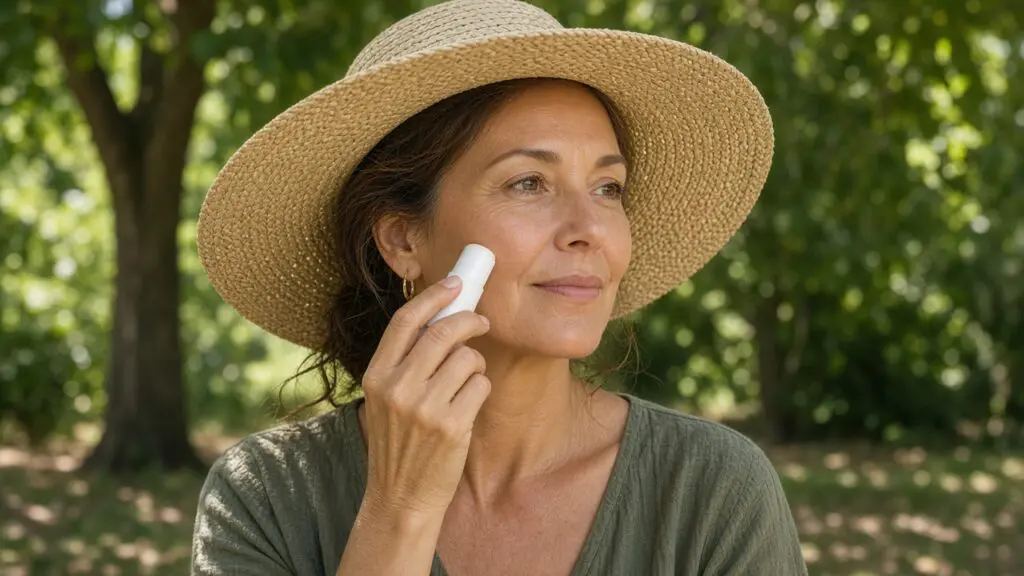
Sun protection is the foundation of every anti-aging plan, according to the AAD’s skin care advice for your 40s and 50s. It also recommends seeking shade between 10 a.m. and 2 p.m. and wearing a wide-brimmed hat when you can.
Using retinol at night? Our morning vs night routine for mature skin shows how to split your actives so everything plays nicely.
FAQ: People Also Ask
Do you put vitamin C serum before or after sunscreen?
Before. Vitamin C serum goes on clean skin, followed by moisturizer if you use one, and sunscreen is always the last skincare step. Makeup goes on top of sunscreen.
How long should I wait to apply sunscreen after vitamin C serum?
Usually a minute or two, or until your skin no longer feels wet. Stable forms like 3-O Ethyl Ascorbic Acid don’t need extra time to adjust pH, so you’re just letting the serum absorb.
Can vitamin C serum replace sunscreen?
No. Vitamin C doesn’t absorb UV light, so it can’t stop sunburn. It works alongside sunscreen by neutralizing free radicals that UV creates, which is why using vitamin C serum and sunscreen together is so effective.
Can I mix vitamin C serum and sunscreen together?
It’s best not to. Mixing dilutes your sunscreen and can make coverage uneven, which means less protection than the label promises. Apply your vitamin C serum and sunscreen as separate layers instead.
Should I use vitamin C serum in the morning or at night?
Morning is a great choice because vitamin C’s antioxidant support pairs naturally with your daytime sunscreen. You can also use it at night if that fits your routine better.
Do I still need sunscreen on cloudy days?
Yes. The AAD notes that UV rays reach your skin every time you go outside, even on cloudy days and in winter. Daily SPF keeps your vitamin C routine working for you.
Conclusion
Getting vitamin C serum and sunscreen right isn’t complicated. Serum first, sunscreen last, a minute in between, and a generous layer of SPF you reapply when you’re outdoors.
Think of it as a daily promise to your future skin. Stay consistent, be gentle, and that brighter, more even glow will follow, one blend at a time.
Ready to build your routine? Try the Trendy Blends 18% Vitamin C Serum with 3-O Ethyl Ascorbic Acid, niacinamide, and hyaluronic acid in a fresh-keeping airless pump, backed by our 60-Day Glow Guarantee.
Disclaimer
This article is for general education and isn’t medical advice. Vitamin C serum is not a substitute for sunscreen or other sun protection. If you have a skin condition, a history of skin cancer, or a new or changing spot, please see a board-certified dermatologist. Results vary from person to person.
References
- Telang PS. Vitamin C in dermatology. Indian Dermatol Online J. 2013;4(2):143-146.
- Lin JY, Selim MA, Shea CR, et al. UV photoprotection by combination topical antioxidants vitamin C and vitamin E. J Am Acad Dermatol. 2003;48(6):866-874.
- Murray JC, Burch JA, Streilein RD, et al. A topical antioxidant solution containing vitamins C and E stabilized by ferulic acid provides protection for human skin against damage caused by ultraviolet irradiation. J Am Acad Dermatol. 2008;59(3):418-425.
- Zerbinati N, et al. The anti-ageing and whitening potential of a cosmetic serum containing 3-O-ethyl-l-ascorbic acid. Life (Basel). 2021;11(5):406.
- Pullar JM, Carr AC, Vissers MCM. The roles of vitamin C in skin health. Nutrients. 2017;9(8):866.
- American Academy of Dermatology. How to select a sunscreen.
- American Academy of Dermatology. How to apply sunscreen.
- American Academy of Dermatology. Skin care in your 40s and 50s.
