
Vitamin C Serum With Snail Mucin: 6 Surprising Facts
Vitamin C serum with snail mucin is a pairing you’ll see all over skincare blogs right now, and if you’re over 40, you’ve probably wondered whether it’s worth the shelf space. One serum promises brightness; the other promises that dewy, bouncy look.
We dug into the actual studies, not just the hype. Some of what we found surprised us, including how small the research is and how little anyone has tested these two together.
Here’s what snail mucin really is, what the evidence says, how to layer a vitamin C serum with snail mucin, and who should skip it.
Table of Contents
Vitamin C Serum With Snail Mucin: The Quick Answer
Yes, most people can use a vitamin C serum with snail mucin in the same routine. They do different jobs: vitamin C is an antioxidant, and snail essences are mostly used for hydration and a cushiony feel.
A simple order works for most skin: vitamin C serum on clean, dry skin, then the snail essence, then moisturizer, then sunscreen in the morning. Just know that no published study has tested this exact combination.
What Is Snail Mucin, Really?
On an ingredient label, snail mucin usually appears as “snail secretion filtrate.” It’s the slime a snail makes, collected and filtered for use in cosmetics.
A 2025 review describes snail mucin as containing compounds such as allantoin, glycolic acid, and hyaluronic acid. That mix is one reason it’s marketed for hydration.
The same review points out a real gap, though: there are no standardized formulas, and clinical trials are limited. One brand’s essence may be quite different from another’s.
What Each Layer Brings to Your Routine
Vitamin C is the part with the deeper research base. A 2017 dermatology review says topical vitamin C has been shown to help protect against photoaging, increase collagen synthesis, and decrease melanin formaton.
That same review is honest that clinical studies on topical vitamin C “remain limited,” and that the formula matters. Stability and how well it gets into skin both count.
Snail mucin’s role is gentler. Think of it as the comfort layer: slippery, hydrating, and pleasant under moisturizer. In a vitamin C serum with snail mucin routine, vitamin C does the antioxidant work and snail mucin adds cushion.
If you already use niacinamide, our niacinamide and vitamin C guide explains how it pairs with vitamin C.
6 Surprising Facts About Vitamin C Serum With Snail Mucin
1. Most of the Research Is About One Garden Snail
Most of the human skin studies we found used secretion from Cryptomphalus aspersa, also called Helix aspersa, the common brown garden snail. Researchers often call it SCA.
That matters because snail products vary, and a vitamin C serum with snail mucin routine could use any brand. Results from one carefully prepared SCA formula can’t simply be applied to every snail essence on the shelf.
2. The Best Human Studies Are Small
In a 2013 study by Fabi and colleagues, 25 people with moderate to severe facial sun damage used an 8% SCA emulsion and a 40% SCA serum on one side of the face and a placebo on the other for 12 weeks.
The treated side showed significant improvement in lines around the eyes at 12 weeks. Interestingly, participants didn’t report a significant difference in the overall quality of their skin.
A 2020 trial from Singapore followed 50 women aged 45 to 65 for three months. The snail group showed improvements in roughness, firmness, and elasticity, but both the snail and placebo groups improved in fine lines and wrinkles.
The authors themselves said larger randomized studies are needed. That study was funded by Cantabria Labs, a skincare company, and one author worked there, which is useful context when you weigh a vitamin C serum with snail mucin.
3. Much of the Science Comes From Labs and Brands
A 2008 lab study by Brieva and colleagues found that SCA had antioxidant enzyme activity and encouraged skin cells called fibroblasts to multiply. Its lead author worked in a company’s research and development department.
A 2012 cell study found SCA helped skin cells move and survive in a dish, and a 2021 study found snail filtrate sped up wound closure in mice. Cell and animal results are a starting point, not proof for your face.
A 2024 review in the Journal of Cosmetic Dermatology put it plainly: most snail studies were preclinical or small clinical studies, and larger trials are needed.
4. Nobody Has Tested Vitamin C Serum With Snail Mucin Together
This one surprised us most. We searched PubMed and found no published study that tested a vitamin C serum with snail mucin as a pair.
So claims that snail mucin “boosts” vitamin C, or that the two create a special effect, aren’t backed by research. The honest reason to pair them is simpler: you get an antioxidant step and a comfortable hydrating step.
5. The “Vitamin C First” Rule Comes From One Form of Vitamin C
You’ll read that vitamin C must always go first. That advice is usually explained by L-ascorbic acid, which in a pig-skin study needed a pH below 3.5 to enter the skin.
Not every vitamin C serum uses that form. Ours uses 3-O Ethyl Ascorbic Acid, which researchers developed as a stable vitamin C derivative for topical products. Still, putting any vitamin C serum on clean skin first is a sensible default.
6. Allergy Questions Are Still Open
Snail allergy research mostly involves eating snails. A 2005 study found that eating snails can trigger strong asthma or severe allergic reactions, mainly in people already sensitized to house dust mites.
Whether that applies to a snail essence on your face hasn’t been well studied. Both recent reviews list allergy and irritation as open questions, so caution makes sense if you have a known snail or dust mite allergy.
How to Layer Vitamin C Serum With Snail Mucin
The American Academy of Dermatology says the order of your products affects how well they work. Its basic steps: cleanse, apply any treatment, then moisturizer and sunscreen, then makeup.
A common rule of thumb is to go from thinnest to thickest texture. For a vitamin C serum with snail mucin, that usually looks like this.
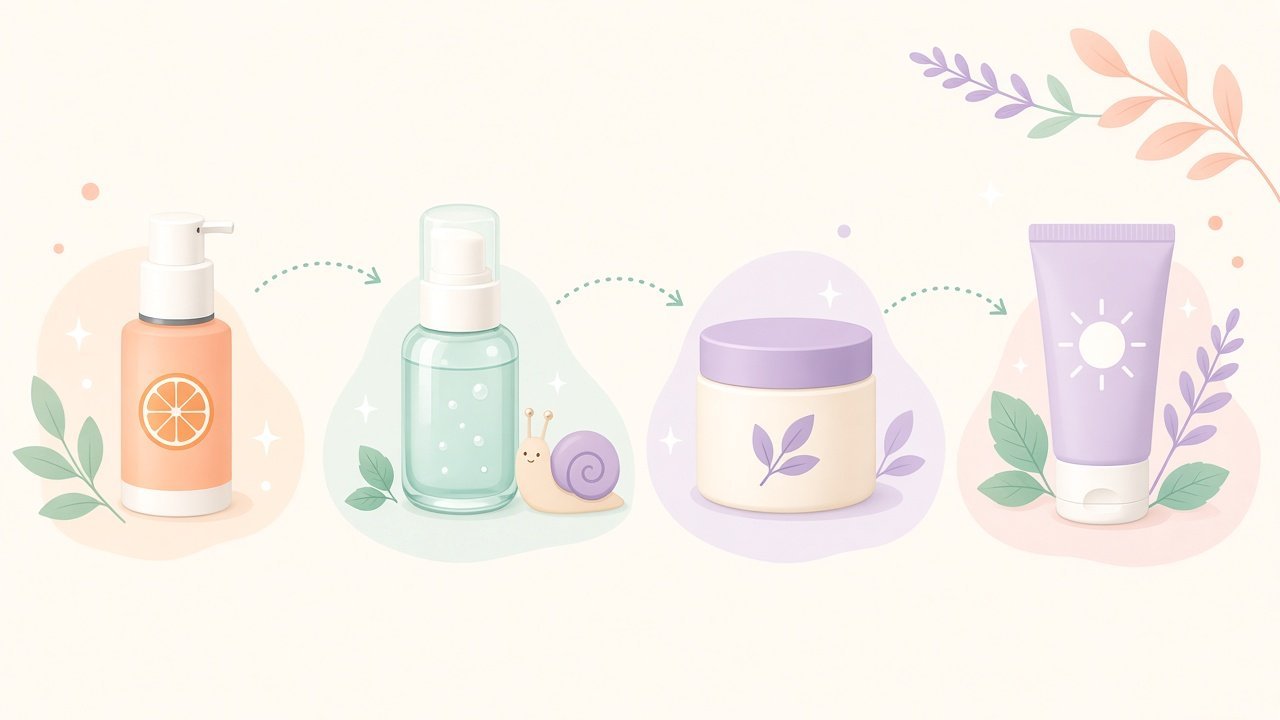
- Wash with a gentle cleanser and pat dry.
- Apply 1–2 pumps of vitamin C serum to clean, dry skin.
- Pat on your snail essence or serum.
- Follow with moisturizer.
- In the morning, finish with sunscreen.
If your snail product is a very watery essence, some people like it first, as a toner-like step. That’s fine too; the toner layering tips in our vitamin C serum and toner guide follow the same thin-to-thick idea.
How Long to Wait Between Layers
Many blogs say to wait 60 seconds, or five minutes. We couldn’t find research proving any required wait time.
When layering a vitamin C serum with snail mucin, a practical approach is to let the vitamin C feel mostly dry before the next layer, so you’re not just sliding products around. Keep them in separate layers rather than mixing them in your palm.
Morning vs Night: Simple Routines After 40
A vitamin C serum with snail mucin works in either routine. We like vitamin C in the morning, layered under sunscreen.
A Simple Morning Routine
- Gentle cleanser
- Vitamin C serum
- Snail essence
- Moisturizer
- Broad-spectrum sunscreen, SPF 30 or higher
The AAD recommends a broad-spectrum, water-resistant sunscreen with SPF 30 or higher. No serum replaces it, which is why we cover it in depth in our vitamin C serum and sunscreen guide.
A Simple Evening Routine
At night, you can skip vitamin C and let the snail essence and moisturizer do the comforting work. If you prefer vitamin C serum with snail mucin at night too, use the same order as the morning, minus sunscreen.
- Gentle cleanser
- Any prescription treatment, as your doctor directs
- Snail essence
- Moisturizer
The AAD also warns that using too many products, especially several anti-aging products, may irritate skin. If your evening already includes retinoids, keep the rest of the routine short.

Sensitive Skin, Patch Testing, and Who Should Skip
Any new product can irritate skin. The AAD suggests testing it on a quarter-sized spot, such as the inside of your arm, twice daily for 7 to 10 days.
If you see redness, itching, or swelling, wash it off and stop using it. Add one new product at a time, so you know which one is the culprit.
That means patch testing your vitamin C serum and your snail essence separately before you start a vitamin C serum with snail mucin routine.
If your skin is reactive, our vitamin C serum for sensitive skin guide has more gentle tips. You may want to skip a vitamin C serum with snail mucin, or ask your dermatologist first, if you:
- Have a known allergy to snails or house dust mites
- Have eczema, rosacea, or broken, irritated skin
- Are recovering from a laser or peel, unless your dermatologist approves it
- Avoid animal-derived ingredients
A Note on Ethics and Vegan Skincare
Snail secretion filtrate comes from animals, so products containing it aren’t vegan. The 2024 review also listed ethical collection as one of the open issues for snail mucin.
If that matters to you, look for hydrating serums built on ingredients such as glycerin or hyaluronic acid instead. Your vitamin C serum doesn’t need snail mucin to do its job.
Where Trendy Blends Fits
We make the Trendy Blends 18% Vitamin C Serum mentioned here. It’s our own product, sold on this site, not an affiliate recommendation.
Our Trendy Blends 18% Vitamin C Serum uses 3-O Ethyl Ascorbic Acid with niacinamide, hyaluronic acid, aloe, and cucumber. It does not contain snail mucin, so if you want a vitamin C serum with snail mucin routine, you’d add a separate snail essence after it.
It’s fragrance-free in a 1 oz airless pump, and 1–2 pumps covers your face. It’s $24.99 with free shipping in 3–4 business days, backed by our 60-Day Glow Guarantee with free returns.
Frequently Asked Questions
Can I use vitamin C serum with snail mucin every day?
Many people can, once a patch test shows no reaction. Start slowly, watch for redness or itching, and use sunscreen every morning.
Do you apply snail mucin before or after vitamin C?
For most routines, apply vitamin C serum first on clean, dry skin, then snail mucin. If your snail product is a very watery essence, using it first is also reasonable.
Can snail mucin and vitamin C be used together in the morning?
Yes. Apply vitamin C serum, then snail essence, then moisturizer, and finish with broad-spectrum sunscreen of SPF 30 or higher.
Does snail mucin help vitamin C absorb better?
There’s no published research showing that. Snail mucin adds hydration and a comfortable feel, but we found no study testing a vitamin C serum with snail mucin.
Is snail mucin good for skin over 40?
Small studies in adults with sun-damaged or aging skin found some improvements, but they were small and often had industry ties. It’s a nice-to-have, not a must-have.
Who should not use snail mucin?
Skip it or ask a dermatologist first if you have a snail or dust mite allergy, very reactive skin, or prefer vegan products. Stop if you notice redness or swelling.
Conclusion
A vitamin C serum with snail mucin can be a pleasant, comfortable pairing, as long as you keep expectations realistic. The research on snail mucin is promising but small, and no one has studied the combination itself.
Keep it simple: vitamin C serum first, snail essence next, moisturizer, and daily sunscreen. That’s a vitamin C serum with snail mucin routine your skin can actually enjoy.
Medical disclaimer: This article is for general education only and is not medical advice. Talk with a board-certified dermatologist before starting new products if you have allergies, a skin condition, or are recovering from a procedure.
References
- Fabi SG, Cohen JL, Peterson JD, Kiripolsky MG, Goldman MP. The Effects of Filtrate of the Secretion of the Cryptomphalus Aspersa on Photoaged Skin. J Drugs Dermatol. 2013;12(4):453-7. PMID: 23652894.
- Lim VZ, Yong AA, Tan WPM, Zhao X, Vitale M, Goh CL. Efficacy and Safety of a New Cosmeceutical Regimen Based on the Combination of Snail Secretion Filtrate and Snail Egg Extract to Improve Signs of Skin Aging. J Clin Aesthet Dermatol. 2020;13(3):31-36. PMID: 32308795.
- Brieva A, Philips N, Tejedor R, et al. Molecular basis for the regenerative properties of a secretion of the mollusk Cryptomphalus aspersa. Skin Pharmacol Physiol. 2008;21(1):15-22. PMID: 17912020.
- Cruz MC, Sanz-Rodríguez F, Zamarrón A, et al. A secretion of the mollusc Cryptomphalus aspersa promotes proliferation, migration and survival of keratinocytes and dermal fibroblasts in vitro. Int J Cosmet Sci. 2012;34(2):183-9. PMID: 22171745.
- Gugliandolo E, Macrì F, Fusco R, et al. The Protective Effect of Snail Secretion Filtrate in an Experimental Model of Excisional Wounds in Mice. Vet Sci. 2021;8(8):167. PMID: 34437489.
- Singh N, Brown AN, Gold MH. Snail extract for skin: A review of uses, projections, and limitations. J Cosmet Dermatol. 2024;23(4):1113-1121. PMID: 38429932.
- Sekar D, Nagarajan P, Ekambaram G, Port Louis LR, Bazeer AB. From slime to sublime: the impact of snail mucin on scar therapy and wound healing in dermatology. Cutan Ocul Toxicol. 2025;44(4):409-412. PMID: 40920056.
- Martins LM, Peltre G, da Costa Faro CJ, Pires EM, da Cruz Inácio FF. The Helix aspersa (brown garden snail) allergen repertoire. Int Arch Allergy Immunol. 2005;136(1):7-15. PMID: 15591808.
- Al-Niaimi F, Chiang NYZ. Topical Vitamin C and the Skin: Mechanisms of Action and Clinical Applications. J Clin Aesthet Dermatol. 2017;10(7):14-17. PMID: 29104718.
- Pinnell SR, Yang H, Omar M, et al. Topical L-ascorbic acid: percutaneous absorption studies. Dermatol Surg. 2001;27(2):137-42. PMID: 11207686.
- Iliopoulos F, Sil BC, Moore DJ, Lucas RA, Lane ME. 3-O-ethyl-l-ascorbic acid: Characterisation and investigation of single solvent systems for delivery to the skin. Int J Pharm X. 2019;1:100025. PMID: 31517290.
