Vitamin C Serum vs Supplement: 5 Honest Answers for Skin
Vitamin C serum vs supplement: if you’re over 40 and wondering which one actually helps your skin, you’ve heard confident answers on both sides. One friend swears by her morning tablet; another says only a serum “gets in.”
The honest answer is reassuring. Your body handles vitamin C you swallow very differently from vitamin C on your face, and each route has limits.
Here’s what research says about the vitamin C serum vs supplement choice, when a pill makes sense, how much is too much, and an easy routine.
Table of Contents
Vitamin C Serum vs Supplement: The Short Answer
For most healthy adults, food covers your body’s vitamin C needs, and a serum is the more direct way to put vitamin C on the skin you see. A supplement mainly helps if your intake or blood levels are low.
So in the vitamin C serum vs supplement matchup, they aren’t rivals. A 2017 review in Nutrients said the benefit of topical vitamin C, compared with simply eating enough, “is poorly understood.” Anyone promising a dramatic winner is ahead of the evidence.
How Vitamin C Reaches Your Skin: Two Routes
Healthy skin is rich in vitamin C. According to the 2017 review by Pullar, Carr and Vissers, levels in skin are well above those in blood, which suggests skin actively pulls it in from your circulation.
The same review notes several reports of lower vitamin C levels in aged or sun-damaged skin, one reason the vitamin C serum vs supplement question comes up so often after 40.
Vitamin C Serum vs Supplement: Inside vs Outside
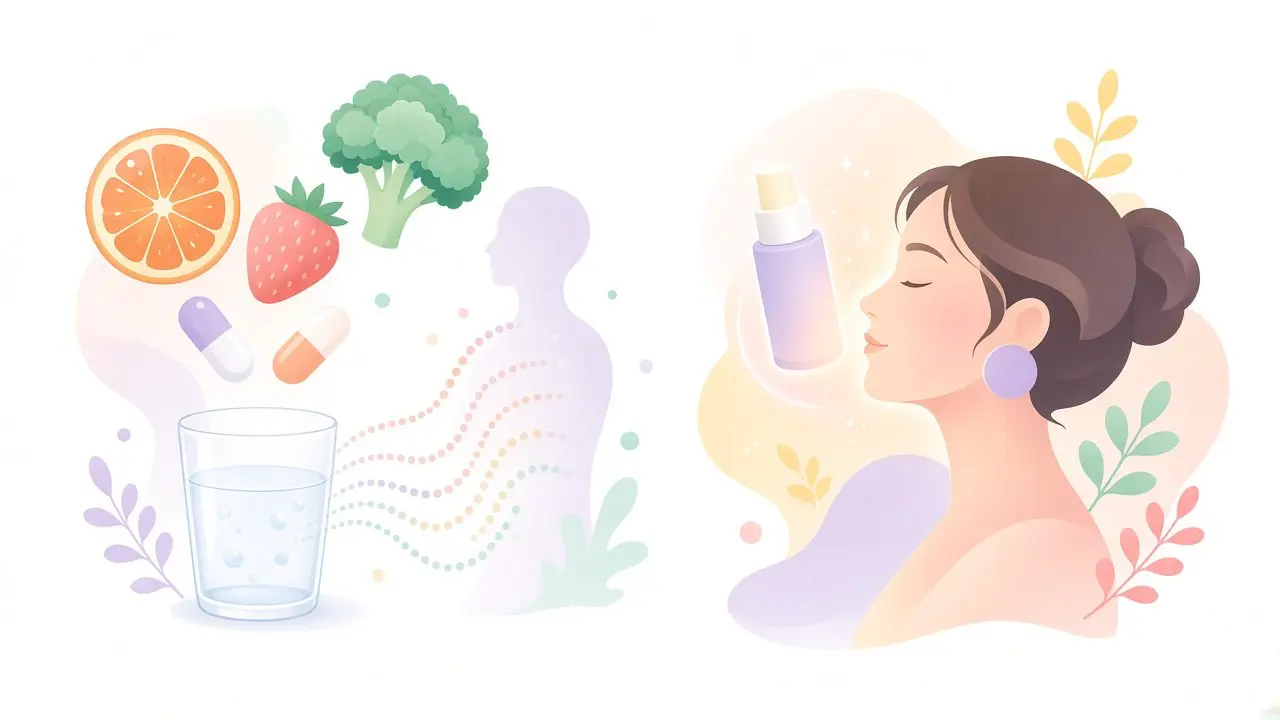
Vitamin C you eat or swallow is absorbed in your gut, travels in your blood, and is carried into skin cells by transporters. Deeper layers, where collagen is made, are fed mainly this way.
A serum skips the gut and goes straight onto the surface. But vitamin C is water-loving and charged, so the skin’s outer barrier tends to keep it out. The review says how much reaches the epidermis “is dependent on the formulation.”
5 Honest Answers About Vitamin C Serum vs Supplement
1. Your Body Tightly Controls Vitamin C From Pills
In a classic NIH study, seven healthy volunteers spent months in hospital on a very low vitamin C diet, then took doses from 30 to 2,500 mg a day. Blood levels were completely saturated at 1,000 mg daily.
At single doses of 500 mg and up, the researchers found absorption dropped and the extra was passed in urine. A later NIH team summed it up: oral vitamin C produces blood levels that are “tightly controlled.”
The NIH Office of Dietary Supplements says about 70% to 90% is absorbed at 30 to 180 mg a day, but less than 50% above 1 gram. In the vitamin C serum vs supplement debate, a mega-dose pill isn’t a shortcut to glowing skin.
2. Supplements Mostly Help When Your Levels Are Low
Because absorption levels off, the 2017 review says supplementation is “only expected” to lift skin vitamin C in people whose blood levels are below saturation.
In a 1998 placebo-controlled trial, 3 g a day for 50 days raised vitamin C in cheek-lining cells, a stand-in for skin cells. Yet vitamin C alone didn’t significantly change how easily skin reddened under simulated sunlight; only vitamin C plus high-dose vitamin E did.
3. A Serum Puts Vitamin C Where You Can See It
A 2017 dermatology review says topical vitamin C has been shown to help protect against sun-related aging, increase collagen synthesis, and decrease melanin formation. It also admits clinical studies “remain limited.”
One split-arm study applied vitamin C to one forearm and a placebo to the other in postmenopausal women. Collagen-related gene activity rose on the vitamin C side, most of all in women with the lowest dietary vitamin C intake.
The flip side? The Nutrients review says that when blood levels are already saturated, topical vitamin C doesn’t appear to raise skin content further. So the vitamin C serum vs supplement answer depends partly on your starting point.
4. The Form of Vitamin C in Your Serum Matters
On the serum side of vitamin C serum vs supplement, formula is everything. Plain L-ascorbic acid is the original form, but it’s fragile; in pig-skin tests, it needed a pH below 3.5 to get into skin.
3-O Ethyl Ascorbic Acid, the form in our serum, was developed as a stable vitamin C derivative for topical products. In a 2019 lab study on pig skin, it moved into and through skin from several simple solvents, including glycerol and 1,2-hexanediol.
A tiny 2026 study in three volunteers detected it in the skin’s outer layer after a serum was applied, and cell and zebrafish research suggests it may reduce melanin production. Promising, not proven. Rare allergic reactions have been reported, so patch test first.
To compare options, our guide to the forms of vitamin C breaks down each one and its research.
5. You Don’t Have to Pick a Side in the Vitamin C Serum vs Supplement Debate
Here’s the part we love: you can do both. A colorful plate handles the inside, and a well-made serum handles the outside.
A large U.S. study of 4,025 women aged 40 to 74 found that higher dietary vitamin C intake was linked with a lower likelihood of a wrinkled appearance and age-related dryness. It was an observational study, so it shows a link, not cause and effect.
For many readers, the smartest vitamin C serum vs supplement plan is simple: eat your fruits and vegetables, use a serum you enjoy, and add a pill only if your doctor thinks you need one.

Food First: Easy Vitamin C Wins on Your Plate
Before you settle vitamin C serum vs supplement, check your plate. The NIH consumer fact sheet calls fruits and vegetables the best sources: citrus, peppers, and kiwifruit lead, with broccoli, strawberries, and tomatoes close behind.
Cooking and long storage can lower vitamin C, and NIH says most people in the United States get enough from foods and drinks.
In vitamin C serum vs supplement terms, pills aren’t “worse” vitamin C. NIH says supplement ascorbic acid is about as available to your body as the vitamin C in orange juice or broccoli. More food-first ideas: how to boost collagen naturally.
When a Vitamin C Supplement Makes Sense
NIH lists groups more likely to fall short, including people who smoke or breathe secondhand smoke, eat a very limited variety of foods, or have severe malabsorption or kidney disease requiring dialysis.
People who smoke need 35 mg more vitamin C a day than nonsmokers. Getting below about 10 mg a day for weeks can lead to scurvy, with fatigue, gum problems, small red or purple skin spots, and poor wound healing.
Scurvy is rare in the U.S. and Canada. If any of these groups sounds like you, the vitamin C serum vs supplement question is worth raising with your doctor.
How Much Vitamin C Per Day, and How Much Is Too Much?
NIH sets the daily recommended amount at 75 mg for adult women and 90 mg for adult men. The adult upper limit is 2,000 mg a day from food, drinks, and supplements combined.
Taking too much can cause diarrhea, nausea, and stomach cramps.
NIH also notes high intakes may raise urinary oxalate, which could contribute to kidney stones, especially in people with kidney problems, though the evidence is mixed. People with hemochromatosis, an iron-overload condition, should be careful, since high doses could worsen it.
Vitamin C pills can also interact with some medicines, including cancer treatments. Talk with your doctor or pharmacist before starting one, especially at high doses.
Sunscreen Still Does the Heavy Lifting
No pill or serum replaces sun protection. The American Academy of Dermatology (AAD) says the right sunscreen can help prevent sunburn, reduce skin cancer risk, and help prevent early signs of skin aging.
The AAD recommends a broad-spectrum, water-resistant sunscreen with SPF 30 or higher. Whatever you choose in vitamin C serum vs supplement, vitamin C is a helper, never the plan. See our guide to vitamin C serum and sunscreen for layering.
A Simple Inside-and-Out Routine for 40+ Skin
Morning
Cleanse, smooth on 1–2 pumps of vitamin C serum, then moisturizer and sunscreen. The AAD’s product order guide says treatments go on right after cleansing, then moisturizer and/or sunscreen.
On Your Plate
Aim for a vitamin C food at most meals: berries at breakfast, peppers or broccoli at lunch, citrus or kiwi as a snack.
If You Take a Pill
Keep it modest and doctor-approved; moderate doses are absorbed far better than huge ones. Our post on how antioxidants protect your skin from aging explains why steady habits matter most.
Where Trendy Blends Fits
We make the Trendy Blends 18% Vitamin C Serum mentioned here. It’s our own product, sold on this site, not an affiliate recommendation.
Our Trendy Blends 18% Vitamin C Serum covers the topical side of vitamin C serum vs supplement. It uses 3-O Ethyl Ascorbic Acid, a stable form of vitamin C, with niacinamide, hyaluronic acid, aloe, and cucumber.
It’s fragrance-free and comes in a 1 oz airless pump, and 1–2 pumps covers your face. The serum is $24.99 with free shipping in 3–4 business days, backed by our 60-Day Glow Guarantee with free returns.
It isn’t a supplement and doesn’t replace a healthy diet.
Frequently Asked Questions
Is it better to take vitamin C or use a serum for skin?
For most healthy adults, food covers the body’s needs, so in the vitamin C serum vs supplement choice, a serum is the more direct way to reach your skin. A supplement mainly helps if your levels are low.
Can you use vitamin C serum and take supplements together?
Yes. Vitamin C serum vs supplement isn’t an either-or choice; they work through different routes, and we found no evidence they interfere. Stay under the adult upper limit of 2,000 mg a day, and check with your doctor first.
Do vitamin C pills help wrinkles?
There’s no strong proof that pills reduce wrinkles in people who already get enough vitamin C. On wrinkles, vitamin C serum vs supplement research is thin either way; diet studies show a link, not cause and effect.
How much vitamin C per day do adults need?
NIH recommends 75 mg a day for adult women and 90 mg for adult men. People who smoke need an extra 35 mg. The adult upper limit is 2,000 mg a day from all sources.
Can too much vitamin C cause side effects?
Yes. High doses from pills can cause diarrhea, nausea, and stomach cramps. Very high intakes may raise kidney stone risk in some people, especially those with kidney problems, though evidence is mixed.
Does vitamin C serum work if I eat plenty of fruit?
It can still add antioxidant support on the surface, though research suggests the extra benefit may be smaller when your levels are already high. Many people use both, plus daily sunscreen.
Conclusion
The vitamin C serum vs supplement debate has a calm, honest answer. Eat your fruits and vegetables, use a stable, well-made serum if you enjoy it, and save pills for when you truly need them.
Add daily sunscreen, and your vitamin C serum vs supplement plan covers the inside and the outside without overdoing it.
Medical disclaimer: This article is for general education only and is not medical advice. Talk with your doctor or pharmacist before starting a vitamin C supplement, especially if you have kidney problems or hemochromatosis, take prescription medicines, or are pregnant or breastfeeding.
References
- Pullar JM, Carr AC, Vissers MCM. The Roles of Vitamin C in Skin Health. Nutrients. 2017;9(8):866. PMID: 28805671.
- Levine M, Conry-Cantilena C, Wang Y, et al. Vitamin C pharmacokinetics in healthy volunteers: evidence for a recommended dietary allowance. Proc Natl Acad Sci U S A. 1996;93(8):3704-9. PMID: 8623000.
- Levine M, Wang Y, Padayatty SJ, Morrow J. A new recommended dietary allowance of vitamin C for healthy young women. Proc Natl Acad Sci U S A. 2001;98(17):9842-6. PMID: 11504949.
- Padayatty SJ, Sun H, Wang Y, et al. Vitamin C pharmacokinetics: implications for oral and intravenous use. Ann Intern Med. 2004;140(7):533-7. PMID: 15068981.
- Fuchs J, Kern H. Modulation of UV-light-induced skin inflammation by D-alpha-tocopherol and L-ascorbic acid: a clinical study using solar simulated radiation. Free Radic Biol Med. 1998;25(9):1006-12. PMID: 9870553.
- Al-Niaimi F, Chiang NYZ. Topical Vitamin C and the Skin: Mechanisms of Action and Clinical Applications. J Clin Aesthet Dermatol. 2017;10(7):14-17. PMID: 29104718.
- Nusgens BV, Humbert P, Rougier A, et al. Topically applied vitamin C enhances the mRNA level of collagens I and III, their processing enzymes and tissue inhibitor of matrix metalloproteinase 1 in the human dermis. J Invest Dermatol. 2001;116(6):853-9. PMID: 11407971.
- Pinnell SR, Yang H, Omar M, et al. Topical L-ascorbic acid: percutaneous absorption studies. Dermatol Surg. 2001;27(2):137-42. PMID: 11207686.
- Iliopoulos F, Sil BC, Moore DJ, Lucas RA, Lane ME. 3-O-ethyl-l-ascorbic acid: Characterisation and investigation of single solvent systems for delivery to the skin. Int J Pharm X. 2019;1:100025. PMID: 31517290.
- Trzaska AH, Kotowska AM, Starr NJ, et al. Permeation behaviour of cosmetic actives into the human stratum corneum. Int J Pharm. 2026;705:127447. PMID: 42790608.
- Chen SJ, Hseu YC, Gowrisankar YV, et al. The anti-melanogenic effects of 3-O-ethyl ascorbic acid via Nrf2-mediated α-MSH inhibition in UVA-irradiated keratinocytes and autophagy induction in melanocytes. Free Radic Biol Med. 2021;173:151-169. PMID: 34314818.
- Suzuki K, Futamura K, Nishimura A, Matsunaga K, Yagami A. Seven cases of allergic contact dermatitis caused by cosmetics containing 3-O-ethyl-L-ascorbic acid. Contact Dermatitis. 2022;86(5):421-423. PMID: 34994407.
- Cosgrove MC, Franco OH, Granger SP, Murray PG, Mayes AE. Dietary nutrient intakes and skin-aging appearance among middle-aged American women. Am J Clin Nutr. 2007;86(4):1225-31. PMID: 17921406.
- National Institutes of Health, Office of Dietary Supplements. Vitamin C: Fact Sheet for Health Professionals.
- National Institutes of Health, Office of Dietary Supplements. Vitamin C: Fact Sheet for Consumers.
- American Academy of Dermatology. How to select a sunscreen.
- American Academy of Dermatology. Should I apply my skin care prod
- ucts in a certain order?
