Every Form of Vitamin C in Skincare, Compared (Chart + Guide)
Walk down any skincare aisle and you’ll see “vitamin C” on dozens of labels, yet the ingredient lists rarely match. One says L-ascorbic acid. Another says sodium ascorbyl phosphate. A third lists something called tetrahexyldecyl ascorbate. They’re all forms of vitamin C, but they don’t behave the same way on your skin.
This guide puts the seven forms of vitamin C you’ll see most often side by side. For each one we cover whether it dissolves in water or oil, how stable it is, the levels used in published studies, its pH needs, how likely it is to irritate, which skin types tend to like it, and what the research actually shows.
Every fact links to a study or dermatology review we read and checked. Where the evidence is thin, we say so.
A note on fairness: we make a vitamin C serum built on 3-O Ethyl Ascorbic Acid, so we’ve worked hard to keep this guide neutral. Each form has real strengths, and the best one depends on your skin and the formula around it.
The Short Answer
- L-ascorbic acid has the most human research behind it, but it’s the least stable and needs a very acidic formula (below pH 3.5) to get into skin.1,2
- Derivatives (every other form in this guide) trade some of that track record for better stability and, often, gentler formulas.
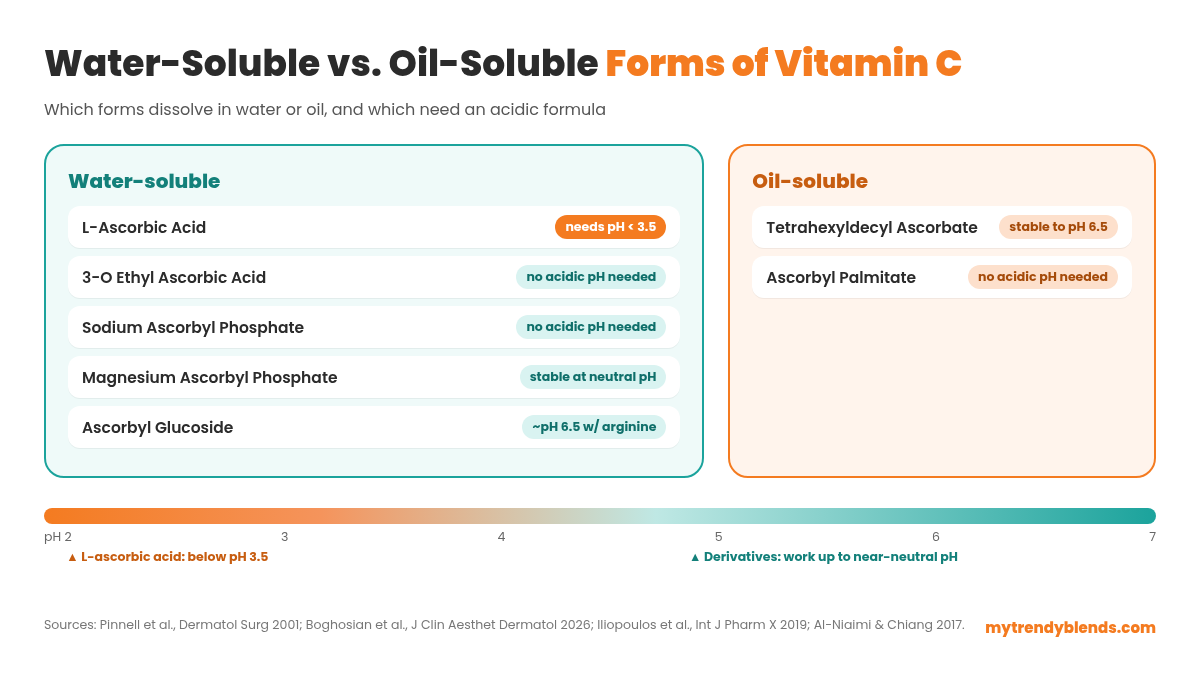
- Water-soluble forms of vitamin C include L-ascorbic acid, 3-O Ethyl Ascorbic Acid, sodium ascorbyl phosphate, magnesium ascorbyl phosphate and ascorbyl glucoside. Oil-soluble forms include tetrahexyldecyl ascorbate and ascorbyl palmitate.
- With all forms of vitamin C, the formula, the packaging and how consistently you use it matter as much as the name on the label.
Table of Contents
Why Are There So Many Forms of Vitamin C?
Pure vitamin C, L-ascorbic acid, is the form your body uses. Normal skin holds high levels of it, where it supports collagen production and helps defend against UV-related damage.4 The trouble is that it’s fragile. It oxidizes readily on exposure to air,9 and to get through the skin’s outer layer, it has to be formulated at a pH below 3.5.1 That acidity can sting, especially on sensitive skin.2
Chemists responded by attaching other molecules to vitamin C, such as a phosphate, a sugar, an ethyl group or fatty acid chains. These derivatives are generally more stable in the bottle. The catch is that most of them have to be converted back into active vitamin C by enzymes in the skin, and how well that happens varies by form.4
A 2026 systematic review in the Journal of Clinical and Aesthetic Dermatology summed it up well: how well vitamin C works depends on the derivative chemistry, the vehicle, the pH, the stabilization strategy and the delivery method.2
That’s why comparing forms of vitamin C by name alone only gets you so far, but knowing each one’s basics makes labels much easier to read.
Forms of Vitamin C Compared: The Chart
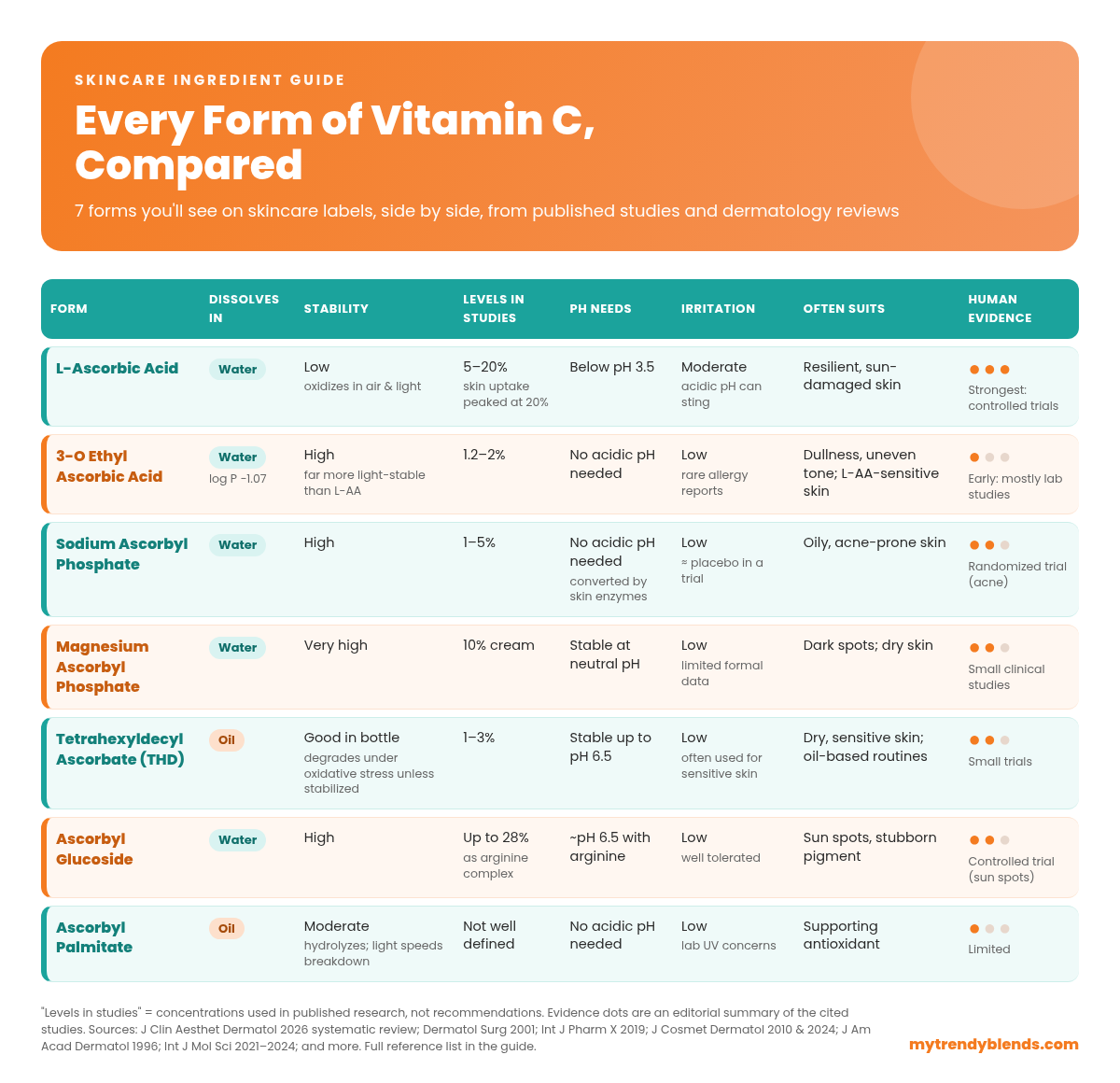
Share this chart on your site: copy the code below and paste it into your page. Please keep the credit link.
<a href="https://mytrendyblends.com/forms-of-vitamin-c/"><img src="https://mytrendyblends.com/wp-content/uploads/2026/10/vitamin-c-forms-chart.png" alt="Forms of vitamin C in skincare compared: comparison chart" width="1200" style="max-width:100%;height:auto;" /></a>
<p>Chart: <a href="https://mytrendyblends.com/forms-of-vitamin-c/">Every Form of Vitamin C in Skincare, Compared</a> by Trendy Blends</p>
Prefer text? Here’s the same comparison of the forms of vitamin C as a table.
| Form (INCI name) | Dissolves in | Stability | Levels used in published studies | pH needs | Irritation potential | Often suits | Strength of human evidence |
|---|---|---|---|---|---|---|---|
| L-ascorbic acid | Water | Low. Oxidizes on exposure to air and light9,10 | 5% creams; 10–15% serums; skin uptake peaked at 20%1,2,6 | Below pH 3.5 to enter skin1 | Moderate (low pH can irritate)2,3 | Resilient skin; sun-damaged skin | Strongest (several controlled trials) |
| 3-O Ethyl Ascorbic Acid | Water (log P -1.07)9 | High. Far more light-stable than L-ascorbic acid in gel tests10 | 1.2–2% in skin-delivery studies9,11 | No acidic pH needed; penetrated skin from simple solvents in lab tests9 | Low, but rare allergy cases reported12 | Dullness, uneven tone; people who find L-ascorbic acid harsh | Early (mostly lab and skin-penetration studies) |
| Sodium ascorbyl phosphate | Water | High15 | 1–5% in acne research; 3% after microneedling2,13,14 | No acidic pH needed; converted by skin enzymes16 | Low (similar to placebo in a trial)13 | Oily and acne-prone skin | Moderate (randomized trial in acne) |
| Magnesium ascorbyl phosphate | Water2 | Very high2,17 | 10% cream in a pigmentation study18 | Stable at neutral pH3 | Low (limited formal data) | Dark spots; dry skin | Moderate (small clinical studies) |
| Tetrahexyldecyl ascorbate (THD) | Oil2 | Good in the bottle, but breaks down under oxidative stress unless stabilized20 | 1–3%21,22 | Stable up to pH 6.52 | Low; often recommended for sensitive skin2 | Dry and sensitive skin; oil-based routines | Moderate (small trials, often in combination formulas) |
| Ascorbyl glucoside | Water2 | High4 | Up to 28% as an arginine complex24 | About pH 6.5 when paired with arginine2 | Low; well tolerated2 | Sun spots and stubborn pigmentation | Moderate (controlled trial for sun spots) |
| Ascorbyl palmitate | Oil2 | Moderate. Breaks down by hydrolysis; light speeds it up15,17 | Not well defined in clinical research | No acidic pH needed3 | Low on contact, but lab data raise UV questions26 | Supporting antioxidant in a formula | Limited |
“Strength of human evidence” is our own summary of the studies cited here, not an official grade. “Often suits” is general guidance based on each form’s pH, solubility and tolerability, not a medical recommendation.
The Forms of Vitamin C, One by One
1. L-Ascorbic Acid: The Original
L-ascorbic acid is vitamin C itself, and it’s still the most clinically validated of all the forms of vitamin C in dermatology.2 In a six-month double-blind trial, a 5% vitamin C cream visibly improved photoaged skin compared with the cream base alone.6
In a 16-week study of women with melasma, 5% ascorbic acid didn’t lighten as well as 4% hydroquinone by patients’ own ratings, but it caused side effects in just 1 of 16 women, compared with 11 of 16 on hydroquinone.7 Paired with vitamin E and ferulic acid, a 15% L-ascorbic acid solution became more stable and doubled its protection against simulated sunlight in lab testing.8
The trade-offs are stability and comfort. Classic pig-skin research found it must sit below pH 3.5 to absorb, and uptake peaked at 20%.1 Dermatologists note that going above 20% doesn’t add benefit and may irritate.3 If you love it, choose opaque, air-restricted packaging and toss it once it turns dark orange or brown. Our guide to why vitamin C serums turn orange explains what that color change means.
2. 3-O Ethyl Ascorbic Acid: Stable and Water-Loving
3-O Ethyl Ascorbic Acid (you’ll also see “ethyl ascorbic acid”) is vitamin C with an ethyl group attached at the third carbon position. It was developed as a stable alternative to L-ascorbic acid.9 It’s often described online as dissolving in both water and oil, but measured data tell a clearer story.
A University College London study found a log P of -1.07, meaning it prefers water. It dissolved readily in water-friendly solvents like glycerin and propylene glycol and far less in oils. It also passed through skin in lab tests from those simple solvents, with no acidic pH required.9
Among the water-soluble forms of vitamin C, its standout trait is stability. In one light-exposure test, plain ascorbic acid broke down completely within one to two hours in most of the gels tested, while 3-O Ethyl Ascorbic Acid lost only about 2–5% after six hours.10 In cell studies, it reduced melanin production through several pathways.11
Honest caveats: most research is lab-based rather than large clinical trials, the UCL authors said its stability still deserves more study, and a small number of allergic contact dermatitis cases have been reported.9,12 Our deeper look at why we chose 3-O Ethyl Ascorbic Acid covers it in more detail.
3. Sodium Ascorbyl Phosphate (SAP): The Acne-Friendly Option
SAP adds a phosphate group, which makes it stable in formulas. In one study it held up in both oil-in-water and water-in-oil microemulsions where ascorbyl palmitate didn’t.15 Skin enzymes have to convert it into free ascorbic acid.16 Its research niche is acne. In lab testing, 1% SAP strongly reduced acne-causing bacteria.
In a randomized, double-blind trial of 50 people, a 5% SAP lotion beat the plain lotion on every acne measure, with tolerability similar to the plain lotion.13,14 The downside is that phosphate forms are poorly absorbed through skin.4 The U.S. Cosmetic Ingredient Review reported cosmetic use levels of 0.01% to 3%.19 If breakouts are your main concern, see our post on vitamin C serum for oily skin.
4. Magnesium Ascorbyl Phosphate (MAP): The Steady One
MAP is one of the most stable forms of vitamin C. A stability study found its phosphate group protected the molecule from breaking down, making it “a very stable derivative.”17 In a dermatology study, a 10% MAP cream lightened spots in 19 of 34 people with melasma or age spots.18 It’s also described as hydrating.5 One limitation: in pig-skin testing, applying MAP did not raise skin levels of L-ascorbic acid.1
A note on conflicting info. Some older dermatology reviews call MAP “lipophilic” (oil-loving).3,5 The 2026 systematic review lists it as hydrophilic,2 which fits its chemistry as a magnesium salt. We list it as water-soluble.
5. Tetrahexyldecyl Ascorbate (THD): The Oil-Soluble Favorite
THD is one of the oil-soluble forms of vitamin C: vitamin C bonded to four branched fatty acid chains. PubChem lists ascorbyl tetraisopalmitate and vitamin C tetra-isopalmitate as synonyms,27 though some suppliers and the 2026 review treat the names separately.2 It stays stable up to pH 6.5 and is often favored for sensitive skin.2 In a three-week clinical test, a 3% cream helped suppress UV-induced pigmentation.21 A 1% formula improved skin hydration and smoothness.22
The surprise came in 2021. Lab research found THD breaks down quickly when exposed to singlet oxygen, a reactive form of oxygen, and that on its own it switched on inflammatory signaling in skin cells.
Pairing it with the antioxidant acetyl zingerone prevented the breakdown and blunted that inflammatory effect.20 A 12-week open-label study of 35 people using a THD and acetyl zingerone serum found improvements in pigmentation, fine lines, firmness and elasticity.23 We compare it head to head in THD ascorbate vs. L-ascorbic acid.
6. Ascorbyl Glucoside: The Brightening Specialist
Ascorbyl glucoside is one of the gentler forms of vitamin C, pairing vitamin C with glucose. Skin cells slowly release vitamin C from it using an enzyme called alpha-glucosidase. In fibroblast studies, it stimulated collagen as well as L-ascorbic acid did and kept working longer.25
It’s very stable, though how quickly it converts in living skin isn’t known.4 Its best human evidence is for pigmentation. In a 24-week double-blind half-face study, a lotion with 28% ascorbyl glucoside–arginine complex significantly faded sun spots compared with placebo, with no skin problems reported.24
7. Ascorbyl Palmitate: The Supporting Player
Ascorbyl palmitate attaches a single fatty acid to vitamin C, making it oil-soluble. It’s widely used, but of all the forms of vitamin C here, its research is the least flattering. The palmitate ester doesn’t prevent hydrolysis in solutions or emulsions, and light speeds up its breakdown.15,17
It also didn’t raise skin vitamin C levels in pig-skin testing.1 A Mayo Clinic lab study found that, despite antioxidant effects, it increased UVB-induced lipid damage and cell death in skin cells.26 Those are lab findings, not proof of harm in people, but they’re why many formulators treat it as a supporting antioxidant rather than the star.
Other Forms of Vitamin C You May See
A few newer or niche forms show up too. Bis-glyceryl ascorbate is a newer derivative studied mainly as a 1% cream for a specific side effect of certain cancer drugs, so there’s not enough data yet to rate it for everyday skincare.2 Sodium ascorbate is mostly used at very low levels as an antioxidant to protect formulas, not as a headline active.19
How to Choose Among the Forms of Vitamin C
- Resilient skin, sun damage, want the most-studied option: a low-pH L-ascorbic acid serum in protective packaging.
- Sensitive or easily stung skin: a gentler derivative such as 3-O Ethyl Ascorbic Acid, THD or ascorbyl glucoside. Our vitamin C guide for sensitive skin has patch-testing tips.
- Oily or breakout-prone skin: sodium ascorbyl phosphate has the most acne-specific research.
- Dark spots and uneven tone: MAP, ascorbyl glucoside and 3-O Ethyl Ascorbic Acid all have pigment-focused research, at different levels of evidence.
- Dry skin or oil-based routines: THD, ideally in a formula with a stabilizing antioxidant.
Whatever you pick, pair it with daily broad-spectrum sunscreen and give it a few months. Many of the human trials above ran 12 to 24 weeks.
Packaging Matters for Every Form
Air and light speed up vitamin C breakdown, and even the most stable forms of vitamin C benefit from protection.10,15 Opaque bottles and airless pumps limit exposure each time you use the product. Check the concentration too. Higher isn’t automatically better. For L-ascorbic acid, skin uptake peaked at 20%,1 and studied levels for other forms vary widely, as the chart shows.
Where Trendy Blends Fits
Our Trendy Blends 18% Vitamin C Serum uses 18% 3-O Ethyl Ascorbic Acid. We chose it for its stability and because it doesn’t need a stinging low pH. We pair it with niacinamide, hyaluronic acid, glycerin, aloe and cucumber. The serum is fragrance-free, paraben-, sulfate- and dye-free, and cruelty-free. It comes in a 1 oz airless pump, and 1–2 pumps covers your face and neck.
You can see every ingredient and why it’s there on our ingredient list. It’s $24.99 with free shipping in 3–4 business days and our 60-Day Glow Guarantee with free returns. If another of the forms of vitamin C on this chart suits your skin better, that’s a great choice too.
FAQ: Forms of Vitamin C
Which of the forms of vitamin C is most effective?
L-ascorbic acid has the most clinical research, so it’s the benchmark.2 “Most effective” for you also depends on whether your skin tolerates its low pH and whether the formula stays fresh. A stable derivative you use every day may serve you better than a potent serum that irritates or oxidizes.
Which forms of vitamin C are best for sensitive skin?
Forms that don’t need a very acidic pH tend to be gentler. The 2026 review highlights THD for sensitive skin and notes ascorbyl glucoside is well tolerated.2 3-O Ethyl Ascorbic Acid also doesn’t need low pH, though rare allergies have been reported.9,12 Patch test any new product first.
Is 3-O Ethyl Ascorbic Acid water- or oil-soluble?
Mainly water-soluble. Its measured log P is -1.07, and it dissolves far better in water-friendly solvents like glycerin than in oils.9
Do vitamin C derivatives turn into real vitamin C in the skin?
Most are designed to. Phosphate forms and ascorbyl glucoside are converted by skin enzymes, but conversion rates in living skin are not well measured, and some derivatives did not raise skin vitamin C levels in testing.1,4,25
Why do some vitamin C serums turn orange or brown?
That’s usually oxidation. L-ascorbic acid is especially prone to it,9 and oxidized vitamin C can also leave a yellowish tint on skin or clothes.5 Stable derivatives and airless packaging help limit it.
Can I combine different forms of vitamin C?
Yes. Many formulas already combine forms, such as a 10% L-ascorbic acid and 7% THD blend studied for uneven pigment.9 Layering isn’t required, though. One well-made product used consistently is plenty.
How We Built This Guide
We started with the seven forms of vitamin C most often seen on ingredient lists. For each fact, we read the original study or review on PubMed or PubMed Central and cited only what it says. Where studies disagreed, as on MAP’s solubility, we said so. Chart concentrations are levels used in published research, not recommendations. This guide is educational, not medical advice. See a board-certified dermatologist for persistent skin concerns. Last reviewed October 2026.
References
- Pinnell SR, et al. Topical L-ascorbic acid: percutaneous absorption studies. Dermatol Surg. 2001;27(2):137-142. PubMed
- Boghosian T, et al. Clinical Applications of Vitamin C in Dermatology: A Systematic Review. J Clin Aesthet Dermatol. 2026;19(7):10-15. PMC
- Al-Niaimi F, Chiang NYZ. Topical Vitamin C and the Skin: Mechanisms of Action and Clinical Applications. J Clin Aesthet Dermatol. 2017;10(7):14-17. PMC
- Pullar JM, Carr AC, Vissers MCM. The Roles of Vitamin C in Skin Health. Nutrients. 2017;9(8):866. PMC
- Telang PS. Vitamin C in dermatology. Indian Dermatol Online J. 2013;4(2):143-146. PMC
- Humbert PG, et al. Topical ascorbic acid on photoaged skin: double-blind study vs. placebo. Exp Dermatol. 2003;12(3):237-244. PubMed
- Espinal-Perez LE, Moncada B, Castanedo-Cazares JP. A double-blind randomized trial of 5% ascorbic acid vs. 4% hydroquinone in melasma. Int J Dermatol. 2004;43(8):604-607. PubMed
- Lin FH, et al. Ferulic acid stabilizes a solution of vitamins C and E and doubles its photoprotection of skin. J Invest Dermatol. 2005;125(4):826-832. PubMed
- Iliopoulos F, et al. 3-O-ethyl-l-ascorbic acid: Characterisation and investigation of single solvent systems for delivery to the skin. Int J Pharm X. 2019;1:100025. PMC
- Golonka I, et al. Assessment of the Influence of the Selected Range of Visible Light Radiation on the Durability of the Gel with Ascorbic Acid and Its Derivative. Int J Mol Sci. 2022;23(15):8759. PubMed
- Chen SJ, et al. The anti-melanogenic effects of 3-O-ethyl ascorbic acid via Nrf2-mediated α-MSH inhibition in UVA-irradiated keratinocytes and autophagy induction in melanocytes. Free Radic Biol Med. 2021;173:151-169. PubMed; Li Y, et al. Lamellar Liquid Crystal Improves the Skin Retention of 3-O-Ethyl-Ascorbic Acid. AAPS PharmSciTech. 2016;17(3):767-777. PubMed
- Suzuki K, et al. Seven cases of allergic contact dermatitis caused by cosmetics containing 3-O-ethyl-L-ascorbic acid. Contact Dermatitis. 2022;86(5):421-423. PubMed
- Woolery-Lloyd H, Baumann L, Ikeno H. Sodium L-ascorbyl-2-phosphate 5% lotion for the treatment of acne vulgaris: a randomized, double-blind, controlled trial. J Cosmet Dermatol. 2010;9(1):22-27. PubMed
- Klock J, et al. Sodium ascorbyl phosphate shows in vitro and in vivo efficacy in the prevention and treatment of acne vulgaris. Int J Cosmet Sci. 2005;27(3):171-176. PubMed
- Spiclin P, Gasperlin M, Kmetec V. Stability of ascorbyl palmitate in topical microemulsions. Int J Pharm. 2001;222(2):271-279. PubMed
- Spiclin P, et al. Sodium ascorbyl phosphate in topical microemulsions. Int J Pharm. 2003;256(1-2):65-73. PubMed
- Austria R, Semenzato A, Bettero A. Stability of vitamin C derivatives in solution and topical formulations. J Pharm Biomed Anal. 1997;15(6):795-801. PubMed
- Kameyama K, et al. Inhibitory effect of magnesium L-ascorbyl-2-phosphate (VC-PMG) on melanogenesis in vitro and in vivo. J Am Acad Dermatol. 1996;34(1):29-33. PubMed
- Elmore AR. Final report of the safety assessment of L-Ascorbic Acid, Calcium Ascorbate, Magnesium Ascorbate, Magnesium Ascorbyl Phosphate, Sodium Ascorbate, and Sodium Ascorbyl Phosphate as used in cosmetics. Int J Toxicol. 2005;24 Suppl 2:51-111. PubMed
- Swindell WR, et al. Tetrahexyldecyl Ascorbate (THDC) Degrades Rapidly under Oxidative Stress but Can Be Stabilized by Acetyl Zingerone to Enhance Collagen Production and Antioxidant Effects. Int J Mol Sci. 2021;22(16):8756. PubMed
- Ochiai Y, et al. A new lipophilic pro-vitamin C, tetra-isopalmitoyl ascorbic acid (VC-IP), prevents UV-induced skin pigmentation through its anti-oxidative properties. J Dermatol Sci. 2006;44(1):37-44. PubMed
- Maia Campos PM, et al. Application of tetra-isopalmitoyl ascorbic acid in cosmetic formulations: stability studies and in vivo efficacy. Eur J Pharm Biopharm. 2012;82(3):580-586. PubMed
- Min M, Pérez Damonte SH, Sivamani RK. Open-label topical application of tetrahexyldecyl ascorbate and acetyl zingerone containing serum improves the appearance of photoaging and uneven pigmentation. J Cosmet Dermatol. 2024;23(8):2628-2635. PubMed
- Takada M, et al. Treatment with Ascorbyl Glucoside-Arginine Complex Ameliorates Solar Lentigos. Int J Mol Sci. 2024;25(24):13453. PubMed
- Yamamoto I, et al. Collagen synthesis in human skin fibroblasts is stimulated by a stable form of ascorbate, 2-O-alpha-D-glucopyranosyl-L-ascorbic acid. J Nutr. 1992;122(4):871-877. PubMed
- Meves A, et al. Vitamin C derivative ascorbyl palmitate promotes ultraviolet-B-induced lipid peroxidation and cytotoxicity in keratinocytes. J Invest Dermatol. 2002;119(5):1103-1108. PubMed
- PubChem. Tetrahexyldecyl ascorbate (CID 10260680), synonyms. National Library of Medicine. PubChem
