
Signs of a Damaged Skin Barrier: 7 Red Flags and What to Do
Red, tight or stinging skin is often your first clue that something is wrong. Knowing the signs of a damaged skin barrier helps you catch the problem early, before a little irritation turns into weeks of sensitivity.
This guide covers the 7 most common warning signs, how barrier damage differs from dry or dehydrated skin, what usually causes it, and when to see a dermatologist. When you are ready to fix it, our step-by-step guide on how to repair a damaged skin barrier picks up where this one ends.
Table of Contents
What Is Your Skin Barrier?
Your skin barrier is the outermost layer of your skin, also called the stratum corneum. As dermatologist Melissa Piliang, MD, explains to Cleveland Clinic, it is made of dead cells plus lipids, proteins and fats that help protect your skin from the environment.
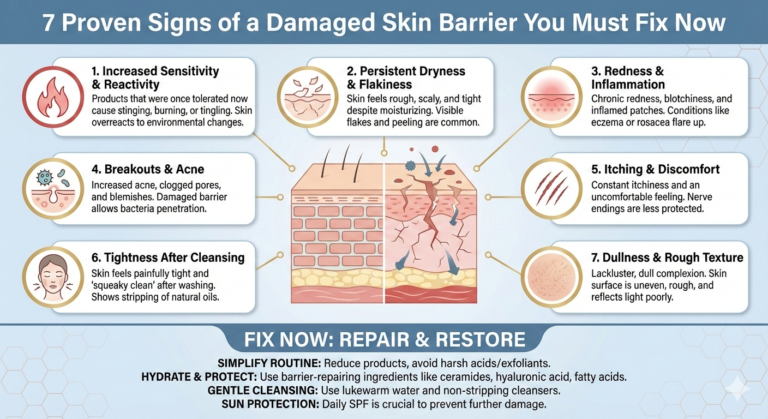
Think of it as a brick wall. The skin cells are the bricks, and lipids such as ceramides, cholesterol and fatty acids are the mortar. When the wall is intact, it keeps water in and irritants out. When gaps appear, water escapes and irritants get in, and your skin starts to send signals.
7 Signs of a Damaged Skin Barrier
Cleveland Clinic lists the most common signs as dryness and flaking, stinging, inflammation, itching, rough patches, breakouts and tenderness. Here is what each one looks and feels like.
1. Tight, Dry or Flaky Skin
Skin that feels tight soon after cleansing, or looks dull and flaky even though you moisturize, is losing water faster than it should. Scaly patches often show up around the nose, cheeks and chin first.
What helps: apply moisturizer while your skin is still damp. Cleveland Clinic suggests applying emollients within three minutes of getting out of the bath or shower.
2. Stinging or Burning When You Apply Products
If a cleanser, serum or even a plain moisturizer that never bothered you suddenly stings, take it seriously. Stinging, especially when you apply skin care products, is one of the clearest signs of a damaged skin barrier.
What helps: pause exfoliating acids, retinoids and fragranced products until the stinging stops.
3. Redness and Irritation
Blotchy redness, a warm feeling or irritation after washing can all point to a weakened barrier. Because redness also has other causes, such as rosacea, persistent flushing is worth showing to a dermatologist.
What helps: wash with warm, not hot, water and a mild, soap-free cleanser. Dr. Piliang compares hot water on skin to butter under a hot tap: it melts the protective fats away.
4. Itching
An itch that keeps coming back, especially with dryness, suggests your skin is struggling to hold water. Itching is also a hallmark of eczema (atopic dermatitis), which Cleveland Clinic lists among the conditions linked with a poor skin barrier.
What helps: a thick, fragrance-free cream or ointment. The American Academy of Dermatology (AAD) notes that creams and ointments add more moisture than lotions.
5. Rough Patches and Uneven Texture
Skin that feels rough or sandpapery, or where makeup clings to dry spots, often has a disrupted surface. It is tempting to scrub those patches away, but that usually makes things worse.
What helps: stop physical scrubs. Cleveland Clinic warns that harsh scrubs can create tiny tears in the barrier.
6. Breakouts
Acne appears on Cleveland Clinic’s list of signs, too. Over-washing, harsh soaps and stacking drying acne treatments can irritate skin and leave it both oily and flaky at the same time.
What helps: use one gentle acne treatment at a time, follow it with an oil-free moisturizer, and don’t pick. Picking causes trauma that can lead to inflammation and scars.
7. Tenderness and Reacting to Everything
When almost every product, change in weather or touch makes your face feel sore, your barrier is likely compromised. Frequent skin infections can also be a sign. Cleveland Clinic includes both infection and tenderness among the warning signs.
What helps: strip your routine back to a gentle cleanser, a plain moisturizer and sunscreen. See our skin care advice for sensitive skin for product tips.
A Quick Self-Check
Not sure whether your symptoms add up? Ask yourself these questions:
- Do products you have used for months suddenly sting or burn?
- Does your skin feel tight within an hour of washing, even after moisturizer?
- Have you added a new acid, retinoid, scrub or cleanser in the last few weeks?
- Are you washing more often, or with hotter water, than usual?
- Is your skin red, itchy or flaky in patches that don’t go away?
If you answered yes to two or more, your barrier is probably under strain. The good news is that the most common causes are habits you control. Removing the trigger is often the fastest fix, so think back to what changed in your routine or environment just before the trouble started, such as a new product, a cold snap, a trip or a stressful week.
Keep a short note of what you use each day while your skin recovers. It makes it much easier to spot a pattern, and it is useful information to bring to a dermatologist if the problem continues.
Dry vs. Dehydrated vs. Damaged Skin Barrier
These three are easy to mix up, and they need slightly different care:
- Dry skin is a skin type that makes less oil. It tends to feel rough year-round and loves richer creams. Read more about what causes dry skin.
- Dehydrated skin is short on water, and any skin type can be dehydrated, including oily skin. Humectants such as glycerin and hyaluronic acid help. Here is how to keep skin hydrated.
- A damaged skin barrier means the protective layer isn’t working well. It usually brings dryness plus stinging, redness or itching, and it needs a gentler routine, not just more product.
A simple rule: if moisturizer alone fixes the problem, you were probably dealing with dryness or dehydration. If products sting and your skin stays red or itchy, look at barrier damage.
What Causes Barrier Damage?
Cleveland Clinic points to a few common culprits:
- Harsh soaps and cleansers, and cleansing for too long.
- Over-exfoliating or scrubbing, including frequent acids and grainy scrubs.
- Skipping moisturizer.
- Hot water and long showers.
- Sun exposure without protection.
- Skin conditions such as eczema, psoriasis, rosacea, ichthyosis or adult acne.
Age matters as well. Dr. Piliang notes that the barrier doesn’t replace itself as quickly once you are in your 50s, 60s or 70s, so older skin bounces back more slowly from hot showers or harsh products. If that sounds familiar, see how a simpler routine helps mature skin barriers.
What to Do When You Spot the Signs
Recognizing the signs of a damaged skin barrier is step one. Step two is giving your skin a break. These first moves come from dermatologist advice:
- Simplify. Pause exfoliants, retinoids and anything fragranced. Keep a gentle cleanser, a moisturizer and sunscreen.
- Cleanse briefly. Massage your cleanser on, then rinse. Dr. Piliang says there is no benefit to leaving it on longer.
- Moisturize with barrier lipids. Look for ceramides, fatty acids and cholesterol. In barrier-repair research, balanced mixtures of these three lipids supported repair better than any one lipid alone.
- Consider niacinamide. In a laboratory and clinical study, niacinamide increased ceramide production and improved the skin’s barrier function.
- Wear sunscreen every day. The AAD recommends a broad-spectrum SPF 30 or higher. For sensitive skin, the AAD suggests a physical sunscreen with zinc oxide or titanium dioxide.
For a full step-by-step plan, see our guide to repairing a damaged skin barrier. To choose the right cream, use our tips for choosing a moisturizer.
When Can You Bring Back Active Ingredients?
Wait until stinging, redness and flaking have settled, then reintroduce one active at a time, a few days a week at first. Start with the gentlest option and watch how your skin responds before adding the next.
A vitamin C serum is often one of the easier actives to bring back, because it is used once a day in the morning under sunscreen. The Trendy Blends 18% Vitamin C Serum uses 18% 3-O ethyl ascorbic acid, a stable form of vitamin C, with niacinamide, hyaluronic acid, aloe and cucumber. It is fragrance-free and comes in a 1 oz airless pump. Patch test first, then use 1–2 pumps on alternate mornings and build up. It costs $24.99 with free shipping in 3–4 business days and is backed by our 60-Day Glow Guarantee. See more tips on vitamin C serum for sensitive skin.
When to See a Dermatologist
A Cleveland Clinic guide to sensitive skin suggests talking to a healthcare provider if home care hasn’t helped after a week or so. Book an appointment sooner if you notice:
- Itchy, scaly patches that could be eczema or psoriasis.
- Persistent redness and flushing that could be rosacea.
- Signs of infection, such as oozing, crusting, warmth or pain.
- A rash that blisters, spreads quickly or comes with a fever. Cleveland Clinic advises urgent care for these.
A dermatologist can find the cause and, if needed, prescribe treatment that calms inflammation so your barrier can recover.
Frequently Asked Questions
What are the signs of a damaged skin barrier?
Common signs include dry, flaky or scaly skin, stinging when you apply products, redness and irritation, itching, rough patches, breakouts, and skin that feels tender or reacts to almost everything.
Why do my skin care products suddenly sting?
Stinging from products you used to tolerate is a classic warning sign. When the outer layer of skin is weakened, ingredients reach the skin more easily and irritate it. Stop actives and fragrance, and keep your routine simple until the stinging settles.
Can a damaged skin barrier cause acne?
It can play a part. Cleveland Clinic lists acne among the signs of a damaged barrier, and harsh scrubs and drying products can make breakouts and irritation worse.
Is a damaged skin barrier the same as dry skin?
Not exactly. Dry skin describes a skin type that makes less oil, and dehydrated skin is short on water. A damaged barrier means the protective outer layer isn’t working well, and it often causes dryness along with stinging, redness or itching.
How long does it take a damaged skin barrier to heal?
It varies. Mild irritation often calms within a few weeks of a gentle routine, but a Cleveland Clinic dermatologist notes it typically takes three or four months to see the full benefit of a new skin care approach.
When should I see a dermatologist?
See a dermatologist if your skin doesn’t improve after you simplify your routine, or if you have signs of eczema, psoriasis, rosacea, infection, or a rash that spreads, blisters or oozes.
Conclusion: Listen to the Signs
The signs of a damaged skin barrier, including tightness, stinging, redness, itching, rough patches, breakouts and tenderness, are your skin asking you to slow down. Spotting them early lets you simplify, protect and moisturize before the irritation spreads.
Be patient. Many people feel better within a few weeks, but the full benefit of a gentler routine can take a few months. If your skin doesn’t improve, a dermatologist can help.
