
Vitamin C Serum for Dry Skin: 7 Gentle Tips for Soft Glow
If you’ve been hunting for a vitamin C serum for dry skin, you’ve probably noticed that some formulas leave your face tight, flaky or stinging. The good news? With the right formula and a few gentle habits, vitamin C can sit comfortably in even the thirstiest routine.
Dry skin often sneaks up in our 40s and 50s, and menopause can make it worse. You’re not imagining it, and you’re not alone.
Below, we’ll cover why mature skin gets drier, whether a vitamin C serum for dry skin really makes sense, seven gentle tips, and an easy morning routine that keeps moisture locked in.
Table of Contents
Why Skin Gets Drier After 40 and in Menopause
Dryness isn’t just about the weather.
A review on the roles of vitamin C in skin health notes that dry skin is very common in older adults, largely due to a loss of glycosaminoglycans, the moisture-holding molecules in skin, and a reduced ability to keep moisture levels up.
Hormones play a big part, too. The American Academy of Dermatology (AAD) explains in its guide to caring for your skin during menopause that skin loses some ability to hold water, so it can get quite dry, especially when the air is dry.
A review on estrogen-deficient skin adds that increased dryness is one of the first symptoms, followed by decreased firmness and elasticity, alongside lower sebum production and collagen.
Dry vs. dehydrated: what’s the difference?
In everyday skincare talk, “dry” usually means skin that’s low in oil and feels rough or flaky, while “dehydrated” means skin that’s short on water and feels tight.
Mature skin is often both at once. That’s why a vitamin C serum for dry skin works best as one part of a routine that adds water and then seals it in.
Is a Vitamin C Serum for Dry Skin a Good Idea?
For many people, yes, as long as you choose it for the right reasons. A review by two consultant dermatologists on topical vitamin C and the skin calls it one of the most powerful antioxidants in the skin, with antiaging effects through increasing collagen synthesis and decreasing collagen breakdown.
It also decreases melanin formation, which is why vitamin C is linked to a brighter, more even-looking complexion. Those are the main reasons to reach for a vitamin C serum for dry skin.
What about dryness itself? The Pullar review is honest here: because the effects of topical formulas vary so much, it’s difficult to come to any firm conclusion about whether vitamin C affects skin dryness.
The same review describes lab studies showing vitamin C promotes the making and organization of barrier lipids, which is early evidence. So let a vitamin C serum for dry skin do its antioxidant job, and let hydrators and moisturizer handle the moisture.
Why some vitamin C serums feel drying
The dermatologists’ review explains that L-ascorbic acid is unstable, and that lowering its pH below 3.5 is an effective way to improve its stability and permeability. In other words, many classic formulas are quite acidic.
It also notes that concentrations above 20% don’t add benefit and might cause some irritation. Cleveland Clinic notes that most people don’t get side effects from vitamin C serum, but in rare cases you may have dryness, itching or redness.
Add in fragrance or alcohol, and the AAD’s dermatologist tips to relieve dry skin are clear: if your skin is dry, stop using products that contain alcohol or fragrance.
Gentle derivative forms worth knowing
L-ascorbic acid isn’t the only option. A lab study describes 3-O-ethyl-L-ascorbic acid as a stable vitamin C derivative used in topical products, noting that plain L-ascorbic acid readily oxidizes when exposed to air.
In tests on pig skin, it got into the skin from simple solvents including glycerol (glycerin) and 1,2-hexanediol. That’s lab work, not a human trial, but it’s a nice fit for a vitamin C serum for dry skin built on hydrating bases. Our guide to the forms of vitamin C compares the options.
7 Gentle Tips for Using a Vitamin C Serum for Dry Skin
These tips keep a vitamin C serum for dry skin soothing instead of stripping.
1. Start with a gentle, low-lather cleanse
The AAD says that for mature skin, soap can be too drying, so wash with a mild cleanser instead. Its dry-skin tips add a useful detail: use enough cleanser to remove dirt and oil, but not so much that you see a thick lather.
Then gently pat dry with a clean towel, since rubbing can irritate very dry skin.
2. Apply 1–2 pumps right after cleansing
The AAD’s guide to applying skin care in the right order suggests washing with a gentle cleanser, then applying any treatment right after cleansing, then moisturizer and/or sunscreen, then makeup.
With our serum, 1–2 pumps of vitamin C serum for dry skin covers your face and neck. Press it in with your fingertips rather than rubbing hard.
3. Pair vitamin C with hyaluronic acid
Hyaluronic acid is a natural partner. In a randomized study of 76 women aged 30 to 60, hyaluronic acid creams of different molecular weights were applied twice daily around one eye for 60 days, with a plain cream around the other.
All the 0.1% hyaluronic acid creams significantly improved skin hydration and elasticity compared with the plain cream. The lower-molecular-weight versions also significantly reduced wrinkle depth.
That was a cream study around the eyes, so results won’t translate exactly to every serum. Still, it’s a good reason to look for a vitamin C serum for dry skin that includes hyaluronic acid, and our post on vitamin C serum and hyaluronic acid goes deeper.
4. Look for glycerin in the formula
Glycerin is a humble hero. A review on glycerol and the skin in the British Journal of Dermatology reports that it improves stratum corneum hydration, skin barrier function and skin mechanical properties, and helps protect against irritating stimuli.
The AAD’s menopause guide also says a moisturizer with hyaluronic acid or glycerin can be especially helpful for dry skin. Finding both in a vitamin C serum for dry skin is a lovely bonus.
5. Let niacinamide support your barrier
Niacinamide (also called nicotinamide) is a B vitamin studied for barrier support. In a study on nicotinamide and stratum corneum lipids, it raised ceramide production 4.1- to 5.5-fold in lab-grown skin cells.
Applied to skin, it increased ceramide and free fatty acid levels in the outer layer and decreased water loss in dry skin. Our guide to niacinamide and vitamin C explains why the two work well together.
6. Seal it in with moisturizer while skin is still damp
The AAD says moisturizer plays a key role for dry skin. It recommends applying moisturizer when your skin is still damp and again whenever it feels dry, taking time to gently massage it in.
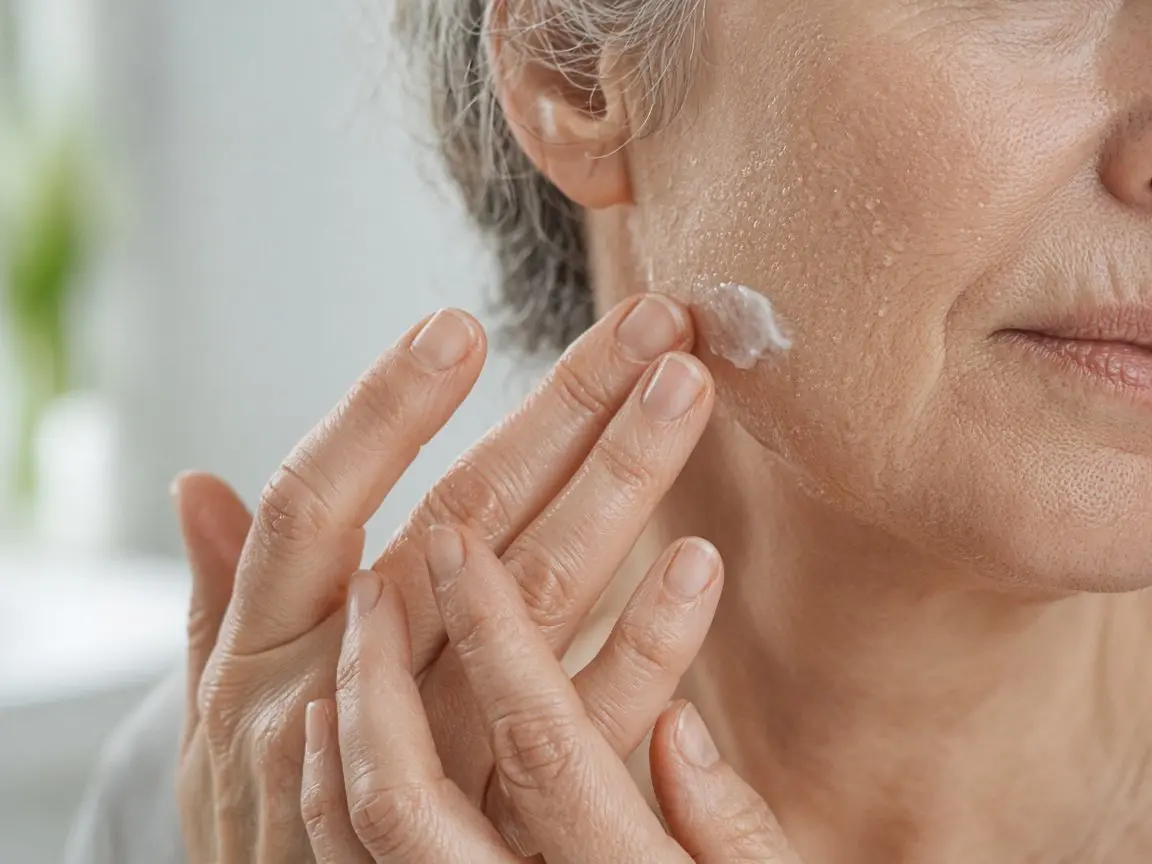
It also says creams and ointments are more effective than lotions, ideally with ingredients like glycerin, hyaluronic acid, dimethicone, shea butter or petrolatum.
Once your vitamin C serum for dry skin has settled in and your face still feels slightly dewy, smooth on a fragrance-free cream.
7. Finish with sunscreen every single morning
The AAD’s tips for skin care in your 40s and 50s call sun protection the foundation of every anti-aging skin care plan. Use a broad-spectrum, water-resistant sunscreen with SPF 30 or higher.
In menopause, the AAD adds, daily sunscreen can help fade age spots and prevent new ones. Dr. Piliang says vitamin C and sunscreen “work in synergy,” so layer your vitamin C serum for dry skin underneath.
How to Avoid Irritation With a Vitamin C Serum for Dry Skin
As skin gets drier it can become more easily irritated, and the AAD notes that around 50, the skin’s pH changes and skin becomes more sensitive. A little caution goes a long way.
Patch test your vitamin C serum for dry skin first
The AAD suggests applying a new product to a quarter-sized spot, like the underside of your arm, twice daily for seven to 10 days. If there’s no redness, itching or swelling, go ahead and use it.
If you do react, gently wash it off and don’t use it again. Our post on vitamin C serum burning explains the difference between a mild tingle and a real warning sign.
Don’t stack too many actives
The AAD warns that using more than one anti-aging product in a few days or weeks can irritate skin. Its dry-skin page also lists retinoids among the products to stop if your skin is dry.
If you love your retinoid, ask your dermatologist how to fit it in alongside your vitamin C serum for dry skin, and add one change at a time.
A Simple Morning Routine for Dry, Mature Skin
- Cleanse with warm water and a mild, low-lather cleanser, then pat dry.
- Apply 1–2 pumps of your vitamin C serum to your face and neck.
- Moisturize with a fragrance-free cream while skin is slightly damp.
- Protect with a broad-spectrum, water-resistant sunscreen, SPF 30 or higher.
- Makeup, if you wear it, goes on last.
Give it time. Dr. Piliang says, “It takes about three months to really see the effects, so be patient.”
Small habits that help dry skin
The AAD’s dry-skin tips include keeping showers and baths to five to ten minutes in warm water and using a humidifier, ideally in your bedroom while you sleep. Clean it regularly to prevent mold.
Pair these habits with a vitamin C serum for dry skin and your skin gets support from every angle.
When to see a dermatologist
If dryness doesn’t improve after trying these tips, the AAD says it’s time to see a board-certified dermatologist. Very dry skin can be linked to conditions like atopic dermatitis, psoriasis or kidney disease.
Our Pick: Trendy Blends 18% Vitamin C Serum
If you want one product that keeps things simple, our Trendy Blends 18% Vitamin C Serum was made for routines like this.
It uses 18% 3-O Ethyl Ascorbic Acid, a stable form of vitamin C, along with niacinamide, hyaluronic acid (sodium hyaluronate), glycerin, aloe and cucumber. It’s fragrance-free, labeled safe for all skin types, and comes in a 1 oz airless pump, so 1–2 pumps is all you need.
It’s $24.99 with free shipping in 3–4 business days, and it’s backed by our 60-Day Glow Guarantee with free returns. That makes it an easy, low-risk vitamin C serum for dry skin to try.
FAQ
Is vitamin C serum good for dry skin?
It can be. Vitamin C is a strong antioxidant that supports collagen and a brighter tone, and a vitamin C serum for dry skin works best in a hydrating, fragrance-free formula followed by moisturizer.
Can vitamin C serum make dry skin worse?
Occasionally. Cleveland Clinic says rare side effects include dryness, itching and redness, and strengths above 20% might cause some irritation. Patch test first and stop if irritation doesn’t settle.
What should I put on before or after vitamin C serum for dry skin?
Cleanse gently first. Afterward, apply a fragrance-free cream while skin is slightly damp, then broad-spectrum sunscreen with SPF 30 or higher in the morning.
Can I use vitamin C and hyaluronic acid together?
Yes. They pair well, and in one study, hyaluronic acid creams improved skin hydration and elasticity over 60 days. Many serums, including ours, already combine them.
Which form of vitamin C is best for dry, sensitive skin?
There’s no single best form. Stable derivatives such as 3-O Ethyl Ascorbic Acid are good options to consider, especially in formulas with hydrators like glycerin and hyaluronic acid.
How often should I use vitamin C serum if my skin is dry?
Daily use is fine for many people, and Dr. Piliang suggests the morning. If your skin feels sensitive, you might start a few times a week and build up slowly.
Conclusion
A vitamin C serum for dry skin isn’t a moisturizer in disguise, but it can be a lovely partner to one. Choose a gentle, fragrance-free formula with hydrators, use 1–2 pumps on clean skin, seal it in with cream and finish with sunscreen.
Mature, menopausal skin deserves extra kindness. Stay consistent for a few months and let your vitamin C serum for dry skin do its quiet work.
Disclaimer: This article is for general information only and isn’t medical advice. Talk to a board-certified dermatologist or your doctor about any skin condition, before starting new products if your skin is very dry or sensitive, or if irritation doesn’t settle.
References
- Pullar JM, Carr AC, Vissers MCM. The roles of vitamin C in skin health. Nutrients. 2017;9(8):866.
- Al-Niaimi F, Chiang NYZ. Topical vitamin C and the skin: mechanisms of action and clinical applications. J Clin Aesthet Dermatol. 2017;10(7):14-17.
- Rzepecki AK, Murase JE, Juran R, Fabi SG, McLellan BN. Estrogen-deficient skin: the role of topical therapy. Int J Womens Dermatol. 2019;5(2):85-90.
- Iliopoulos F, Sil BC, Moore DJ, Lucas RA, Lane ME. 3-O-ethyl-l-ascorbic acid: characterisation and investigation of single solvent systems for delivery to the skin. Int J Pharm X. 2019;1:100025.
- Pavicic T, Gauglitz GG, Lersch P, et al. Efficacy of cream-based novel formulations of hyaluronic acid of different molecular weights in anti-wrinkle treatment. J Drugs Dermatol. 2011;10(9):990-1000.
- Fluhr JW, Darlenski R, Surber C. Glycerol and the skin: holistic approach to its origin and functions. Br J Dermatol. 2008;159(1):23-34.
- Tanno O, Ota Y, Kitamura N, Katsube T, Inoue S. Nicotinamide increases biosynthesis of ceramides as well as other stratum corneum lipids to improve the epidermal permeability barrier. Br J Dermatol. 2000;143(3):524-531.
- American Academy of Dermatology. How to treat dry skin; Skin care during menopause; Skin care in your 40s and 50s; Get the most from your skin care products; How to test skin care products; Selecting anti-aging products.
- Cleveland Clinic. What can vitamin C do for your skin? (interview with Melissa Piliang, MD).
