Vitamin C Serum for Acne Scars: 7 Proven Ways to Fade Marks.
Table of Contents
A vitamin C serum for acne scars is one of the first things people reach for once a breakout finally calms down. The pimple is gone, but that stubborn brown or pinkish shadow it left behind? Still there, weeks later.
If you’re dealing with adult acne in your 40s or beyond, you know the feeling. Breakouts heal more slowly now, and the marks seem to hang around even longer.
Here’s the honest, hopeful truth. Vitamin C can do a lot for those flat, discolored marks. It can’t rebuild deep, pitted scars on its own, though, so let’s sort out which is which and how to get the best results.
Acne Scars vs. Dark Marks: Know What You’re Treating
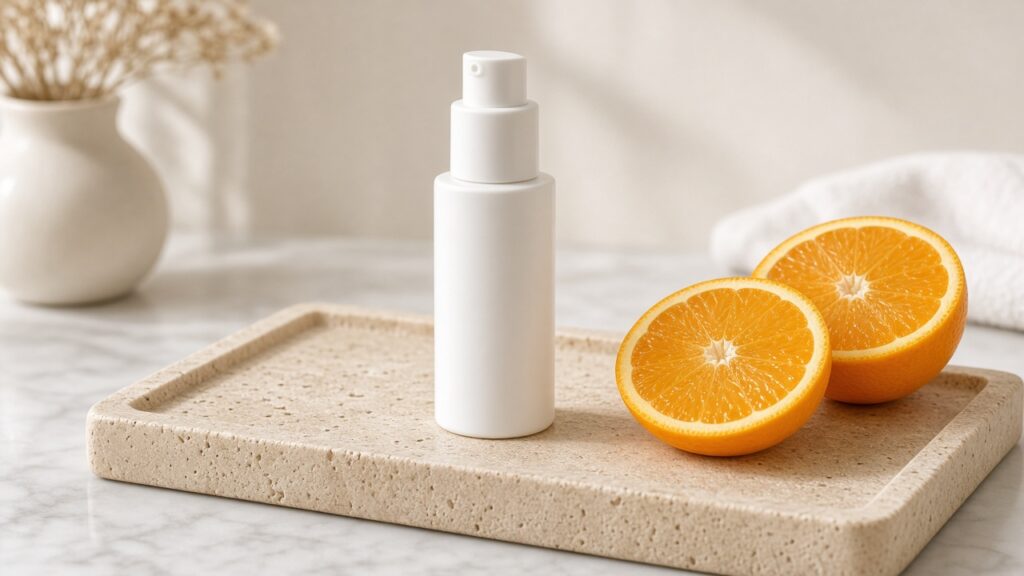
Most people say “acne scars” for anything a pimple leaves behind. Before you buy a vitamin C serum for acne scars, it helps to know that dermatologists split these into two very different groups.
Flat dark marks (post-inflammatory hyperpigmentation)
These are the brown, tan, or grayish spots that sit flat on the skin. They form when inflammation pushes your skin to make extra melanin, a process called post-inflammatory hyperpigmentation, or PIH.
A review in the Journal of Clinical and Aesthetic Dermatology notes that PIH is especially common and long-lasting in deeper skin tones. It’s also very treatable with patience. Want the full background? Our guide on what hyperpigmentation is covers the basics.
Textured scars (indented or raised)
These are the ice pick, boxcar, and rolling scars that change the actual surface of your skin. They happen when deep inflammation damages collagen and the skin heals unevenly.
The American Academy of Dermatology explains that these scars usually need in-office treatment such as lasers, fillers, or acne scar surgery. No serum, however good, can fill a pitted scar by itself.
So when we talk about a vitamin C serum for acne scars, we’re really talking about fading the flat marks and supporting overall skin quality. That’s where it shines.
How a Vitamin C Serum for Acne Scars Actually Works
Vitamin C isn’t magic. It works through a few well-understood pathways that happen to be exactly what post-acne skin needs.
It helps slow down excess pigment
Vitamin C interferes with tyrosinase, the enzyme your skin uses to make melanin. A dermatology review on topical vitamin C and the skin describes this as one of its main brightening actions.
Less melanin production means new dark marks are less intense. Existing ones also get a chance to fade as your skin naturally renews itself.
The AAD even lists vitamin C among the ingredients that can fade existing dark spots, alongside azelaic acid, retinoids, and others.
It supports collagen
Vitamin C is a key helper in collagen building. That same review explains that it’s needed for the enzymes that keep collagen stable.
That won’t erase a deep scar. Still, firmer, healthier-looking skin can make shallow texture look a little softer over time, especially in mature skin, where collagen naturally declines.
It calms oxidative stress
Inflamed, healing skin is under a lot of oxidative stress. As an antioxidant, vitamin C helps neutralize free radicals from sun and pollution that can keep marks darker for longer.
There’s also some early evidence for acne itself. In a randomized, double-blind trial, a 5% sodium ascorbyl phosphate lotion (another vitamin C derivative) improved acne compared with a vehicle lotion over 12 weeks. Fewer breakouts means fewer new marks to fade.
Why 3-O Ethyl Ascorbic Acid Is a Smart Pick for Post-Acne Skin
Not all vitamin C behaves the same way in a bottle. Classic L-ascorbic acid has the longest research history, but it’s famously unstable and usually needs a very acidic formula.
3-O Ethyl Ascorbic Acid is a stabilized form with a protective “ethyl” group on the part of the molecule that normally oxidizes. That makes it far steadier in a serum, and it can be formulated at a gentler pH, which matters when your skin is already inflamed from breakouts.
The brightening evidence looks encouraging, too. In lab research, a serum with 3-O-ethyl-l-ascorbic acid reduced melanin and supported collagen in reconstructed human skin models, with good tolerability.
Those were lab-grown skin models, not a long clinical trial on people, so we keep expectations realistic. But it’s a strong, sensible choice for a vitamin C serum for acne scars when you want brightening without the sting.
Why niacinamide makes a great partner
Niacinamide works on pigment from a different angle. A study in the British Journal of Dermatology found it reduced hyperpigmentation by suppressing melanosome transfer, the step where pigment moves into your surface skin cells.
Pairing the two in one formula is a well-matched team. We break down that duo in our article on niacinamide and vitamin C together.
7 Proven Tips for Using Vitamin C Serum for Acne Scars
The ingredient matters, but how you use it matters just as much. These seven habits make the biggest difference.
1. Use it every morning, consistently
Pigment fades with steady, daily support. Skipping days here and there slows everything down.
Apply your vitamin C serum for acne scars each morning after cleansing. Make it as automatic as brushing your teeth.
2. Never skip sunscreen
This is the big one. UV light darkens post-acne marks and can undo weeks of progress in a single sunny weekend.
The AAD recommends a broad-spectrum, SPF 30 or higher, water-resistant sunscreen. Your vitamin C serum for acne scars adds antioxidant backup underneath, but it’s never a replacement for SPF.
3. Hands off your breakouts
Picking and squeezing pushes inflammation deeper. More inflammation means a darker mark and a higher chance of a true scar.
Spot-treat instead, and let blemishes heal on their own schedule.
4. Apply to clean, dry skin
Pat your face fully dry after cleansing, then press in one pump of your vitamin C serum for acne scars. A second pump covers the jawline and neck, where adult breakouts love to show up.
5. Keep the rest of your routine gentle
Over-scrubbing irritates healing skin, and irritation can trigger more pigment. Skip harsh scrubs and keep strong exfoliating acids or retinol for evenings, a few nights a week.
6. Give it at least 8 to 12 weeks
Marks didn’t appear overnight, and they won’t vanish overnight either. Give your vitamin C serum for acne scars time to work, since many people start seeing a brighter, more even tone after a couple of months of daily use.
The AAD notes that a dark spot a few shades darker than your natural skin color usually fades within 6 to 12 months once the cause is stopped. A good routine helps you land on the faster end. Our vitamin C results timeline walks through what to expect week by week.
7. Take a monthly progress photo
Daily mirror checks fool you. Snap a photo in the same window light once a month and compare.
It’s surprisingly motivating to see a mark that was obvious in month one turn faint by month three.
A Simple Morning Routine for Fading Post-Acne Marks
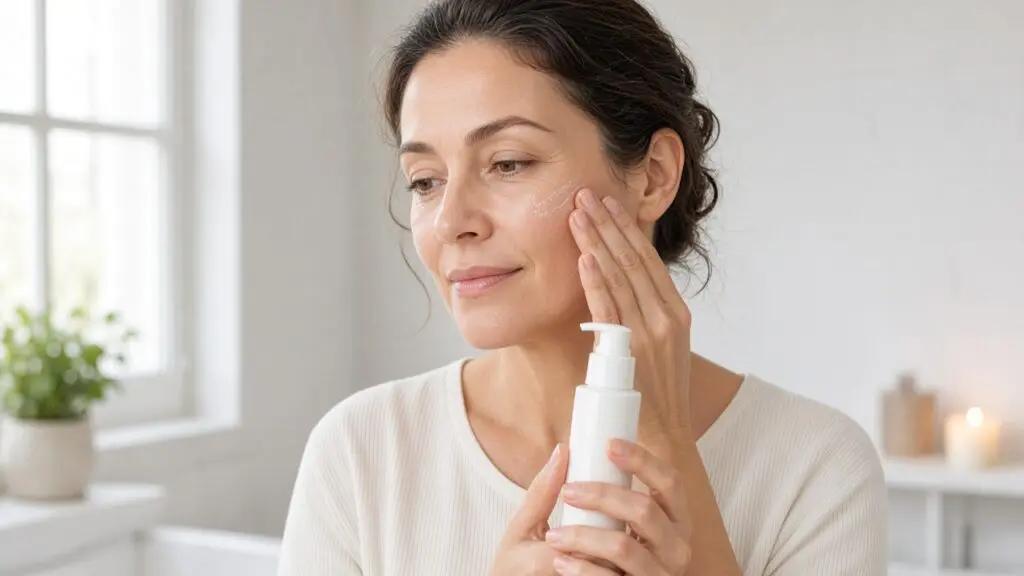
Here’s an easy, five-minute routine built around a vitamin C serum for acne scars. It works beautifully for mature skin that’s prone to the occasional hormonal breakout.
- Cleanse gently. Use lukewarm water and a mild, fragrance-free cleanser. Pat dry.
- Apply vitamin C. Press one or two pumps of your vitamin C serum for acne scars into your face and any marks along the jaw or neck.
- Moisturize. A light, non-comedogenic moisturizer keeps your barrier comfortable while marks fade.
- Protect. Finish with broad-spectrum SPF 30 or higher, every single day.
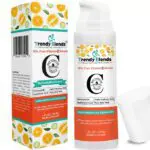
Our own Trendy Blends 18% Vitamin C Serum fits right into step two. It pairs 18% 3-O Ethyl Ascorbic Acid with niacinamide and hyaluronic acid, plus soothing aloe and cucumber.
It’s fragrance-free and comes in a 1 oz airless pump that keeps air out between uses. You can check every ingredient on our full ingredient list, no secrets.
When to See a Dermatologist About Acne Scars
A serum is a wonderful home base, but it has limits. Book a visit with a board-certified dermatologist if you notice any of these:
- Indented or raised scars that change your skin’s texture
- Marks that haven’t budged after three to four months of consistent care and sunscreen
- Active acne that keeps coming back and leaving new marks
- Dark patches that look blue-gray, which can mean the pigment sits deeper in the skin
A dermatologist can combine treatments, and your vitamin C serum for acne scars can keep supporting your skin between appointments.
FAQ: People Also Ask
Does vitamin C serum help acne scars?
Yes, a vitamin C serum for acne scars works well on flat dark marks. Vitamin C helps slow melanin production and supports collagen, so post-acne discoloration fades over time. It won’t fill in indented scars, which usually need professional treatment.
Which is better for acne scars, vitamin C or niacinamide?
You don’t have to choose. Vitamin C slows pigment production, while niacinamide reduces pigment transfer to the surface. Using both, often in one formula, covers more ground.
Can I use a vitamin C serum for acne scars on active acne?
Usually, yes. Gentle, stable forms like 3-O Ethyl Ascorbic Acid are generally well tolerated. Avoid heavy, pore-clogging layers on top, and patch test first if your skin is reactive.
How long does a vitamin C serum for acne scars take to work?
Most people notice a brighter, more even tone in about 8 to 12 weeks of daily use with sunscreen. Deeper or older marks can take several months.
Should I use vitamin C serum in the morning or at night?
Morning is ideal. Its antioxidant support pairs well with your sunscreen, and it keeps vitamin C separate from evening retinol or exfoliating acids.
Conclusion
A vitamin C serum for acne scars is a smart, gentle way to fade the flat marks breakouts leave behind. Pair it with daily sunscreen, hands-off healing, and a little patience.
For deep or textured scars, team up with a dermatologist and let your serum support your skin along the way. Clearer, brighter, more even skin really is possible, one blend at a time.
Ready to start? Try the Trendy Blends 18% Vitamin C Serum with 3-O Ethyl Ascorbic Acid, niacinamide, and hyaluronic acid, backed by our 60-day money-back guarantee.
Disclaimer
This article is for general education and isn’t medical advice. If you have active cystic acne, deep scarring, or any skin condition, talk with a board-certified dermatologist before starting new products. Results vary from person to person.
References
- Al-Niaimi F, Chiang NYZ. Topical vitamin C and the skin: mechanisms of action and clinical applications. J Clin Aesthet Dermatol. 2017;10(7):14-17.
- Davis EC, Callender VD. Postinflammatory hyperpigmentation: a review of the epidemiology, clinical features, and treatment options in skin of color. J Clin Aesthet Dermatol. 2010;3(7):20-31.
- The anti-ageing and whitening potential of a cosmetic serum containing 3-O-ethyl-l-ascorbic acid. Life (Basel). 2021;11(5):406.
- Hakozaki T, et al. The effect of niacinamide on reducing cutaneous pigmentation and suppression of melanosome transfer. Br J Dermatol. 2002;147(1):20-31.
- Woolery-Lloyd H, et al. Sodium L-ascorbyl-2-phosphate 5% lotion for the treatment of acne vulgaris: a randomized, double-blind, controlled trial. J Cosmet Dermatol. 2010;9(1):22-27.
- American Academy of Dermatology. Acne scars: Consultation and treatment.
- American Academy of Dermatology. How to fade dark spots in darker skin tones.
- American Academy of Dermatology. How to select a sunscreen.