
7 Pro Tips: How to Choose a Moisturizer for Combination Skin.
Table of Contents
Choosing a Moisturizer for Combination Skin.
Finding the perfect balance for your skin can often feel like walking a tightrope. One minute your cheeks feel tight and parched, and the next, your T-zone is shining bright enough to guide a ship. This is the classic struggle of combination skin, a common skin type that refuses to pick a side. It requires a nuanced approach that addresses both hydration and oil control simultaneously.
If you are wondering how to choose a moisturizer for combination skin?, you are certainly not alone in this journey. Many people find themselves layering multiple products just to keep their complexion happy. However, the right formula can simplify your routine and restore harmony to your face.
In this comprehensive guide, we will break down exactly what your skin needs. We will explore ingredients, textures, and application techniques that change the game. By the end, you will be an expert on balancing your unique complexion.
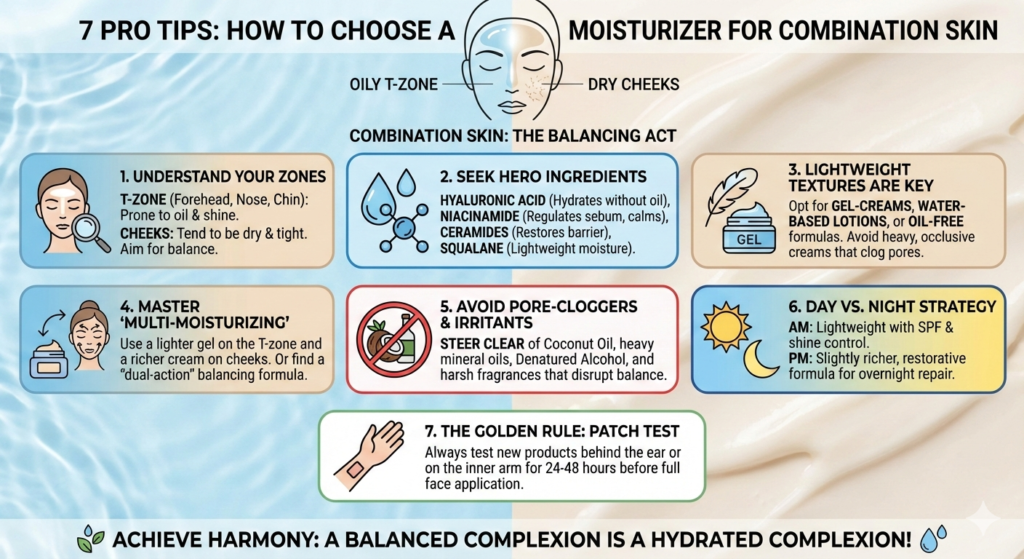
Understanding the Complexity of Combination Skin
7 Tips: How to Choose a Moisturizer for Combination Skin
Before diving into products, we must understand what we are working with. Combination skin is characterized by having two distinct skin types on your face at the same time. Typically, the forehead, nose, and chin (the T-zone) are oily due to a higher concentration of oil glands.
Meanwhile, the cheeks and jawline tend to be dry or normal. This duality makes it tricky because a product that works for your nose might clog your cheeks. Conversely, a rich cream for your cheeks might turn your forehead into an oil slick.
Identifying this skin type is the first step toward skin health. You might notice enlarged pores on your nose but flaky patches on your cheeks. Weather changes can also make these contrasts more extreme.
According to the American Academy of Dermatology, understanding your skin type is the foundation of any effective routine. Without this knowledge, you risk exacerbating your skin concerns. How to choose a moisturizer for combination skin? It starts with accepting that your skin has multiple personalities.
1. Look for Humectants over Heavy Occlusives
When dealing with oily zones, you want to avoid heavy, waxy ingredients that sit on top of the skin. These are known as occlusives, and while great for dry skin, they can be a nightmare for your T-zone. Instead, your best friends are humectants.
Humectants are ingredients that draw moisture from the air and pull it into your skin. They provide deep hydration without adding weight or grease. This makes them perfect for the “combination” puzzle we are trying to solve.
How to choose a moisturizer for combination skin? Prioritize formulas where the top ingredients include things like glycerin or hyaluronic acid. These bind water to the skin cells, plumping them up instantly.
Top Humectants to Spot
- Hyaluronic Acid: Holds up to 1000 times its weight in water.
- Glycerin: A classic, effective hydrator that is gentle on pores.
- Aloe Vera: Soothes inflammation while hydrating.
- Sodium PCA: A natural component of skin that binds moisture.
Pro Tips
- Apply humectant-rich moisturizers to damp skin to lock in extra water.
- Check the label to ensure these ingredients are near the top of the list.
- Avoid mineral oil if you are prone to breakouts in your T-zone.
2. The Magic of Niacinamide
If there is one ingredient that acts as a peacekeeper for combination skin, it is Niacinamide. Also known as Vitamin B3, this powerhouse ingredient does it all. It is famous for its ability to regulate oil production.
This means it stops your T-zone from producing excess sebum. At the same time, it strengthens the skin barrier, which helps your dry cheeks retain moisture. It effectively treats both problems without causing new ones.
We love adding Niacinamide to our formulations because it is generally well-tolerated by all skin types. It also helps reduce the appearance of enlarged pores, a common complaint for those with combination skin.
When asking how to choose a moisturizer for combination skin?, look for “Niacinamide” on the bottle. It is often paired with Zinc for an extra oil-controlling boost. Studies from sources like Healthline highlight its versatility in skincare.
Benefits of Niacinamide
- Reduces inflammation and redness.
- Regulates oil flow to prevent shine.
- Improves skin texture and smoothness.
- Brightens dull skin tone over time.
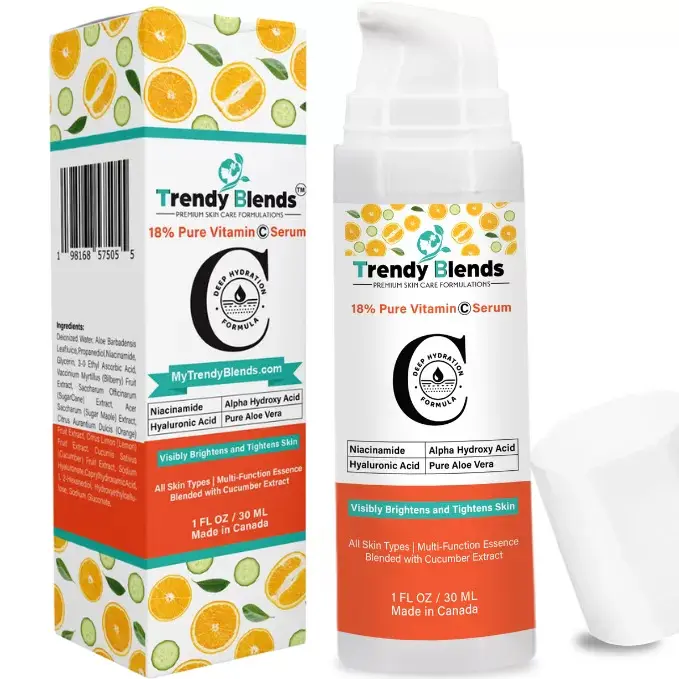
Weightless Hydration: Best Non-Comedogenic Gel Moisturizer.
Finally, a moisturizer that won’t clog pores! 🚫 Our oil-free niacinamide formula mattifies shine while locking in moisture. Perfect for humid weather and acne-prone skin.

3. Analyze the Texture: Gel, Lotion, or Cream?
Texture is just as important as the ingredient list. The weight of the product determines how it feels and absorbs into your skin. For combination skin, the “Goldilocks” texture is usually a lightweight lotion or a gel-cream.
Gel Moisturizers: These are water-based and often free of oils. They absorb instantly and leave a matte finish, making them ideal for summer or very oily days. They provide a burst of hydration without the heavy “cream” feeling.
Lotions: These are a step up in richness but still flow easily. They contain a balance of oil and water. They are excellent for daily use as they moisturize dry areas without suffocating oily ones.
Creams: Generally, these are too heavy for the T-zone. However, they can be used exclusively on the cheeks if they are very dry. How to choose a moisturizer for combination skin? You might need a “multi-texture” approach depending on the season.
Texture Pro Tips
- Summer: Switch to a gel moisturizer to combat humidity and sweat.
- Winter: Opt for a lightweight lotion to fight against artificial heating.
- Night: You can get away with a slightly richer texture while you sleep.
4. Seek Out “Non-Comedogenic” Labels
One of the biggest fears for people with combination skin is breaking out. The oily areas of your face are prone to clogged pores and blackheads. Therefore, avoiding pore-clogging ingredients is non-negotiable.
The term you are looking for is “non-comedogenic.” This means the product has been formulated and tested to ensure it does not block pores. While not a guarantee, it is a crucial safety net.
Many thick oils, such as coconut oil, can be highly comedogenic. If you apply these to your nose or chin, you might wake up with unwanted blemishes. Sticking to non-comedogenic formulas keeps your skin clear.
How to choose a moisturizer for combination skin? Always flip the bottle and look for that specific phrase. It is a small step that saves you from weeks of breakout recovery. Mayo Clinic experts often recommend this as a first step in acne prevention.
5. Ceramides for Barrier Repair
Your skin barrier is the shield that keeps bad stuff out and good stuff (moisture) in. When this barrier is damaged, your cheeks get flaky and your oil glands might actually overproduce oil to compensate. Ceramides are the glue that holds this barrier together.
Ceramides are lipids (fats) that occur naturally in the skin. Adding them back through a moisturizer helps repair the dry zones of your face effectively. They smooth out rough texture and reduce sensitivity.
Unlike heavy oils, ceramides can be formulated into lightweight lotions. This means you get the repair benefits without the grease. They are essential for long-term skin health and resilience.
Why Ceramides Matter
- They mimic the skin’s natural structure.
- They prevent Transepidermal Water Loss (TEWL).
- They help protect against environmental aggressors.
- They soothe irritated or red skin quickly.
6. The “Multi-Moisturizing” Technique
Sometimes, one product simply cannot do it all. If your T-zone is extremely oily and your cheeks are like the Sahara desert, you might need to zone your routine. This technique is often called “multi-moisturizing.”
How to choose a moisturizer for combination skin? In this case, you choose two. You apply a mattifying gel to your forehead, nose, and chin to control shine. Then, you apply a richer cream to your cheeks and neck.
This might sound high-maintenance, but it guarantees every inch of your face gets exactly what it needs. It prevents the common issue of one area suffering for the sake of the other.
Alternatively, you can use one lightweight moisturizer all over, and then layer a facial oil just on the dry cheeks. This allows you to customize a single product. It is a favorite tip among professional estheticians.
Pro Tips for Multi-Moisturizing
- Apply the lighter product first (usually the gel) all over.
- Dab the richer cream only where you feel tightness.
- Listen to your skin; some days you might not need the second layer.
- Be precise with application to avoid crossing zones.
7. Don’t Forget Sun Protection
We cannot talk about skin health without mentioning the sun. UV rays damage the skin barrier, worsening dryness and causing oily skin to thicken. A moisturizer with SPF is a great way to tackle two steps in one.
However, many sunscreens can feel greasy, which scares off those with an oily T-zone. The key is to find a “dry-touch” or oil-free moisturizer with broad-spectrum protection. These modern formulas disappear into the skin.
How to choose a moisturizer for combination skin? Look for chemical sunscreens or micronized mineral sunscreens (Zinc Oxide) that don’t leave a white cast or greasy film. Protection is vital for preventing premature aging and keeping your skin balanced.
The Skin Cancer Foundation recommends daily use of SPF 15 or higher. For combination skin, a matte-finish SPF moisturizer is often the holy grail.
Detailed Ingredient Breakdown
Let’s dig deeper into the specific ingredients you should look for and avoid. Knowledge is power when you are standing in the skincare aisle.
Best Ingredients for Combination Skin:
- Squalane: A bio-identical oil that is incredibly lightweight and non-clogging. It mimics your skin’s natural sebum, making it safe for oily zones.
- Lactic Acid: A gentle AHA that hydrates while it exfoliates. It keeps pores clear in the T-zone and smooths dry patches.
- Dimethicone: A silicone that creates a breathable barrier. It gives a silky feel and locks in moisture without feeling heavy.
- Panthenol (Vitamin B5): A soothing agent that heals the skin barrier. It reduces redness and is non-acnegenic.
Ingredients to Approach with Caution:
- Coconut Oil: Highly comedogenic and likely to cause breakouts in the T-zone.
- Cocoa Butter: Too rich for most combination skin types; save it for the body.
- High concentrations of Alcohol: SD Alcohol or Denatured Alcohol can strip the skin. This triggers more oil production as a rebound effect.
- Heavy Fragrances: Can irritate the dry, sensitive areas of your face.
The Role of pH Balance
Your skin has a natural pH level that is slightly acidic, around 5.5. When this balance is thrown off, your skin reacts. It might become too oily or too dry, exacerbating combination skin issues.
Cleansers that are too alkaline (like bar soap) strip the skin. Your moisturizer should help restore this pH balance. How to choose a moisturizer for combination skin? Look for “pH-balanced” on the packaging.
A balanced pH ensures your acid mantle remains intact. This mantle is what keeps bacteria out and moisture in. When your pH is optimized, your skin is better at regulating its own oil and hydration levels.
Seasonal Adjustments for Your Routine
Your skin is not static; it changes with the environment. In the winter, the air is dry and cold, sucking moisture from your cheeks. In the summer, humidity increases oil production.
Winter Strategy: During colder months, lean towards lotions with ceramides and perhaps a drop of squalane oil. You need to protect your cheeks from windburn and central heating. Do not be afraid to use a slightly heavier product at night.
Summer Strategy: When the heat hits, switch to oil-free gels or water creams. You want hydration that feels like a drink of water, not a blanket. You might find you only need moisturizer on your cheeks during the day.
Transition Seasons: Spring and Autumn are tricky. Stick to your balanced lotion and adjust the amount you apply. How to choose a moisturizer for combination skin? It is about flexibility and listening to your skin’s daily needs.
Application Techniques for Maximum Benefit
How you apply your moisturizer matters just as much as what you apply. Slapping it on haphazardly can lead to congestion.
The Dot Method: Dot the moisturizer on your forehead, cheeks, nose, and chin. Use more product on the cheeks and less on the T-zone. This ensures an even distribution tailored to each zone.
The Warm-Up: Warm the product between your fingers before applying. This helps it absorb faster and more evenly. It prevents the product from sitting on top of the skin and looking greasy.
Massage Upwards: Always massage in upward, circular motions. This boosts circulation and helps the ingredients penetrate. Be gentle around the delicate eye area.
Common Mistakes to Avoid
Even with the best products, mistakes can happen. Here are a few pitfalls to watch out for.
1. Over-washing the Face: Trying to scrub away the oil in your T-zone is a mistake. It strips the skin, leading to rebound oil production. Stick to a gentle, balanced cleanser.
2. Skipping Moisturizer Entirely: Some people think their oily T-zone means they don’t need moisture. This is false. Dehydrated skin produces more oil. You must hydrate to regulate oil.
3. Using Hot Water: Hot water strips natural oils, hurting your dry cheeks. Always wash with lukewarm water to maintain balance.
4. Ignoring Exfoliation: Dead skin cells can clog pores in the T-zone and make dry patches flaky. Use a gentle BHA (Salicylic Acid) exfoliant once or twice a week.
Lifestyle Factors That Affect Combination Skin
Your skin is a reflection of your internal health. Diet and lifestyle play a massive role in how your skin behaves.
Hydration: Drinking enough water is crucial. It hydrates your skin from the inside out. When you are well-hydrated, your oil glands don’t need to work as hard.
Diet: High-sugar and high-glycemic diets can trigger insulin spikes. These spikes can increase oil production. Eating a balanced diet rich in Omega-3s helps regulate skin health.
Stress: Stress releases cortisol, a hormone that pumps up oil production. Finding ways to manage stress, like yoga or meditation, can actually help your T-zone.
Why “Oil-Free” Isn’t Always the Answer
We often see “oil-free” plastered on products for combination skin. While helpful, it is not the only rule. Some plant oils are actually beneficial.
Oils like Jojoba, Squalane, and Grapeseed are low on the comedogenic scale. They can actually help dissolve the hardened sebum in your pores. They signal to your skin that it has enough oil, potentially slowing down your own production.
How to choose a moisturizer for combination skin? Don’t be afraid of all oils. Be afraid of heavy oils. Lightweight, dry oils can be a combination skin savior.
The Importance of Patch Testing
Before slathering a new product all over your face, you must patch test. Combination skin can be sensitive. What works for the masses might irritate you.
Apply a small amount of the new moisturizer behind your ear or on your inner arm. Wait 24 hours to see if there is any reaction. This is a crucial safety step.
If you are prone to acne, test it on a small area of your chin. This will tell you if the product is going to cause a breakout. Better a small spot than a full-face reaction.
Recommended Routine for Combination Skin
To bring it all together, here is a simple routine framework.
Morning:
- Cleanse: Use a gentle, foaming gel cleanser.
- Tone: Apply an alcohol-free toner to balance pH.
- Serum: Vitamin C or Niacinamide serum.
- Moisturize: Lightweight lotion or gel-cream.
- Protect: SPF 30+ sunscreen.
Evening:
- Cleanse: Double cleanse if wearing makeup.
- Exfoliate: BHA liquid (2-3 times a week).
- Serum: Hyaluronic acid or peptide serum.
- Moisturize: Barrier-repairing lotion with ceramides.
- Treat: Spot treat breakouts if necessary.
Conclusion
Navigating the world of skincare with combination skin does not have to be a battle. It is about understanding the unique duality of your face. By focusing on hydration without heaviness, you can find peace.
Remember to look for humectants like hyaluronic acid and regulators like niacinamide. Pay attention to textures, opting for gels and light lotions. And most importantly, listen to your skin’s changing needs.
How to choose a moisturizer for combination skin? It is a process of selection, testing, and balancing. But with these tips, you are well on your way to a healthy, glowing complexion.
Your skin is unique, and it deserves a routine that respects its complexity. We hope this guide helps you find that perfect bottle of moisture. Here is to good skin days, every day.
