
What Not to Mix With Vitamin C Serum: 10 Clear Combos
What not to mix with vitamin C serum is one of the most searched vitamin C questions, and it matters most when your shelf after 40 already holds retinol, acids and a rich night cream. It’s a smart question, because the wrong pairing can leave mature skin stinging.
Here’s the good news: we didn’t find a list of combinations that are truly dangerous. Most of the advice about what not to mix with vitamin C serum comes down to irritation, timing and doing too much at once.
We make a vitamin C serum, so we checked each point below against the American Academy of Dermatology (AAD), MedlinePlus (U.S. National Library of Medicine), the FDA and studies on PubMed.
Below: the short answer, why skin after 40 is less forgiving, 10 clear combos showing what not to mix with vitamin C serum (and what’s fine), a weekly plan and honest research notes.
Table of Contents
What Not to Mix With Vitamin C Serum: The Short Answer
If you only remember one thing about what not to mix with vitamin C serum, make it this: strong actives rarely need to share the same moment on your face. Give them their own time of day instead.
The AAD advises starting with one anti-aging product, because using several at the same time can irritate your skin. It adds that irritated skin makes signs of aging more noticeable, which is the opposite of what you want.
So most “don’t mix” rules are really “don’t stack” rules. Your serum can still live alongside retinol or an acid, just not in the same layer.
What “Mixing” Really Means
Mixing can mean blending, layering or using two products on the same day. A simple morning and night split solves most questions about what not to mix with vitamin C serum.
Why Skin After 40 Is Less Forgiving
MedlinePlus explains that aging skin becomes thinner and more fragile. It also notes that women gradually produce less oil beginning after menopause, which can make it harder to keep skin moist.
The AAD adds that skin becomes drier as we age. It also notes that some ingredients can irritate overly dry skin, so knowing what not to mix with vitamin C serum matters more in your 40s and 50s.
Does the Type of Vitamin C Matter?
It can. Many classic vitamin C studies used L-ascorbic acid. A 2001 pig-skin study found L-ascorbic acid had to be formulated at a pH below 3.5 to enter the skin, so effective L-ascorbic acid serums tend to be acidic.
Our serum uses 3-O Ethyl Ascorbic Acid, which researchers describe as a stable vitamin C derivative. The study of it we read was lab work on pig skin, so we still follow the same gentle pairing rules below.
L-ascorbic acid remains a well-studied, effective form. Formula details, not just the word “vitamin C,” shape how a serum behaves next to other actives.

10 Clear Combos: What Not to Mix With Vitamin C Serum (and What’s Fine)
Here’s our list of what not to mix with vitamin C serum, plus pairings you can relax about. Combos 1 to 8 need spacing; 9 and 10 are happy partners.
1. Glycolic and Lactic Acid: Space Them Out
Glycolic and lactic acid, both alpha hydroxy acids (AHAs), top most lists of what not to mix with vitamin C serum. The FDA reports that after four weeks of AHA use, volunteers’ sensitivity to UV reddening rose by 18 percent, and sensitivity to UV-induced cell damage doubled on average.
The effect faded within a week of stopping. Still, the AAD warns that using several actives at once can irritate skin, so don’t layer an AHA right on top of vitamin C.
Try vitamin C in the morning and your AHA on a few evenings a week, with sunscreen every day. Our guide to vitamin C and glycolic acid goes deeper.
2. Salicylic Acid: Choose a Different Time
Salicylic acid (a BHA) helps with clogged pores and breakouts. MedlinePlus notes it can make skin dry or irritated at first, and suggests applying it less often at the start.
Vitamin C isn’t on MedlinePlus’s list of products to avoid with salicylic acid. But if your skin is dry or sensitive, give each one its own time of day rather than layering them.
3. Retinol and Tretinoin: Split Morning and Night
Retinoids are another top answer to what not to mix with vitamin C serum, mainly because of timing. The AAD’s retinoid guide quotes dermatologists who advise starting every other night and using retinoids only at night, because they can make skin more sensitive to sun.
That makes the easiest plan vitamin C in the morning and your retinoid at night. If yours is prescription tretinoin, MedlinePlus says to avoid other topical medicines unless your doctor approves.
It also warns against products with a lot of alcohol, menthol, spices or lime while using tretinoin. Our serum has orange and lemon extracts, so ask your dermatologist. See pairing vitamin C serum with tretinoin.
4. Benzoyl Peroxide: Keep Them Apart
Benzoyl peroxide fights acne, and it belongs on any list of what not to mix with vitamin C serum at the same time. MedlinePlus advises avoiding anything that may irritate your skin while you use it, such as alcohol-containing products, and says it may bleach hair and colored fabrics.
The AAD notes it can make skin more sensitive or peel. Use vitamin C in the morning and benzoyl peroxide at night, or as your doctor directs.
5. Copper Peptides: Use Them at Different Times
A 1988 lab study found that ascorbate stayed stable in solution once trace “catalytic” metals were removed, which suggests trace metals such as copper can speed up vitamin C’s breakdown.
We found no study of copper peptide serums with vitamin C on human skin, so we’d play it safe: vitamin C in the morning, copper peptides at night.
6. Scrubs, Peel Pads and Gritty Tools: Not on the Same Day
The AAD’s exfoliation tips warn that exfoliating while using retinoids or benzoyl peroxide may worsen dry skin or even cause breakouts. It also says over-exfoliating can leave skin red and irritated.
For dry or sensitive skin, the AAD says scrubs may be too irritating. So they’re high on our list of what not to mix with vitamin C serum on the same day; moisturize instead.
7. Alcohol-Heavy Toners and Fragrance: Skip Them
For dry skin, the AAD recommends stopping products that contain alcohol or fragrance. It also points out that “unscented” isn’t the same as “fragrance-free,” since unscented products can contain chemicals that hide odors.
A stinging astringent is a clear case of what not to mix with vitamin C serum. Choose a gentle, fragrance-free cleanser and moisturizer instead.
8. A Second Vitamin C or Too Many New Actives: Go Slow
More isn’t always better. The AAD warns that some products contain active ingredients that can cause problems if you apply more than directed, and it suggests starting with one product at a time.
Doubling up on vitamin C is an easy example of what not to mix with vitamin C serum. Before adding anything new, the AAD suggests testing it on your inner arm twice daily for 7 to 10 days.
9. Niacinamide: Go Ahead
Here’s a myth we’re happy to retire. We found no AAD or MedlinePlus warning against pairing niacinamide with vitamin C, and many formulas combine them, including ours.
In a 2024 trial of 50 women with melasma, a product with 10% nicotinamide (niacinamide), 5% magnesium ascorbyl phosphate and 5% hyaluronic acid was safe and well tolerated over 60 days. It was a different product, and its results were numerically a little behind 4% hydroquinone.
Read more about niacinamide and vitamin C together.
10. Moisturizer, Vitamin E and Sunscreen: Great Partners
In a 2003 pig-skin study, 15% L-ascorbic acid plus 1% vitamin E protected skin from UV better than either alone, with a protection factor of about 4.
A 2005 follow-up found adding ferulic acid doubled that to about 8-fold, also in pig skin. That isn’t the same as SPF, so sunscreen still does the heavy lifting.
The AAD recommends daily moisturizer and a broad-spectrum, water-resistant SPF 30 or higher. So the best answer to what to mix with vitamin C serum is simple: moisturizer and sunscreen, every morning.
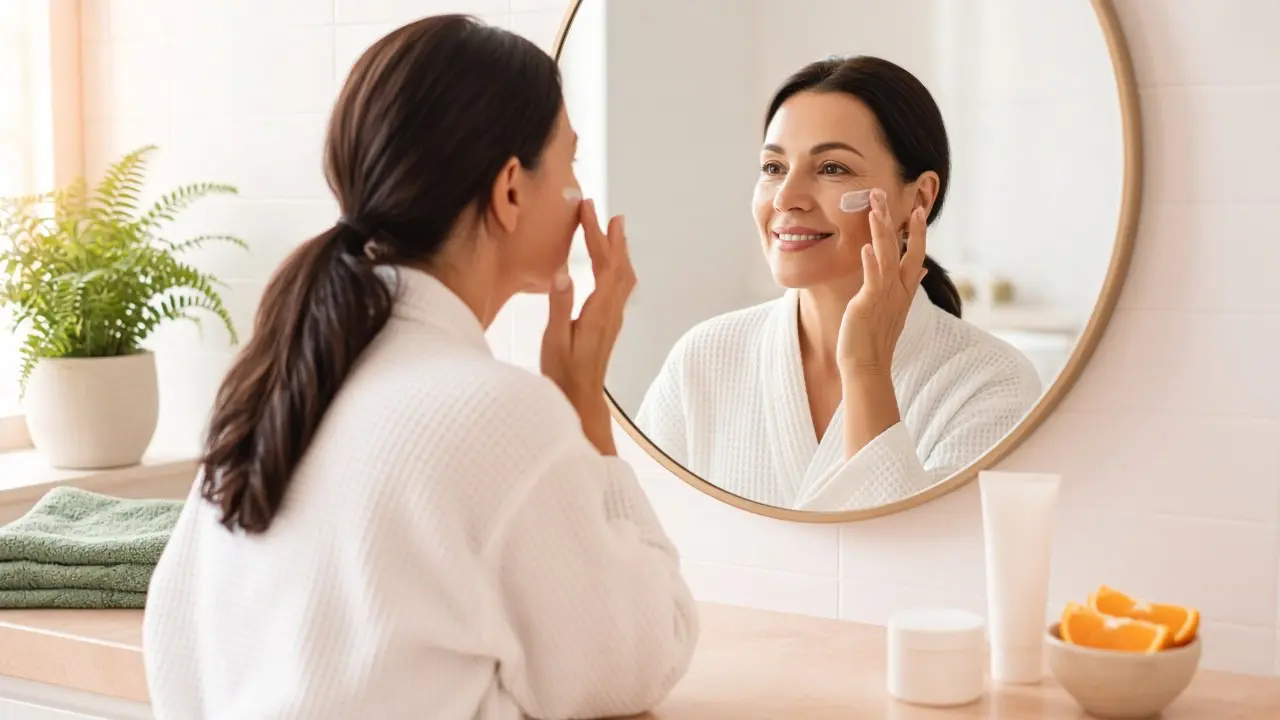
A Simple Week That Respects What Not to Mix With Vitamin C Serum
Every morning: gentle cleanser, 1–2 pumps of vitamin C serum, moisturizer, then SPF 30 or higher. That alone sidesteps most of what not to mix with vitamin C serum.
Most evenings: cleanser, your retinoid if you use one, then moisturizer. Start the retinoid every other night and build up slowly.
One or two other evenings: an AHA or BHA instead of the retinoid, never both. Keep copper peptides and benzoyl peroxide to evenings too.
If your skin feels tight or stings, take a few nights off actives and just moisturize.
When to Ask Your Dermatologist First
The AAD advises stopping a product that stings, burns or tingles, because those sensations mean it’s irritating your skin. If a dermatologist prescribed it, though, ask first, since some prescription products are expected to sting.
If dryness keeps coming back, a board-certified dermatologist can map out what not to mix with vitamin C serum for your routine.
Prescription Creams and What Not to Mix With Vitamin C Serum
On a prescription cream? The safest answer to what not to mix with vitamin C serum is the one your doctor gives you. MedlinePlus repeatedly advises telling your doctor and pharmacist about the medicines and vitamins you use.
What the Research Can and Can’t Tell Us
We found few studies testing these exact combos on human skin. Most advice about what not to mix with vitamin C serum rests on dermatologists’ irritation guidance.
The vitamin E and ferulic acid findings come from pig skin, the copper finding from a lab solution, and the niacinamide trial was small.
A 2017 review notes that vitamin C has antioxidant, anti-aging and antipigmentary effects, but that clinical studies of topical formulas remain limited. Still, a 2025 survey of 62 cosmetic dermatologists named vitamin C a go-to for fine lines, wrinkles and dark spots.
Where Trendy Blends Fits
Our Trendy Blends 18% Vitamin C Serum pairs 18% 3-O Ethyl Ascorbic Acid with niacinamide, hyaluronic acid, aloe and cucumber. It’s fragrance-free and comes in a 1 oz airless pump, so 1–2 pumps each morning is all you need.
It’s $24.99 with free shipping in 3–4 business days and our 60-Day Glow Guarantee with free returns. Patch test first, and remember what not to mix with vitamin C serum: keep retinoids and acids for the evening.
Frequently Asked Questions
What should you not mix with vitamin C serum?
When it comes to what not to mix with vitamin C serum, don’t layer it with strong acids, retinoids, benzoyl peroxide or copper peptides, and skip alcohol-heavy or fragranced products. Use actives at different times of day instead.
Can I use vitamin C serum and retinol together?
Yes, just not usually in the same layer. Use vitamin C in the morning and retinol at night, starting every other night, with sunscreen every day.
Can you use niacinamide with vitamin C serum?
Yes. We found no AAD or MedlinePlus warning against it, and many serums, including ours, combine the two. A 2024 trial found a niacinamide and vitamin C product was safe and well tolerated over 60 days.
Can I use vitamin C serum with glycolic or salicylic acid?
Yes, but space them out. Try vitamin C in the morning and the acid on a few evenings a week. AHAs can increase sun sensitivity, so wear sunscreen daily.
Can I use vitamin C serum with benzoyl peroxide?
Keep them apart. MedlinePlus advises avoiding anything that may irritate your skin while you use benzoyl peroxide. Vitamin C in the morning and benzoyl peroxide at night is a simple split.
Should vitamin C serum go before or after moisturizer?
Before. Apply 1–2 pumps to clean, dry skin, follow with moisturizer, then finish with SPF 30 or higher in the morning.
The Bottom Line
What not to mix with vitamin C serum is less about forbidden pairs and more about timing. Keep strong actives apart, skip harsh extras and let moisturizer and sunscreen be its daily partners.
Go slowly and patch test anything new. Bright, comfortable skin after 40 is worth a little patience, one gentle layer at a time.
Medical disclaimer: This article is for general education only and is not medical advice. Talk with a board-certified dermatologist or pharmacist before combining skin care with prescription medicines, especially if you’re pregnant or breastfeeding.
References
- AAD (American Academy of Dermatology). How to get the best results from anti-aging skin care products. https://www.aad.org/public/everyday-care/skin-care-secrets/anti-aging/maximize-anti-aging-products
- AAD (American Academy of Dermatology). How to safely exfoliate at home. https://www.aad.org/public/everyday-care/skin-care-secrets/routine/safely-exfoliate-at-home
- AAD (American Academy of Dermatology). Retinoid or retinol? https://www.aad.org/public/everyday-care/skin-care-secrets/anti-aging/retinoid-retinol
- AAD (American Academy of Dermatology). Skin care in your 40s and 50s. https://www.aad.org/public/everyday-care/skin-care-basics/care/skin-care-in-your-40s-and-50s
- AAD (American Academy of Dermatology). Dermatologists’ top tips for relieving dry skin. https://www.aad.org/public/everyday-care/skin-care-basics/dry/dermatologists-tips-relieve-dry-skin
- AAD (American Academy of Dermatology). How to test skin care products. https://www.aad.org/public/everyday-care/skin-care-secrets/prevent-skin-problems/test-skin-care-products
- MedlinePlus (U.S. National Library of Medicine). Aging changes in skin. https://medlineplus.gov/ency/article/004014.htm
- MedlinePlus (U.S. National Library of Medicine). Salicylic Acid Topical. https://medlineplus.gov/druginfo/meds/a607072.html
- MedlinePlus (U.S. National Library of Medicine). Tretinoin Topical. https://medlineplus.gov/druginfo/meds/a682437.html
- MedlinePlus (U.S. National Library of Medicine). Benzoyl Peroxide Topical. https://medlineplus.gov/druginfo/meds/a601026.html
- U.S. Food and Drug Administration. Alpha Hydroxy Acids. https://www.fda.gov/cosmetics/cosmetic-ingredients/alpha-hydroxy-acids
- Pinnell SR, Yang H, Omar M, et al. Topical L-ascorbic acid: percutaneous absorption studies. Dermatol Surg. 2001;27(2):137-42. PMID: 11207686.
- Lin JY, Selim MA, Shea CR, et al. UV photoprotection by combination topical antioxidants vitamin C and vitamin E. J Am Acad Dermatol. 2003;48(6):866-74. PMID: 12789176.
- Lin FH, Lin JY, Gupta RD, et al. Ferulic acid stabilizes a solution of vitamins C and E and doubles its photoprotection of skin. J Invest Dermatol. 2005;125(4):826-32. PMID: 16185284.
- Buettner GR. In the absence of catalytic metals ascorbate does not autoxidize at pH 7: ascorbate as a test for catalytic metals. J Biochem Biophys Methods. 1988;16(1):27-40. PMID: 3135299.
- Barbosa M, de Amorim RP, Cassiano D, et al. Efficacy and Safety of Nicotinamide 10%, Associated with Magnesium Ascorbyl Phosphate 5% and Hyaluronic Acid 5%, Compared to Hydroquinone 4% in Women with Facial Melasma: A Randomized, Double-Blind, Controlled Clinical Trial. Clin Cosmet Investig Dermatol. 2024;17:2215-2223. PMID: 39376788.
- Al-Niaimi F, Chiang NYZ. Topical Vitamin C and the Skin: Mechanisms of Action and Clinical Applications. J Clin Aesthet Dermatol. 2017;10(7):14-17. PMID: 29104718.
- Iliopoulos F, Sil BC, Moore DJ, et al. 3-O-ethyl-l-ascorbic acid: Characterisation and investigation of single solvent systems for delivery to the skin. Int J Pharm X. 2019;1:100025. PMID: 31517290.
- Alvarez GV, Kang BY, Richmond AM, et al. Skincare ingredients recommended by cosmetic dermatologists: A Delphi consensus study. J Am Acad Dermatol. 2025;93(6):1509-1525. PMID: 40233838.
