
Vitamin C Serum With Squalane: 6 Glowing Secrets
A vitamin C serum with squalane is one of the easiest pairings you can make for dry, thirsty skin over 40. Your serum handles the vitamin C, and a few beads of light oil on top help your face feel soft and comfortable.
Here’s the honest part first: our serum doesn’t contain squalane. So we read the research on PubMed, plus guidance from the American Academy of Dermatology (AAD), to see what squalane really is and what it can and can’t do next to vitamin C.
Below are six glowing secrets worth knowing, a simple step-by-step routine, and a few cautions, so your vitamin C serum with squalane routine feels as good as it looks.
Table of Contents
Vitamin C Serum With Squalane: The Quick Answer
Yes, you can use a vitamin C serum with squalane. Nothing we read suggests the two clash, and they do different jobs: the serum is your vitamin C step, while squalane is a lightweight emollient that softens and comforts.
Apply the water-based serum first, let it settle, then press on squalane. In the morning, sunscreen still goes on last.
Just keep expectations realistic. We found no study testing a vitamin C serum with squalane layered at home, so think of it as a comfort upgrade, not a proven results booster.
6 Glowing Secrets of Vitamin C Serum With Squalane
These are the details that make the biggest difference when you build a vitamin C serum with squalane routine. Most of them come down to one letter, one label and one order of steps.
Secret 1: Squalane and Squalene Aren’t the Same Thing
Squalene, with an “e,” is an oil your own skin makes. A 2009 review in Molecules puts it at about 13% of human sebum, and another review describes it as one of the distinctive lipids of human sebum.
Squalane, with an “a,” is the saturated version of squalene, made by adding hydrogen to it. That small change matters more than it sounds.
Squalene is polyunsaturated, with six double bonds, and a 2015 review describes ozone, long UVA rays and cigarette smoke as powerful oxidizers of it. Squalane has no double bonds left, and researchers describe it as stable.
Secret 2: Where Your Squalane Comes From Is on the Label
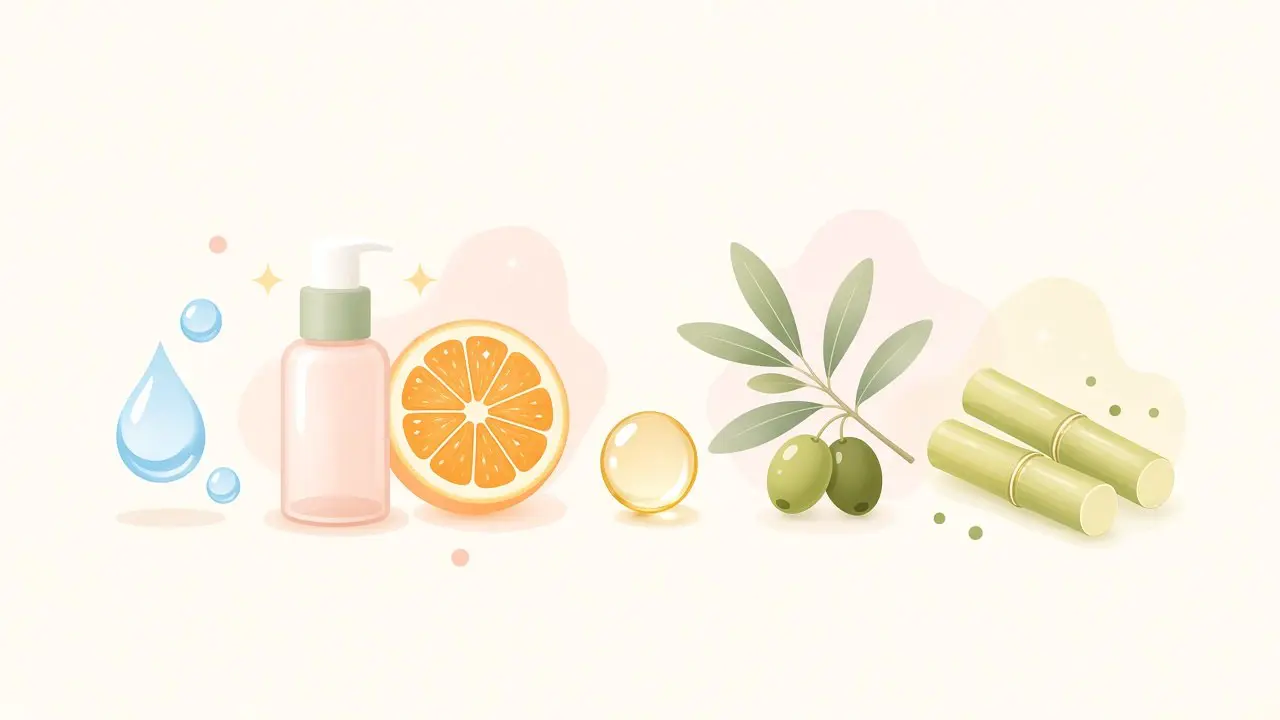
Squalene was named for shark liver oil, its richest source, but it also turns up in olive, palm, wheat-germ, amaranth and rice bran oils. A 2025 study explored a greener way to turn squalene from olive pomace, a leftover from olive oil production, into squalane.
A 2013 review in the Journal of Cosmetic Science argued that animal sources should be replaced with plant alternatives to protect biodiversity. Some brands now make squalane by fermenting sugarcane. If sourcing matters to you, look for “plant-derived,” “olive-derived” or “sugarcane-derived” on the box.
One label tip: our serum lists sugar cane extract, but that’s a plant extract, not squalane. If a product contains squalane, you’ll see the word “squalane” in its ingredient list.
Secret 3: Squalane Won’t Supercharge Your Vitamin C
You’ll see claims that squalane helps other actives sink in deeper. The studies we found behind that idea are lab work on formulated emulsions, not on a serum layered under an oil at home.
A 2025 lab study on pig ear skin found a squalane nanoemulsion delivered vitamin E better than coconut oil versions. A 2022 study on skin samples found squalane kept plant polyphenols in the skin longer, though it actually slowed how fast they passed through.
Neither tested vitamin C. So enjoy squalane for how it makes your skin feel, and let your vitamin C serum with squalane routine stand on what each product does on its own.
Some products skip the layering and dissolve an oil-soluble form of vitamin C, such as ascorbyl tetraisopalmitate, in squalane. That’s a different product type from a vitamin C serum with squalane layered on top.
If you already love one of those oils, you don’t need a second vitamin C step. Pick one vitamin C product you enjoy using every day, and keep the rest of your routine simple.
Secret 4: The Right Order for Vitamin C Serum With Squalane
Our serum uses 18% 3-O Ethyl Ascorbic Acid, a stable vitamin C derivative. In a 2019 lab study on pig skin, it measured as water-loving and reached the skin from simple solvents, including glycerin and 1,2-hexanediol, both in our formula.
Squalane, by contrast, is an oil. That’s why a vitamin C serum with squalane works best as two layers: the watery serum on clean skin first, the oil on top.
It also lines up with the AAD’s basic order: cleanse, apply treatments, then moisturizer and sunscreen. Putting a slippery oil on first may make your serum harder to spread evenly.
Secret 5: Your Skin’s Own Oil Changes After Menopause
A 1979 study of sebaceous glands found that in women, oil gland secretion decreases gradually after menopause. Since squalene is part of that oil, there’s simply less of your skin’s natural softener on the surface.
The AAD adds that in menopause, skin loses some ability to hold water and can get quite dry. That’s where a few beads of squalane after your serum can help dry, mature skin feel more comfortable.
That’s a comfort benefit, not a wrinkle cure. We didn’t find evidence that a vitamin C serum with squalane reverses lines, so we won’t promise it.
Secret 6: The Breakout Story Is Really About Oxidized Squalene
Some acne research focuses on oxidized squalene, the version made when skin oil meets UV light. In a rabbit-ear study, a UVA-made squalene peroxide clogged pores more than squalene itself, and a cell study linked squalene peroxides to inflammation.
A small 2023 pilot study also found more squalene, and some of its peroxide form, on acne-prone skin. Those findings are about your skin’s own oxidized oil, not about stable squalane in a bottle.
The Expert Panel for Cosmetic Ingredient Safety’s 2023 safety review confirmed squalane and squalene are safe as cosmetic ingredients as used. Still, if you get adult acne, the AAD advises choosing products labeled non-comedogenic or “won’t clog pores,” so check the label before you buy.
How to Layer Vitamin C Serum With Squalane, Step by Step
This is the simplest way to build a vitamin C serum with squalane routine from two separate products.
- Wash with a gentle cleanser and pat your skin dry.
- Smooth 1–2 pumps of vitamin C serum over your face and neck.
- Wait a minute or two, until it no longer feels wet.
- Warm a few beads of squalane between your fingertips and press them gently into your cheeks, forehead and neck.
- Follow with your usual moisturizer if your skin still feels tight.
- In the morning, finish with a broad-spectrum sunscreen with SPF 30 or higher.
At night, your vitamin C serum with squalane routine can stop after the oil or moisturizer. If your skin is very dry, the AAD suggests applying moisturizer while your skin is still slightly damp.
New to the routine? Start with squalane every other evening, then build up. The AAD says using several new anti-aging products at once can irritate skin, and most products take at least six weeks to work.
Love richer oils? Our vitamin C serum with rosehip oil guide follows the same order, and our vitamin C serum with vitamin E guide covers another popular add-on.
Why This Pairing Suits Skin Over 40
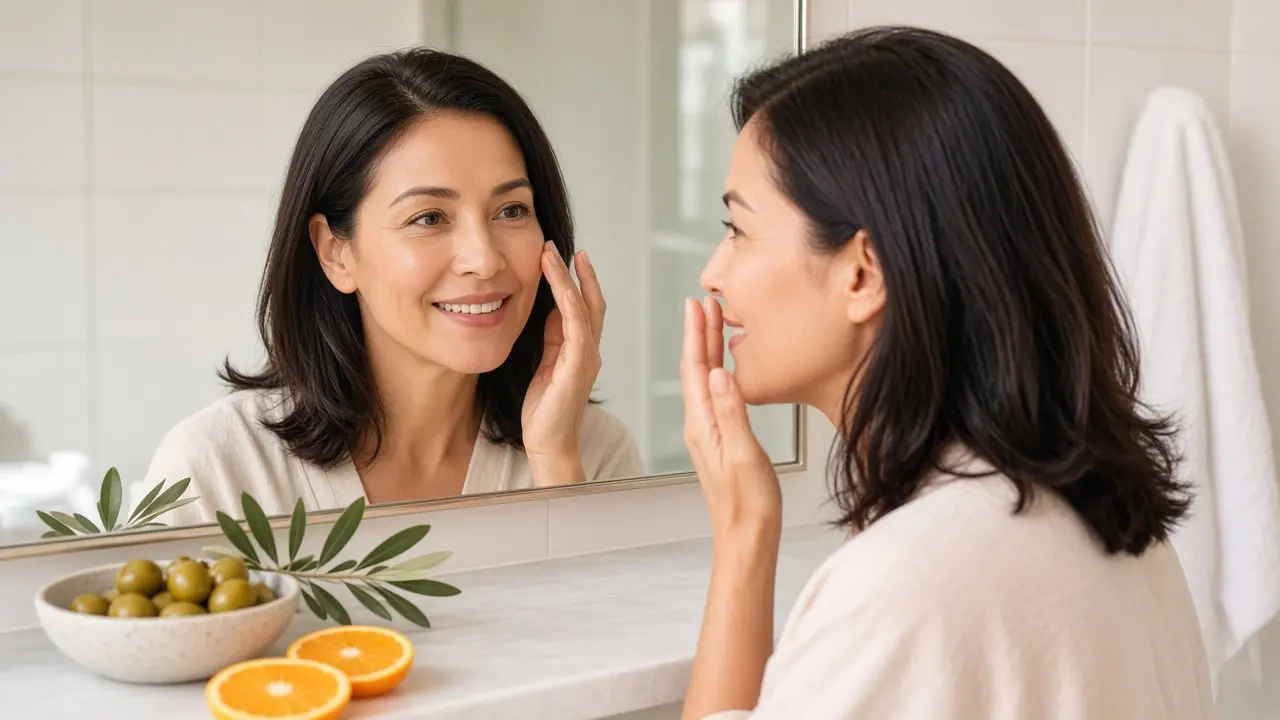
Skin’s needs shift after 40, and many of us want comfort without heaviness. Squalane is known for its light, silky feel, so it’s an easy step for anyone who finds heavier oils greasy. That makes a vitamin C serum with squalane a gentle way to add comfort without changing the rest of your routine.
In the morning, keep the squalane layer thin, which may help your sunscreen spread evenly on top. At night, you can be a little more generous, especially on dry cheeks and around the mouth.
The best vitamin C serum with squalane routine is the one you’ll actually stick with, so choose textures you enjoy and give them a fair six-week trial.
For more on tight, flaky winter skin, see our vitamin C serum for dry skin tips. If your skin is changing with age, our guide to vitamin C serum for mature skin has more ideas.
Who Should Be Careful
A vitamin C serum with squalane routine is generally gentle, but any new product can irritate someone. The AAD suggests testing it on a quarter-sized spot, such as the underside of your arm, twice daily for seven to 10 days.
Check with a board-certified dermatologist before starting a vitamin C serum with squalane routine if you:
- Have reacted to a facial oil or skin care product before
- Get frequent breakouts or have acne-prone skin
- Have rosacea, eczema or very reactive skin
- Use prescription retinoids or acne medicine
- Are healing from a laser treatment, peel or other procedure
Where Trendy Blends Fits
We make the Trendy Blends 18% Vitamin C Serum mentioned here. It’s our own product, sold on this site, not an affiliate recommendation.
Our Trendy Blends 18% Vitamin C Serum uses 3-O Ethyl Ascorbic Acid with niacinamide, hyaluronic acid, aloe and cucumber. It doesn’t contain squalane, so it’s a clean, water-based first layer if you’d like to build your own vitamin C serum with squalane routine.
It’s fragrance-free in a 1 oz airless pump, and 1–2 pumps covers your face. It’s $24.99 with free shipping in 3–4 business days, backed by our 60-Day Glow Guarantee with free returns.
Frequently Asked Questions
Can I use vitamin C serum with squalane?
Yes, for most people. Apply the serum to clean skin first, give it a minute or two, then press on a few beads of squalane. Patch test any new oil, especially if your skin is sensitive.
Should squalane go before or after vitamin C serum?
After. The serum is the thinner, water-based layer, so it goes on first. Squalane is an oil, so it works best on top, before moisturizer or sunscreen.
Can I mix squalane into my vitamin C serum?
We don’t recommend it. Adding anything to a finished formula can change how it performs, and oil and a water-based serum don’t blend well. Layer them instead.
Is squalane the same as squalene?
No. Squalene is an oil your skin makes, and it oxidizes easily. Squalane is its saturated, more stable form, made by adding hydrogen to squalene.
Does squalane clog pores?
Squalane itself isn’t the oxidized squalene linked to clogged pores in lab studies. Still, if you’re breakout-prone, choose a product labeled non-comedogenic and watch how your skin responds.
Is squalane good for skin over 40?
It can be a comfortable choice. Oil gland secretion tends to drop after menopause, and a light layer of squalane can help dry, mature skin feel softer. It isn’t a wrinkle treatment.
The Bottom Line
A vitamin C serum with squalane is a simple, comforting pairing for dry or mature skin, as long as you know what each one does. The serum brings the vitamin C, and squalane adds a light, stable layer of comfort.
Layer the serum first, the oil second, patch test anything new, and wear sunscreen every morning. That’s a vitamin C serum with squalane routine you can trust.
Medical disclaimer: This article is for general education only and is not medical advice. Talk with a board-certified dermatologist before starting new products if you have a skin condition, allergies, acne, or are recovering from a procedure.
References
- Huang ZR, Lin YK, Fang JY. Biological and pharmacological activities of squalene and related compounds: potential uses in cosmetic dermatology. Molecules. 2009;14(1):540-54. PMID: 19169201.
- Kim SK, Karadeniz F. Biological importance and applications of squalene and squalane. Adv Food Nutr Res. 2012;65:223-33. PMID: 22361190.
- Picardo M, Ottaviani M, Camera E, Mastrofrancesco A. Sebaceous gland lipids. Dermatoendocrinol. 2009;1(2):68-71. PMID: 20224686.
- Pham DM, Boussouira B, Moyal D, Nguyen QL. Oxidization of squalene, a human skin lipid: a new and reliable marker of environmental pollution studies. Int J Cosmet Sci. 2015;37(4):357-65. PMID: 25656265.
- Iovine T, Ehm C, Kaluarachchige Don UI, et al. Ir/Rh-catalyzed hydrogenation of squalene: access to stereoregular squalane. RSC Adv. 2026;16(47):61750-61756. PMID: 42707489.
- Wolosik K, Chalecka M, Gasiewska G, et al. The mechanism of protective action of plant-derived squalane (2,6,10,15,19,23-hexamethyltetracosane) against UVA radiation-induced apoptosis in human dermal fibroblasts. Antioxidants (Basel). 2025;14(7):853. PMID: 40722956.
- Wołosik K, Knaś M, Zalewska A, et al. The importance and perspective of plant-based squalene in cosmetology. J Cosmet Sci. 2013;64(1):59-66. PMID: 23449131.
- Cravotto C, Bucciol F, Mazzitelli JB, et al. From olive pomace to squalane: a green chemistry route using 2-methyltetrahydrofuran. ACS Omega. 2025;10(30):33426-33434. PMID: 40787365.
- de Souza AC, Sipoli CC, Samulewski RB, et al. Effect of squalane as a carrier in O/W nanoemulsions for dermal delivery of vitamin E. ACS Omega. 2025;10(49):60707-60722. PMID: 41427219.
- Oliveira ALS, Valente D, Moreira HR, et al. Effect of squalane-based emulsion on polyphenols skin penetration: ex vivo skin study. Colloids Surf B Biointerfaces. 2022;218:112779. PMID: 35994992.
- Iliopoulos F, Sil BC, Moore DJ, et al. 3-O-ethyl-l-ascorbic acid: Characterisation and investigation of single solvent systems for delivery to the skin. Int J Pharm X. 2019;1:100025. PMID: 31517290.
- Pochi PE, Strauss JS, Downing DT. Age-related changes in sebaceous gland activity. J Invest Dermatol. 1979;73(1):108-11. PMID: 448169.
- Chiba K, Yoshizawa K, Makino I, et al. Comedogenicity of squalene monohydroperoxide in the skin after topical application. J Toxicol Sci. 2000;25(2):77-83. PMID: 10845185.
- Ottaviani M, Alestas T, Flori E, et al. Peroxidated squalene induces the production of inflammatory mediators in HaCaT keratinocytes: a possible role in acne vulgaris. J Invest Dermatol. 2006;126(11):2430-7. PMID: 16778793.
- Condrò G, Sciortino R, Perugini P. Squalene peroxidation and biophysical parameters in acne-prone skin: a pilot “in vivo” study. Pharmaceuticals (Basel). 2023;16(12):1704. PMID: 38139830.
- Fiume M, Bergfeld WF, Belsito DV, et al. Squalane and squalene. Int J Toxicol. 2023;42(3_suppl):107S-109S. PMID: 37752766.
- AAD (American Academy of Dermatology). Adult acne. https://www.aad.org/public/diseases/acne/really-acne/adult-acne
- AAD (American Academy of Dermatology). Should I apply my skin care products in a certain order? https://www.aad.org/public/everyday-care/skin-care-basics/care/apply-skin-care-certain-order
- AAD (American Academy of Dermatology). How to test skin care products. https://www.aad.org/public/everyday-care/skin-care-secrets/prevent-skin-problems/test-skin-care-products
- AAD (American Academy of Dermatology). How to select a sunscreen. https://www.aad.org/public/everyday-care/sun-protection/shade-clothing-sunscreen/how-to-select-sunscreen
- AAD (American Academy of Dermatology). How to maximize results from anti-aging skin care products. https://www.aad.org/public/everyday-care/skin-care-secrets/anti-aging/maximize-anti-aging-products
- AAD (American Academy of Dermatology). Caring for your skin in menopause. https://www.aad.org/public/everyday-care/skin-care-secrets/anti-aging/skin-care-during-menopause
- AAD (American Academy of Dermatology). Dermatologists’ top tips for relieving dry skin. https://www.aad.org/public/everyday-care/skin-care-basics/dry/dermatologists-tips-relieve-dry-skin
