Vitamin C Serum for Seborrheic Keratosis: 4 Helpful Clues
A vitamin C serum for seborrheic keratosis won’t remove those waxy, stuck-on spots, but it can still earn a place in your routine for the sun-touched skin around them. Knowing the difference can save you money and worry.
If you’ve noticed a few raised brown spots on your chest, back or hairline after 40, you’re in very good company, and you may be wondering whether a vitamin C serum for seborrheic keratosis is worth a try.
We make a vitamin C serum, so before writing about a vitamin C serum for seborrheic keratosis, we read guidance from the American Academy of Dermatology (AAD), MedlinePlus and the research on PubMed.
Below: four helpful clues for spotting these growths, what vitamin C can and can’t do, and what dermatologists use instead.
Table of Contents
What Is a Seborrheic Keratosis?
The AAD describes seborrheic keratosis as a common, harmless skin growth. It can look worrying because it may resemble a wart, a precancerous growth called an actinic keratosis, or skin cancer.
The AAD says they’re often called the “barnacles of aging,” and most people get several.
MedlinePlus notes that the condition commonly appears after age 40 and tends to run in families. We touched on body spots in our guide to vitamin C serum for body skin.
Why They Show Up After 40
Age is the clearest pattern. In a 1997 Australian study of 100 adults, the share with seborrheic keratoses rose from 12% of 15- to 25-year-olds to 100% of those over 50.
A 2003 study of 303 Korean men aged 40 to 70 found them in 78.9% of 40-year-olds, 93.9% of 50-year-olds and 98.7% of men over 60. Lifetime sun exposure of more than 6 hours a day carried a 2.28-fold higher risk than under 3 hours.
The AAD says the cause is unknown. They run in families, the sun may play a role, and some people get them during pregnancy or after estrogen replacement therapy. They aren’t contagious.
4 Helpful Clues: Seborrheic Keratosis or Something Else?
These clues come from the AAD’s description of the signs. They’re worth knowing before you buy any vitamin C serum for seborrheic keratosis, but they can’t replace an exam.
Clue 1: It Looks Stuck On
The AAD says these growths tend to have a waxy, stuck-on-the-skin look. Some resemble dabs of warm, brown candle wax, while others look like stucco splattered on the skin.
Age spots are different. The AAD notes they appear where the sun often hits, such as your face and hands.
Clue 2: It Started Small and Slowly Thickened
They tend to start as small, rough bumps, then slowly thicken and develop a warty surface. Most are tan or brown, though they range from white to black, and they usually don’t hurt.
Clue 3: Where It Shows Up
They can form almost anywhere except the palms and soles. The AAD says you’ll most often see them on the chest, back, head or neck.
In dark skin, they tend to be small and appear around the eyes.
Clue 4: It Stays Pretty Much the Same
A typical seborrheic keratosis changes slowly. A spot that grows quickly, turns black, itches or bleeds needs a dermatologist’s eye, according to the AAD.
Lookalikes do happen. In a review of 9,204 lab samples sent with a clinical diagnosis that included seborrheic keratosis, 61 cases (0.66%) turned out to be melanoma.
That’s rare, but it’s why the AAD’s ABCDEs matter: asymmetry, an irregular border, varied color, a diameter usually larger than a pencil eraser, and evolving.
Can a Vitamin C Serum for Seborrheic Keratosis Help?
Not with the growths themselves. We searched PubMed for any study of a vitamin C serum for seborrheic keratosis, or of ascorbic acid on these growths, and found none.
A 2023 systematic review of topical treatments for these growths included 26 reports. Options with good-to-excellent responses included hydrogen peroxide, tazarotene, diclofenac and a urea-based solution. Vitamin C wasn’t among them.
Where a Vitamin C Serum for Seborrheic Keratosis Falls Short
A seborrheic keratosis is a raised growth of skin cells, not just extra pigment. So a vitamin C serum for seborrheic keratosis won’t flatten, shrink or lift one off.
There’s a safety reason, too. The AAD recommends seeing a dermatologist before treating age spots, because seborrheic keratoses, actinic keratoses and skin cancer all become more common with age.
If you use a spot-fading product on a skin cancer, the AAD warns, it can give the cancer time to grow and possibly spread. That’s why a vitamin C serum for seborrheic keratosis should never stand in for a skin check.
What Vitamin C Can Do for the Skin Around Your Spots
Here’s the hopeful part of a vitamin C serum for seborrheic keratosis care. The AAD lists vitamin C among the ingredients that can fade existing dark spots, alongside azelaic acid, glycolic acid, kojic acid and retinoids.
A 2017 review says vitamin C helps protect against sun-related aging, supports collagen and decreases melanin formation, though clinical studies remain limited.
A 2023 systematic review of seven studies with 139 volunteers found treated skin looked smoother and less wrinkled and measured lighter in pigment. Long-term use may be needed for noticeable changes.
Those studies were about sun-aged skin and melasma, not growths. So the real job of a vitamin C serum for seborrheic keratosis-prone skin is the uneven tone around them. Our guide to how vitamin C serum can help age spots goes deeper.
What About 3-O Ethyl Ascorbic Acid?
Our serum uses 3-O Ethyl Ascorbic Acid, a stable form of vitamin C. A 2021 lab study found it could pass through samples of human skin.
We didn’t find any studies of it on seborrheic keratoses, so we won’t claim our vitamin C serum for seborrheic keratosis-prone skin treats them. Think of it as a brightening, antioxidant step, not a spot remover.

What Actually Removes Seborrheic Keratoses
Because they’re harmless, the AAD says these growths most often don’t need treatment. A dermatologist may remove one if it looks like skin cancer, catches on clothing or jewelry, gets irritated easily or bothers you.
If a growth looks like skin cancer, it’s shaved or scraped off and checked under a microscope. Other options include cryosurgery, which freezes it with liquid nitrogen, and electrosurgery with curettage.
Creams and Solutions Studied So Far
The strongest topical evidence is for a 40% hydrogen peroxide solution. In two phase 3 trials with 937 patients, people treated with it had a mean of 47% and 54% of their growths clear or nearly clear, versus 10% and 5% with a placebo solution.
Facial growths responded best in a pooled analysis, with 65% clear or nearly clear versus 10% on placebo.
Tazarotene 0.1% cream improved growths in 7 of 15 people within 16 weeks in a small 2004 study, while one round of cryosurgery improved all the treated growths.
The 2023 review concluded there’s still a need for topical options that reliably match standard treatments like cryotherapy. Don’t try to remove one yourself, since the AAD warns of infection risk, and don’t expect a vitamin C serum for seborrheic keratosis to do it either.
A Gentle Routine With a Vitamin C Serum for Seborrheic Keratosis-Prone Skin
You can’t serum these growths away, but you can care for the skin around them.
Patch Test Before Anything New
Before you start any vitamin C serum for seborrheic keratosis care, the AAD suggests testing it on a quarter-sized spot, such as the underside of your arm, twice a day for 7 to 10 days.
Keep Your Morning Simple
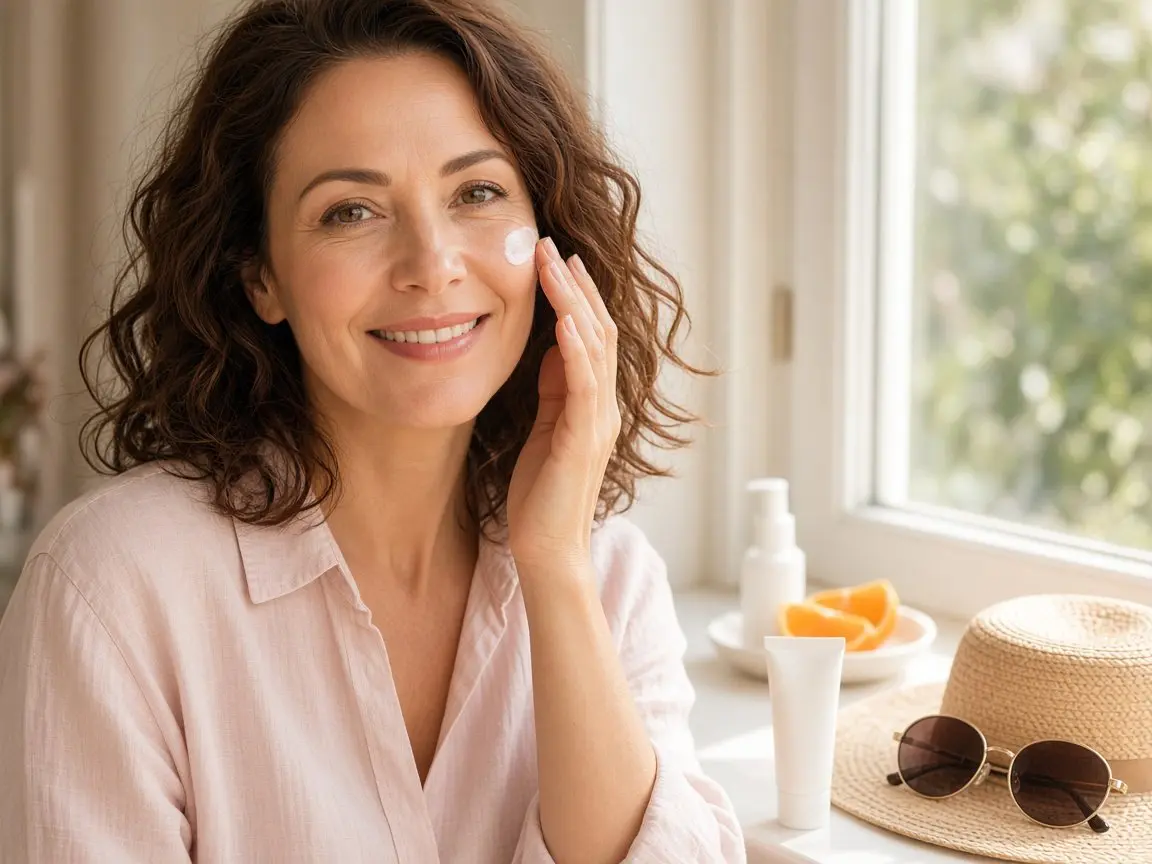
Cleanse gently, smooth 1–2 pumps of serum over your face and neck, then follow with moisturizer and sunscreen. A vitamin C serum for seborrheic keratosis-prone skin belongs in that routine, not on spot duty.
Skip harsh scrubbing and extra serum on raised spots. If one is irritated, itchy, bleeding or catching on clothing, have it checked.
Make Sun Protection Non-Negotiable
Studies link these growths with sun-exposed skin, and the AAD says age spots can return after treatment without sun protection. Pair your vitamin C serum for seborrheic keratosis care with sunscreen every morning.
The AAD recommends a broad-spectrum, water-resistant SPF 30 or higher, reapplied every two hours outdoors, plus shade and a wide-brimmed hat. Our guide to pairing vitamin C with your daily SPF covers the order.
Let Niacinamide Lend a Hand
In a 2002 study, a 5% niacinamide moisturizer reduced hyperpigmentation versus a plain one in 18 people after 4 weeks, and 2% niacinamide with sunscreen lightened tanned skin in a separate group.
Our serum contains niacinamide, though not at a stated percentage. Our post on niacinamide and vitamin C explains how the two get along.
Check Your Skin Regularly
The AAD recommends regular skin self-exams and a dermatologist visit if you notice anything new, changing, itching or bleeding. Your morning serum is a nice reminder to take a quick look.
When to See a Dermatologist
The AAD advises seeing a dermatologist if a growth grows quickly, turns black, itches or bleeds, or looks different from a typical one. Your vitamin C serum for seborrheic keratosis care can wait until that check.
Also go if many new growths appear suddenly, which is a possible sign of cancer inside the body. A dry, flat, rough, scaly spot could be an actinic keratosis, which can progress to skin cancer.
MedlinePlus adds that a lone growth with ragged borders and irregular color needs an exam.
Where Trendy Blends Fits
Our Trendy Blends 18% Vitamin C Serum uses 18% 3-O Ethyl Ascorbic Acid with niacinamide, hyaluronic acid, aloe and cucumber. It’s fragrance-free and comes in a 1 oz airless pump, so you just use 1–2 pumps.
It’s $24.99 with free shipping in 3–4 business days, plus our 60-Day Glow Guarantee with free returns. As a vitamin C serum for seborrheic keratosis-prone skin, it’s a brightening, hydrating step, not a treatment for the growths.
Frequently Asked Questions
Can a vitamin C serum for seborrheic keratosis remove the growths?
No. We didn’t find any studies showing vitamin C removes these growths, and a 2023 review of topical treatments didn’t list it. A dermatologist can remove them with freezing, scraping or other methods.
Is a vitamin C serum for seborrheic keratosis-prone skin safe?
No research covers this exact question, but nothing we read says to avoid vitamin C around these growths. Patch test first, skip extra serum on the growths, and have any spot that’s irritated, itchy or bleeding checked.
Why am I getting more seborrheic keratoses after 40?
Most people get them in middle age or later, and the number tends to increase with age. They also seem to run in families, and the sun may play a role.
Are seborrheic keratoses caused by the sun?
The sun may play a part. Studies have found more of them on sun-exposed skin, but the AAD notes they also appear on covered skin, so more research is needed.
How can I tell a seborrheic keratosis from an age spot?
Seborrheic keratoses tend to look waxy, raised and stuck on, sometimes with a warty surface. Age spots appear where the sun hits, like your face and hands, and a dermatologist can tell you which is which before you try a vitamin C serum for seborrheic keratosis.
Do seborrheic keratoses come back after removal?
Most removed growths don’t return, but new ones may appear elsewhere. The treated skin can be lighter afterward, which usually fades with time.
The Bottom Line
Seborrheic keratoses are common, harmless and a normal part of skin after 40. A vitamin C serum for seborrheic keratosis-prone skin may help the skin around them look brighter and more even, but it won’t remove the growths.
Use these clues as a guide, pair your vitamin C serum for seborrheic keratosis care with daily sunscreen, and let a dermatologist check anything new or changing.
Medical disclaimer: This article is for general education only and is not medical advice. Talk with a board-certified dermatologist before starting new products or treatments, especially if you’re pregnant, have a skin condition or use prescription medicines.
References
- Yeatman JM, Kilkenny M, Marks R. The prevalence of seborrhoeic keratoses in an Australian population: does exposure to sunlight play a part in their frequency? Br J Dermatol. 1997;137(3):411-4. PMID: 9349339.
- Kwon OS, Hwang EJ, Bae JH, et al. Seborrheic keratosis in the Korean males: causative role of sunlight. Photodermatol Photoimmunol Photomed. 2003;19(2):73-80. PMID: 12945806.
- Izikson L, Sober AJ, Mihm MC Jr, et al. Prevalence of melanoma clinically resembling seborrheic keratosis: analysis of 9204 cases. Arch Dermatol. 2002;138(12):1562-6. PMID: 12472343.
- Natarelli N, Krenitsky A, Hennessy K, et al. Efficacy and safety of topical treatments for seborrheic keratoses: a systematic review. J Dermatolog Treat. 2023;34(1):2133532. PMID: 36215682.
- Baumann LS, Blauvelt A, Draelos ZD, et al. Safety and efficacy of hydrogen peroxide topical solution, 40% (w/w), in patients with seborrheic keratoses: Results from 2 identical, randomized, double-blind, placebo-controlled, phase 3 studies (A-101-SEBK-301/302). J Am Acad Dermatol. 2018;79(5):869-877. PMID: 29864467.
- Smith SR, Xu S, Estes E, et al. Anatomic Site-Specific Treatment Response With 40% Hydrogen Peroxide (w/w) Topical Formulation for Raised Seborrheic Keratoses: Pooled Analysis of Data from Two Phase 3 Studies. J Drugs Dermatol. 2018;17(10):1092-1098. PMID: 30365590.
- Herron MD, Bowen AR, Krueger GG. Seborrheic keratoses: a study comparing the standard cryosurgery with topical calcipotriene, topical tazarotene, and topical imiquimod. Int J Dermatol. 2004;43(4):300-2. PMID: 15090020.
- Al-Niaimi F, Chiang NYZ. Topical Vitamin C and the Skin: Mechanisms of Action and Clinical Applications. J Clin Aesthet Dermatol. 2017;10(7):14-17. PMID: 29104718.
- Correia G, Magina S. Efficacy of topical vitamin C in melasma and photoaging: A systematic review. J Cosmet Dermatol. 2023;22(7):1938-1945. PMID: 37128827.
- Iliopoulos F, Chapman A, Lane ME. A comparison of the in vitro permeation of 3-O-ethyl-l-ascorbic acid in human skin and in a living skin equivalent (LabSkin). Int J Cosmet Sci. 2021;43(1):107-112. PMID: 33238056.
- Hakozaki T, Minwalla L, Zhuang J, et al. The effect of niacinamide on reducing cutaneous pigmentation and suppression of melanosome transfer. Br J Dermatol. 2002;147(1):20-31. PMID: 12100180.
- AAD (American Academy of Dermatology). Seborrheic keratoses: Overview. https://www.aad.org/public/diseases/a-z/seborrheic-keratoses-overview
- AAD (American Academy of Dermatology). Seborrheic keratoses: Signs and symptoms. https://www.aad.org/public/diseases/a-z/seborrheic-keratoses-symptoms
- AAD (American Academy of Dermatology). Seborrheic keratoses: Who gets and causes. https://www.aad.org/public/diseases/a-z/seborrheic-keratoses-causes
- AAD (American Academy of Dermatology). Seborrheic keratoses: Diagnosis and treatment. https://www.aad.org/public/diseases/a-z/seborrheic-keratoses-treatment
- AAD (American Academy of Dermatology). Seborrheic keratoses: Tips for managing. https://www.aad.org/public/diseases/a-z/seborrheic-keratoses-self-care
- AAD (American Academy of Dermatology). What can get rid of age spots? https://www.aad.org/public/cosmetic/age-spots-marks/get-rid-spots
- AAD (American Academy of Dermatology). How to fade dark spots in darker skin tones. https://www.aad.org/public/everyday-care/skin-care-secrets/routine/fade-dark-spots
- AAD (American Academy of Dermatology). What to look for: ABCDEs of melanoma. https://www.aad.org/public/diseases/skin-cancer/abcdes-melanoma
- AAD (American Academy of Dermatology). How to prevent skin cancer. https://www.aad.org/public/diseases/skin-cancer/how-to-prevent
- AAD (American Academy of Dermatology). How to test skin care products. https://www.aad.org/public/everyday-care/skin-care-secrets/prevent-skin-problems/test-skin-care-products
- MedlinePlus (U.S. National Library of Medicine). Seborrheic keratosis. https://medlineplus.gov/ency/article/000884.htm
