5 Powerful Ingredients in The Best Affordable Alternative to Expensive Vitamin C Serums.
Table of Contents
The Hunt for the Holy Grail of Glow.
We have all been there, standing in the skincare aisle or scrolling through social media. You see a tiny, amber bottle that promises to erase ten years from your face. It claims to banish dark spots and give you an ethereal glow.
Then, you look at the price tag. Your heart sinks when you see three digits staring back at you. Is glowing skin really reserved only for those with a luxury budget?
We are here to tell you that the answer is a resounding no. You do not need to take out a second mortgage to achieve radiant, healthy skin.
The secret lies in understanding ingredients, not brand names. The best affordable alternative to expensive Vitamin C Serums is out there, and it is likely more effective than you think.
In this guide, we will break down exactly how to find these hidden gems. We will expose the marketing myths that keep prices high. You will learn the science that proves price does not always equal quality.
Get ready to save money and save your skin.
Stop paying for the “brand name” and start paying for the results. 💸✨
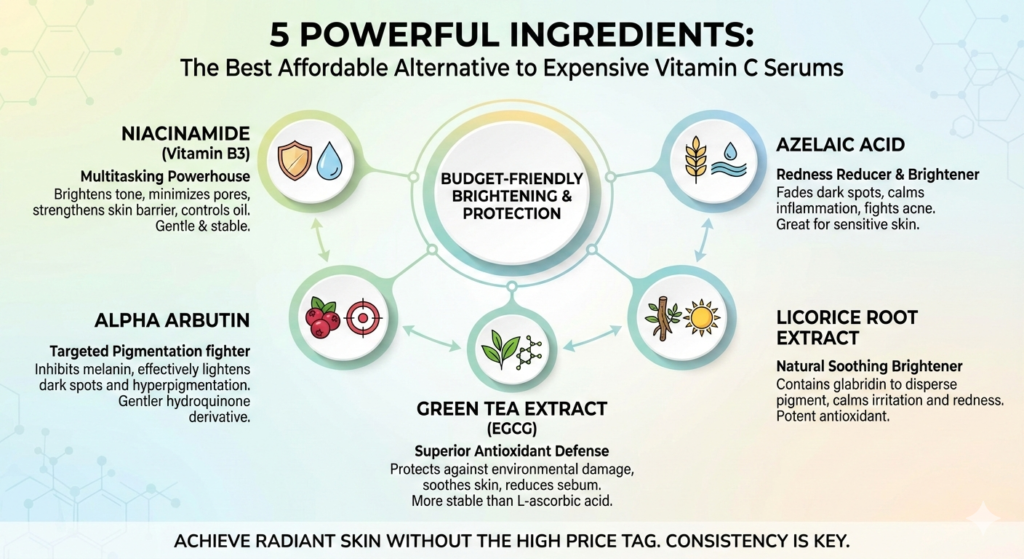
You don’t need to drop $150+ to get that glass-skin glow. We’ve deconstructed the most famous luxury Vitamin C serums to find an affordable alternative that actually rivals the icons. The secret isn’t the price tag—it’s these 5 powerhouse ingredients working in perfect harmony.
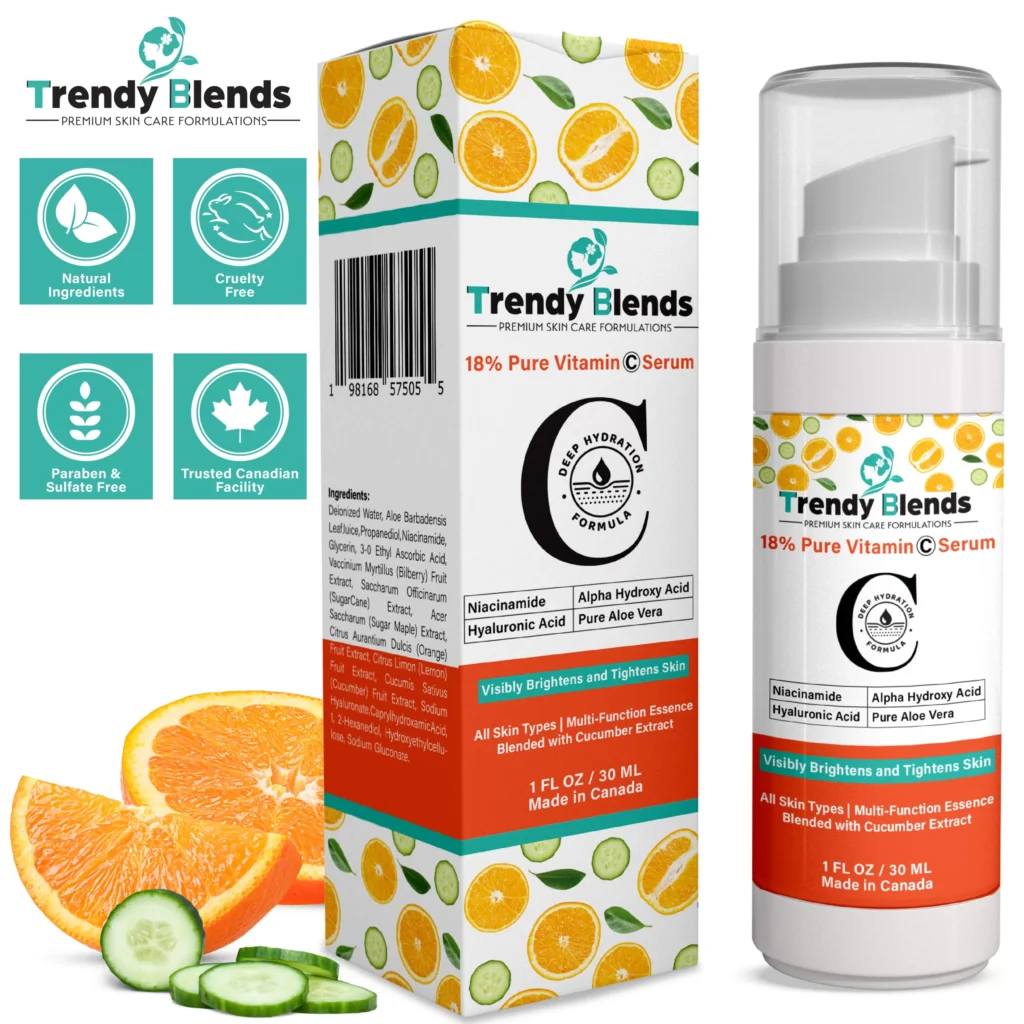
✨✨✨Trendy Blends Vitamin C Serum ✨✨✨

Why We Crave the Glow: The Science of Vitamin C
Before we dive into the alternatives, let’s talk about why Vitamin C is non-negotiable. It is not just a buzzword; it is a biological necessity for your skin. Vitamin C is a potent antioxidant that neutralizes free radicals.
Free radicals are unstable molecules generated by UV rays and pollution. They attack your healthy skin cells, leading to premature aging. Vitamin C steps in to sacrifice itself, protecting your collagen and elastin.
Speaking of collagen, Vitamin C is vital for its production. According to the Linus Pauling Institute, Vitamin C regulates the synthesis of collagen, which is the structural protein that keeps skin firm. Without it, our skin begins to sag and wrinkle.
It also inhibits melanin production. This means it can fade existing dark spots and prevent new ones from forming. It is truly a multitasker in your routine.
However, the human body does not produce Vitamin C on its own. We must get it from our diet or apply it topically. This is where a high-quality serum becomes essential.
But does that serum need to cost $180? Absolutely not.
The Price of Beauty: Why Are Some Serums So Expensive?
If the ingredients are essentially the same, why the massive price gap? The first culprit is often the patent. Years ago, a specific brand patented a highly effective formula of L-Ascorbic Acid, Vitamin E, and Ferulic Acid.
This combination stabilized the volatile Vitamin C and maximized absorption. Because they owned the “recipe,” they could charge a premium. They set the market standard for efficacy.
But patents expire, and science evolves. Today, many cosmetic chemists have figured out how to replicate or even improve these results.
The second reason for high prices is marketing and packaging. Luxury brands spend millions on celebrity endorsements and heavy glass bottles. You are often paying for the experience of the purchase, not just the liquid inside.
Finally, there is the “prestige” factor. In the psychology of pricing, we often assume expensive means better. Brands know this and price their products to signal exclusivity.
The best affordable alternative to expensive Vitamin C serums cuts out the fluff. They focus on the fluid in the bottle, using clinical-grade ingredients without the marketing markup.
The Best Affordable Alternative to Expensive Vitamin C Serums: What to Look For
So, how do you spot a winner on the drugstore shelf? You need to become an ingredient detective. The best affordable alternative to expensive Vitamin C serums will always tick a few specific boxes.
It is not enough for a bottle to just say “Vitamin C” on the label. You need to know the form, the concentration, and the supporting actors.
Here are the five critical factors you must verify before buying.
1. L-Ascorbic Acid: The Gold Standard
When looking for the best affordable alternative to expensive Vitamin C serums, check the ingredient list first. You want to see “L-Ascorbic Acid” (L-AA). This is the pure, most potent form of Vitamin C.
It is the form that has the most clinical data backing its effectiveness. It penetrates the skin barrier quickly and starts working immediately.
However, L-AA is notoriously unstable. It hates light, air, and heat. This is why the formulation matters so much more than the brand name.
Many affordable brands now formulate with 10% to 20% L-Ascorbic Acid. According to research cited by the National Institutes of Health, this is the sweet spot for efficacy without causing excessive irritation.
2. Ferulic Acid: The Stabilizer
This is the secret weapon. You should rarely buy an L-Ascorbic Acid serum that does not contain Ferulic Acid. Ferulic Acid is a plant-based antioxidant found in the cell walls of grains.
On its own, it fights free radicals. But its real magic happens when it meets Vitamin C. It stabilizes the Vitamin C molecule, preventing it from oxidizing (turning brown) too quickly.
Furthermore, it doubles the photoprotection of your serum. A famous study published in PubMed showed that combining Ferulic Acid with Vitamins C and E provides substantial protection against UV damage.
The best affordable alternative to expensive Vitamin C serums will almost always feature this ingredient. It turns a good serum into a great one.
3. Vitamin E (Tocopherol): The Partner
Vitamin C and Vitamin E are best friends. Vitamin C is water-soluble, meaning it works on the surface and inside the watery part of cells. Vitamin E is lipid-soluble, meaning it protects the oil-based cell membranes.
When they work together, they cover all bases. Vitamin E also helps to nourish and moisturize the skin. This counters some of the drying effects that potent Vitamin C can have.
Look for “Tocopherol” or “Tocopheryl Acetate” on the label. This trio—C, E, and Ferulic—is the powerhouse blend you want.
4. The Correct pH Level
This is the technical part that many brands hide. For L-Ascorbic Acid to penetrate the skin, it needs to be acidic. Specifically, the formula needs a pH below 3.5.
If the pH is too high, the molecule cannot get past the skin’s barrier. It will just sit on top of your face and do nothing.
Luxury brands tout their perfect pH balance as a reason for their high cost. But many affordable brands now disclose their pH levels or formulate specifically for this range.
The best affordable alternative to expensive Vitamin C serums will usually sit between a pH of 2.5 and 3.5. This ensures deep penetration and maximum results.
5. Airless and Opaque Packaging
Vitamin C is like a vampire; it hates the sun. Exposure to light breaks down the molecule, rendering it useless.
Never buy a Vitamin C serum in a clear glass bottle. By the time you get it home, it might already be ineffective.
The best affordable alternative to expensive Vitamin C serums often uses airless pumps. These mechanisms push the product up without letting air back in.
Opaque or dark amber glass is also acceptable. The goal is to keep the liquid as fresh as possible for as long as possible.
Top Categories for Affordable Alternatives
Not all skins are created equal. The best affordable alternative to expensive Vitamin C serums for you might differ from your friend’s choice. Here are the main categories of affordable options available today.
The “Clinical” Dupe
These are the direct competitors to the $180 bottles. They mimic the exact 15% L-Ascorbic Acid, 1% Vitamin E, and 0.5% Ferulic Acid ratio.
They are often found in “cosmeceutical” lines that prioritize function over fragrance. They smell a bit like hot dog water (a sign of raw Ferulic Acid), but they work.
These are best for people who want intense anti-aging results. They are perfect for resilient skin types.
The Gentle Derivative
If pure L-Ascorbic Acid stings your face, look for derivatives. Ingredients like Sodium Ascorbyl Phosphate or Magnesium Ascorbyl Phosphate are chemically altered to be stable and gentle.
They convert into pure Vitamin C once they hit your skin. The conversion rate isn’t 100%, so they are less potent, but they are much easier to tolerate.
These are the best affordable alternative to expensive Vitamin C serums for acne-prone or sensitive skin. Sodium Ascorbyl Phosphate, in particular, has antimicrobial properties that can help fight breakouts.
The Oil-Soluble Option
Tetrahexyldecyl (THD) Ascorbate is a rising star. It is an oil-soluble form of Vitamin C that penetrates deep into the dermis.
It is extremely stable and moisturizing. While raw materials for THD Ascorbate are pricey, many mid-range brands offer it at a fraction of the luxury cost.
This is ideal for dry or mature skin that needs extra nourishment. It feels silky, not sticky.
Pro Tips for Maximum Glow
Finding the best affordable alternative to expensive Vitamin C serums is only step one. You also need to use it correctly to see results. Here are our pro tips for application.
Layering Order Matters
Skincare should generally be applied from thinnest to thickest. Since most Vitamin C serums are watery or light gels, they go on first.
Cleanse your face, pat it dry, and apply your Vitamin C immediately. Let it absorb for about 60 seconds before moving on.
If you use a chemical exfoliator (like AHA or BHA), use that before the Vitamin C. However, be careful; this combo can be irritating for some.
The Sunscreen Synergy
Many people think you only use Vitamin C at night. Actually, the morning is the best time to use it.
While it is not a sunscreen, it boosts the efficacy of your SPF. The Skin Cancer Foundation notes that antioxidants provide a second line of defense against UV damage that penetrates your sunscreen.
Think of your Vitamin C serum as your safety net. If your sunscreen misses a spot, your antioxidant is there to catch the free radicals.
Watch for Oxidation
The color of your serum tells a story. When you first open it, it should be clear or very pale yellow.
If it turns dark orange or brown, it has oxidized. This means it has lost its potency and could potentially irritate your skin.
The best affordable alternative to expensive Vitamin C serums is one you can afford to replace often. Freshness is key.
The Fridge Hack
To extend the life of your affordable serum, keep it in the fridge. The cold temperature slows down the chemical reaction that causes oxidation.
Plus, applying a cold serum in the morning helps depuff tired eyes. It is a win-win for your routine.
Common Myths About “Cheap” Skincare
Let’s bust a few myths that keep people buying expensive products.
Myth 1: “Cheap ingredients are lower quality.” Most cosmetic labs source ingredients from the same global suppliers. The L-Ascorbic Acid in a $20 bottle often comes from the same place as the one in a $200 bottle.
Myth 2: “If it doesn’t tingle, it isn’t working.” Tingling is a sign of low pH, not necessarily efficacy. Many modern derivatives work beautifully without any stinging sensation. Irritation is actually a sign of inflammation, which is pro-aging.
Myth 3: “You need 20% concentration or higher.” More is not always better. Studies summarized by the Cleveland Clinic suggest that efficacy plateaus after 20%. Going higher increases irritation without offering more benefits. 10% to 15% is often plenty for most people.
Why Consistency is Key
The most important factor in skincare is consistency. You could have the most expensive serum in the world, but if you only use it once a week, it won’t work.
This is why the best affordable alternative to expensive Vitamin C serums is often the superior choice. Because it is affordable, you won’t ration it.
You will use the proper amount (about half a dropper) every single morning. You won’t feel guilty about bringing it down your neck and onto your chest.
Treating the décolletage is crucial, as this area shows age quickly. An affordable price point allows you to protect all your skin, not just your face.
Addressing Sensitive Skin Concerns
If you have rosacea or eczema, high-potency Vitamin C can be scary. The acidity can trigger flare-ups.
For you, the best affordable alternative to expensive Vitamin C serums is likely a “buffered” formula. Look for products that include soothing ingredients like Aloe Vera, Allantoin, or Centella Asiatica.
According to the American Academy of Dermatology, using products that irritate your skin can actually make signs of aging more noticeable. Always patch test a new serum behind your ear before applying it to your face.
The Verdict on Value
In the end, value is about results per dollar. If a $25 serum brightens your dark spots and smooths your texture, it has infinite value compared to a $180 serum that does the same thing.
The skincare industry has shifted. Transparency is the new luxury. Brands that list their percentages, pH levels, and sourcing are winning the hearts of educated consumers.
You have the power to choose. You can pay for the heavy glass bottle and the glossy magazine ad. Or, you can pay for the science inside the bottle.
Conclusion
The search for the best affordable alternative to expensive Vitamin C serums does not have to be difficult. By focusing on the “Golden Trio” of ingredients—L-Ascorbic Acid, Vitamin E, and Ferulic Acid—you can find clinical-grade results on a budget.
Remember to check the packaging, verify the pH, and store your bottle correctly. Use it every morning under your sunscreen for the ultimate protection against aging.
We believe that great skin should be accessible to everyone. You have the knowledge now to make a smart decision.
Don’t let the price tag fool you. Your glow is waiting, and it is more affordable than you think.
Whether you choose a potent pure acid or a gentle derivative, consistency will be your best friend. Start your journey to brighter skin today.
Check the labels. Trust the science. And enjoy the glow of a smart purchase.
For more deep dives into skin health, consider reading up on the mechanisms of topical antioxidants at JCAD Online or reviewing the latest dermatology advice from Harvard Health.
