
Vitamin C Serum With Aloe Vera: 3 Effortless Routines
A vitamin C serum with aloe vera is one of the gentlest pairings you can build on a bathroom shelf. Vitamin C brings the antioxidant, and aloe brings that cool, watery comfort many of us crave after 40.
Search for it, though, and you’ll find kitchen recipes, “miracle plant” promises and confusion about order. So we read the aloe reviews, small skin studies and NIH and AAD safety notes.
Below you’ll find what aloe can and can’t do, the aloe that’s already inside our serum, and three effortless routines for using vitamin C serum with aloe vera on mature skin.
Table of Contents
Vitamin C Serum With Aloe Vera: The Short Answer
Yes, you can use a vitamin C serum with aloe vera, and nothing we read suggests the two clash. We found no study testing them together, though, so think of them as teammates with different jobs, not a proven formula.
Your serum is the antioxidant step. A plain aloe gel is a light, watery layer that can make skin feel softer, and sunscreen still finishes every morning.
There’s a twist with ours. The Trendy Blends serum already lists aloe leaf juice in its formula, so a separate gel is optional, not required.

What Aloe Vera Can (and Can’t) Do for Your Skin
The clear gel inside an aloe leaf is about 99% water, according to a 2008 review in the Indian Journal of Dermatology. The rest includes sugars called glucomannans, plus amino acids, lipids, sterols and vitamins.
That same review says aloe’s sugars help bind moisture into skin. It also says controlled trials are still needed to show how well aloe really works.
Hydration: Small but Real
In a 2006 study of 20 women, formulas with 0.25% or 0.5% freeze-dried aloe extract raised skin hydration after one use on the forearm. After two weeks, all three aloe strengths tested, including 0.1%, did the same.
Water loss through the skin didn’t change, though, and the authors suggest aloe works mainly as a humectant. That’s why a vitamin C serum with aloe vera still needs a moisturizer on dry, mature skin to help hold that water in.
Calming Redness: Promising, With Limits
In a 2008 trial of 40 volunteers, a 97.5% aloe gel reduced UV-induced redness on test spots on the back after 48 hours. It beat 1% hydrocortisone in a gel base, but 1% hydrocortisone cream worked better than the aloe.
A 2005 study of 20 volunteers found a 70% aloe cream offered no protection from sunburn or tanning and didn’t treat sunburn better than placebo. So aloe isn’t a sunscreen, and it won’t shield you from a burn.
The AAD does suggest a moisturizer with aloe vera or soy to help soothe sunburned skin. If you’re nursing a burn, our vitamin C serum on sunburn guide explains why the serum can wait.
Burns and Wounds: Don’t Overclaim It
The burn evidence is mixed. A 2024 meta-analysis found aloe shortened second-degree burn healing by about 3.76 days versus other topicals, while a 2012 Cochrane review found no high-quality evidence for aloe on wounds, and in one surgical-wound trial it slowed healing.
So treat a burn, cut or blister with your doctor’s advice, not your face routine. For minor burns, the AAD recommends cool water and petroleum jelly.
Wrinkles: The Studies Were Mostly Oral
You may read that aloe “reduces wrinkles.” The best-known study, from 2009, gave 30 women over 45 aloe gel supplements by mouth for 90 days. Wrinkles improved, elasticity improved at the lower dose, and there was no placebo group.
That was a swallowed supplement, not gel on the face, so you can’t apply it to a vitamin C serum with aloe vera.
The Aloe Already Inside Our Serum
Our ingredient list includes aloe leaf juice and cucumber extract next to niacinamide, sodium hyaluronate (a form of hyaluronic acid) and 3-O Ethyl Ascorbic Acid. You can read every ingredient on our ingredient list.
US labeling rules list ingredients above 1% in descending order, with those at 1% or less following in any order. Aloe sits in the back half of ours, so think of it as a supporting ingredient, not a treatment dose.
We include aloe and cucumber for a soothing, comfortable feel. None of the studies here tested our serum, so we won’t promise how much calming you’ll notice.
Why the Vitamin C Form Matters Here
Our serum uses 3-O Ethyl Ascorbic Acid, a stable vitamin C derivative. A 2019 lab study on pig skin found it reached the skin from simple solvents, including glycerin and 1,2-hexanediol, both in our formula.
That study also measured it as water-loving, which may be part of why a watery aloe gel feels easy to layer over a vitamin C serum with aloe vera already in the formula.
L-ascorbic acid is a different story. A 2001 pig-skin study found it needs a pH below 3.5 to enter skin, a rule specific to that form.
3 Effortless Routines for Vitamin C Serum With Aloe Vera
Pick the vitamin C serum with aloe vera routine that matches how your skin feels today. Each one keeps the steps short, because the AAD notes that piling on too many anti-aging products can irritate skin and make signs of aging more noticeable.
Routine 1: The Serum-Only Morning
This is the easiest way to get a vitamin C serum with aloe vera, since the aloe is already in the bottle.
- Wash with a gentle cleanser and pat your skin dry.
- Smooth 1–2 pumps of serum over your face and neck.
- Wait a minute or two, until it no longer feels wet.
- Follow with a moisturizer, then a broad-spectrum sunscreen with SPF 30 or higher, as the AAD recommends.
Routine 2: Vitamin C Serum With Aloe Vera Gel on Top
Choose this vitamin C serum with aloe vera routine when your skin feels thirsty or a little warm. The AAD’s basic order is to cleanse, apply treatments, then moisturizer and sunscreen.
- Cleanse and pat dry.
- Apply 1–2 pumps of vitamin C serum and let it settle.
- Smooth a thin layer of plain, fragrance-free aloe gel over your cheeks and any tight spots.
- Seal it in with moisturizer, then finish with sunscreen in the morning.
Some people put aloe on first to cushion a tingly serum. We found no study comparing the two orders, so if your skin is happy, either is fine.
Routine 3: The Calm Evening Reset
Evenings suit a vitamin C serum with aloe vera, since there’s no makeup or sunscreen to pill.
- Cleanse gently and pat dry.
- Apply your serum, or keep it to mornings if your skin feels sensitive.
- Press on a thin layer of aloe gel.
- Finish with a fragrance-free moisturizer while skin is still slightly damp, as the AAD suggests for dry skin.
If your skin is easily flushed, our vitamin C serum with centella guide covers another soothing partner.
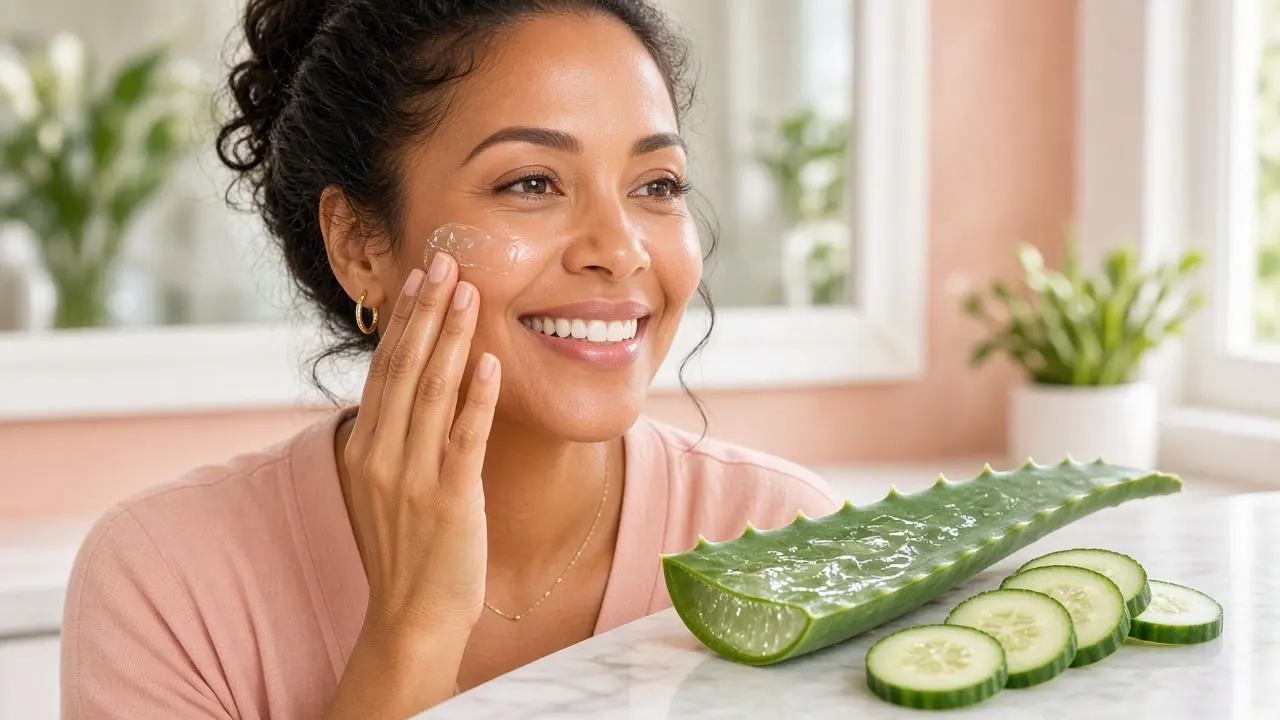
Skip the DIY Vitamin C Serum With Aloe Vera
Homemade recipes fill Google’s suggestions for this topic, often crushed vitamin C tablets or orange peel stirred into aloe gel.
We’d skip it. The 2019 study notes that pure vitamin C is unstable and oxidizes readily in air, and the 2001 study shows L-ascorbic acid needs a carefully controlled low pH to reach skin.
A kitchen mix is unlikely to control either, and it has no preservative. Your homemade vitamin C serum with aloe vera may simply oxidize before it does much.
Fresh leaves have their own risk. Doctors reported a case of allergic contact dermatitis in a woman who used homemade aloe juice on her legs; the rash later reached her eyelids.
The 2008 review explains that the leaf’s yellow latex layer holds anthraquinones such as aloin, which are behind most aloe allergies. The case authors note that most manufacturers process aloe to avoid its irritant parts, probably why such reactions are rare.
How to Choose an Aloe Gel for Your Face
Look for a short ingredient list and the words “fragrance-free.” The AAD cautions that products labeled “unscented” or made with plant botanicals may still contain fragrance-related ingredients.
Skip gels with added color, and keep the bright green after-sun tubes for your body. With a vitamin C serum with aloe vera on your face, the plainer the gel, the better.
Who Should Be Careful
The NIH’s National Center for Complementary and Integrative Health says topical aloe gel is generally well tolerated. It also notes occasional reports of burning, itching, rash and eczema.
Natural doesn’t mean reaction-free. In a 2009 survey of 400 dermatology patients, 241 used herbal skin products such as aloe, marigold and chamomile, and 15 of those reported a skin reaction.
The 2008 review says aloe should be avoided if you’re allergic to plants in the lily family. Patch test first: the AAD suggests applying a product to a quarter-sized spot twice daily for seven to 10 days, such as your inner arm.
Check with a board-certified dermatologist before starting a vitamin C serum with aloe vera routine if you:
- Have rosacea, eczema, or very reactive skin
- Use prescription retinoids, steroid creams or acne medicine
- Are healing from a laser treatment, peel, or other procedure
- Have a burn, open wound, or blistered skin
- Have reacted to aloe, lily-family plants or fragrance before
For more ways to care for changing skin, see our tips on vitamin C serum for mature skin.
Where Trendy Blends Fits
We make the Trendy Blends 18% Vitamin C Serum mentioned here. It’s our own product, sold on this site, not an affiliate recommendation.
Our Trendy Blends 18% Vitamin C Serum uses 3-O Ethyl Ascorbic Acid with niacinamide, hyaluronic acid, aloe leaf juice and cucumber. It’s a ready-made vitamin C serum with aloe vera, and you can add a separate gel if you like.
It’s fragrance-free in a 1 oz airless pump, and 1–2 pumps covers your face. It’s $24.99 with free shipping in 3–4 business days, backed by our 60-Day Glow Guarantee with free returns.
Frequently Asked Questions
Can I use vitamin C serum with aloe vera gel every day?
Many people can, once a patch test shows no reaction. Use the serum daily, add a thin layer of plain aloe gel when your skin feels dry or warm, and wear sunscreen every morning.
Should aloe vera gel go before or after vitamin C serum?
We’d put it after. Apply the serum to clean, dry skin, let it settle for a minute or two, then smooth on the gel and your moisturizer. No study has compared the two orders.
Can I mix aloe vera gel and vitamin C serum in my hand?
We’d layer them instead. Mixing in your palm thins the serum and can make it harder to spread evenly, so apply them one after the other.
Is homemade vitamin C serum with aloe vera safe?
We don’t recommend it. Pure vitamin C oxidizes readily, kitchen mixes have no preservative, and homemade aloe juice has been linked to allergic contact dermatitis in a published case.
Can I leave aloe vera gel and vitamin C serum on overnight?
Yes, both are leave-on steps. At night, apply the serum, then aloe gel, then a fragrance-free moisturizer, and rinse in the morning before your sunscreen routine.
Is aloe vera good for skin over 40?
It can be a nice comfort step. Small studies show aloe can raise skin hydration and calm UV redness, but the best-known wrinkle study used an oral supplement, so a vitamin C serum with aloe vera isn’t a proven anti-aging treatment.
The Bottom Line
A vitamin C serum with aloe vera is a soft, sensible pairing for skin after 40, as long as you keep expectations honest. The serum brings the vitamin C, and aloe adds a light drink of water.
Keep the gel plain, patch test first, and wear sunscreen every morning. That’s a vitamin C serum with aloe vera routine simple enough to stick with.
Medical disclaimer: This article is for general education only and is not medical advice. Talk with a board-certified dermatologist before starting new products if you have a skin condition, allergies, a burn or wound, or are recovering from a procedure.
References
- Surjushe A, Vasani R, Saple DG. Aloe vera: a short review. Indian J Dermatol. 2008;53(4):163-6. PMID: 19882025.
- Dal’Belo SE, Gaspar LR, Maia Campos PM. Moisturizing effect of cosmetic formulations containing Aloe vera extract in different concentrations assessed by skin bioengineering techniques. Skin Res Technol. 2006;12(4):241-6. PMID: 17026654.
- Reuter J, Jocher A, Stump J, et al. Investigation of the anti-inflammatory potential of Aloe vera gel (97.5%) in the ultraviolet erythema test. Skin Pharmacol Physiol. 2008;21(2):106-10. PMID: 18253066.
- Puvabanditsin P, Vongtongsri R. Efficacy of aloe vera cream in prevention and treatment of sunburn and suntan. J Med Assoc Thai. 2005;88 Suppl 4:S173-6. PMID: 16623024.
- Huang YN, Chen KC, Wang JH, Lin YK. Effects of Aloe vera on Burn Injuries: A Systematic Review and Meta-Analysis of Randomized Controlled Trials. J Burn Care Res. 2024;45(6):1536-1545. PMID: 38605441.
- Dat AD, Poon F, Pham KB, Doust J. Aloe vera for treating acute and chronic wounds. Cochrane Database Syst Rev. 2012;(2):CD008762. PMID: 22336851.
- Cho S, Lee S, Lee MJ, et al. Dietary Aloe Vera Supplementation Improves Facial Wrinkles and Elasticity and It Increases the Type I Procollagen Gene Expression in Human Skin in vivo. Ann Dermatol. 2009;21(1):6-11. PMID: 20548848.
- Iliopoulos F, Sil BC, Moore DJ, et al. 3-O-ethyl-l-ascorbic acid: Characterisation and investigation of single solvent systems for delivery to the skin. Int J Pharm X. 2019;1:100025. PMID: 31517290.
- Pinnell SR, Yang H, Omar M, et al. Topical L-ascorbic acid: percutaneous absorption studies. Dermatol Surg. 2001;27(2):137-42. PMID: 11207686.
- Ferreira M, Teixeira M, Silva E, Selores M. Allergic contact dermatitis to Aloe vera. Contact Dermatitis. 2007;57(4):278-9. PMID: 17868225.
- Corazza M, Borghi A, Lauriola MM, Virgili A. Use of topical herbal remedies and cosmetics: a questionnaire-based investigation in dermatology out-patients. J Eur Acad Dermatol Venereol. 2009;23(11):1298-303. PMID: 19486228.
- NIH National Center for Complementary and Integrative Health. Aloe Vera: Usefulness and Safety. https://www.nccih.nih.gov/health/aloe-vera
- US Food and Drug Administration. Cosmetics Labeling Guide. https://www.fda.gov/cosmetics/cosmetics-labeling-regulations/cosmetics-labeling-guide
- AAD (American Academy of Dermatology). How to treat sunburn. https://www.aad.org/public/everyday-care/injured-skin/burns/treat-sunburn
- AAD (American Academy of Dermatology). How to treat a first-degree, minor burn. https://www.aad.org/public/everyday-care/injured-skin/burns/treat-minor-burns
- AAD (American Academy of Dermatology). Should I apply my skin care products in a certain order? https://www.aad.org/public/everyday-care/skin-care-basics/care/apply-skin-care-certain-order
- AAD (American Academy of Dermatology). How to test skin care products. https://www.aad.org/public/everyday-care/skin-care-secrets/prevent-skin-problems/test-skin-care-products
- AAD (American Academy of Dermatology). How to select a sunscreen. https://www.aad.org/public/everyday-care/sun-protection/shade-clothing-sunscreen/how-to-select-sunscreen
- AAD (American Academy of Dermatology). Dermatologists’ top tips for relieving dry skin. https://www.aad.org/public/everyday-care/skin-care-basics/dry/dermatologists-tips-relieve-dry-skin
- AAD (American Academy of Dermatology). How to maximize results from anti-aging skin care products. https://www.aad.org/public/everyday-care/skin-care-secrets/anti-aging/maximize-anti-aging-products
